For more history articles, visit https://johnmilner.ca/history/
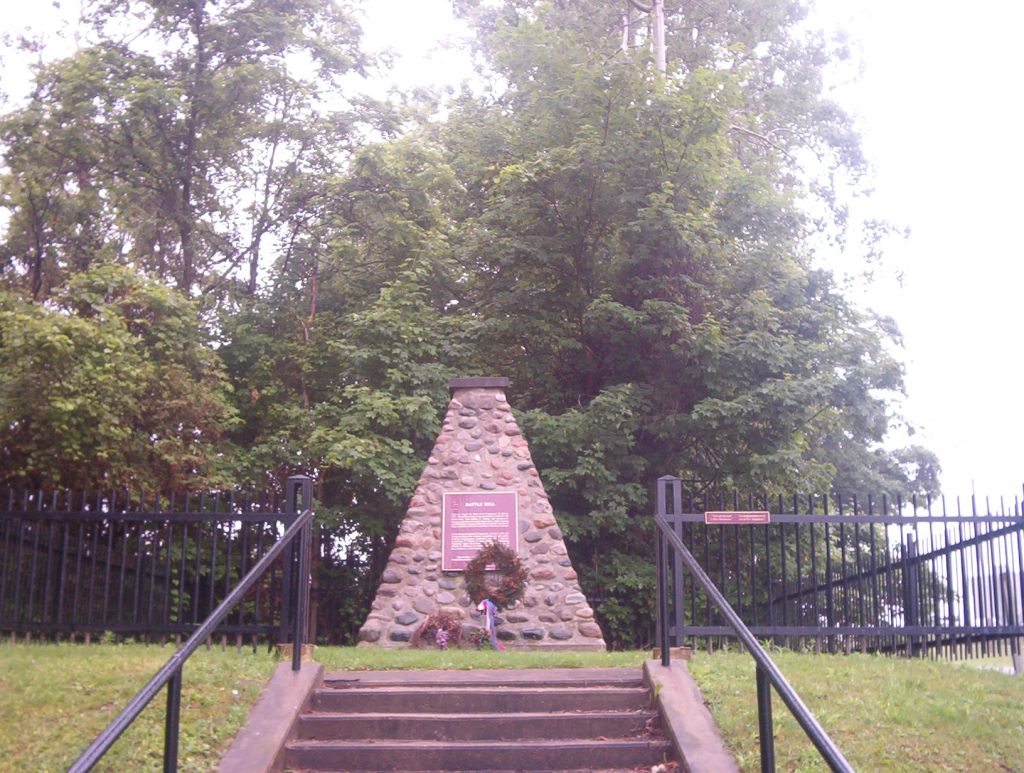
The Battle of Longwoods, which took place on March 4, 1814, despite being an American victory, saved the village of Delaware from capture by the invading Americans.
It’s believed that the American advance that resulted in the Battle of Longwoods came about in retaliation for a British raid on the McCrea’s Farm, thirty miles west of Chatham, where Americans had taken a captured herd of cattle. The British, under Lt. Medcalf, captured the American forces there and sent them to Port Dover.
Under the direction of Lieutenant Colonel Butler, commander of the American forces in Detroit, Captain Andrew Hunter Holmes of the 24th Tennessee took a force of approximately 180 mounted men, consisting of elements of his own regiment as well as 26th Vermont, 27th New York, the 28th Kentucky Regiments as well as the Michigan Rangers, the Michigan Militia Dragoons and two light artillery pieces and headed into Upper Canada. Their goal was to capture either the British outpost at Port Talbot or the one at Delaware.
On March 3rd, an advance party of the Caldwell Rangers (who were led by William Caldwell, Jr. and his half-brother Billy Caldwell) clashed with the Americans in a brief skirmish along Longwoods Road some fifteen miles from Delaware. Caldwell realized that his Rangers were outnumbered, withdrew back towards Delaware, stopping at Fourteen Mile Creek to encamp and await reinforcements.
The American likewise withdrew to Twenty Mile Creek. Despite morale among the American not being high, it was decided to make a stand there. The Americans fortified their position at the top of the hill by creating an abatis and watering the hill, which then froze.
At 5:00pm the next day, the British force arrived. The troops, numbering 300 under the command of Captain James Lewis Basden, consisted of the light companies of the Royal Scots and the 89th Regiment, as well as a detachment of Kent Militia, a company of rangers and about forty Native warriors.
Basden ordered flanking movements against the Americans, sending Captain Caldwell and the Kent Militia to the north and the Native warriors to the south. Basden himself led the balance of his troops in a frontal assault up the hill against the American positions. The Americans unleashed a devastating fire against the British charge. The British would suffer 67 casualties, including Captain Basden himself, who suffered a fatal blow to the knee.
The Americans, meanwhile, suffered light casualties, with four dead and three wounded. The battle lasted only an hour, leaving the British in retreat to Delaware. Holmes realized he was outnumbered gave up hope of taking Delaware and withdrew to Detroit.
 johnmilner.ca