For more history articles, visit https://johnmilner.ca/history/
The remarkable story of Tom Williams began with his birth in Ingersoll, Ontario, on October 12, 1885, to Fred B. and Mary M. (née Langford) Williams. “I was born to the plow and cattle, on good Canadian soil,” he would later reflect.
By 1911, Williams was a homesteader in southern Alberta. Three years later, as the First World War erupted, he was working as a salesman. Standing 5 feet, 7½ inches tall with red hair, blue eyes, and a ruddy complexion, he was described as both capable and determined.
Williams initially joined the Legion of Frontiersmen in Calgary but resigned almost immediately to enlist with the Corps of Guides, later transferring to the Provost Corps of the First Canadian Division. Like many future World War I flying aces, Williams began his military career in the infantry (CEF Service Number 1850).
On September 29, 1914, he sailed for Europe aboard the SS Corinthian. He arrived in France in February 1915 and quickly distinguished himself in service. Williams later recounted catching “the flying bug” in August 1916, after serving as an artillery spotter along the Somme River during a reconnaissance mission. “I enjoyed it so much, I applied to learn to fly even though I was too old—30—and wound up being shot down three times. I’ve been flying ever since,” he said.
In 1916, Major General Arthur Currie recommended Williams for a commission in the Royal Flying Corps (RFC). Operational training took him to Scotland and England, and he had to pull some strings to overcome the age restrictions. On June 17, 1917, Williams went solo in a Rumpety aircraft after three hours and 50 minutes of flight training.
Williams later recalled a humorous but revealing anecdote: when a reviewing officer asked if he could drive a car and he said no, he was told he couldn’t possibly fly. Williams mentioned his motorcycle experience between 1911 and 1914, which ultimately convinced the officer to approve his training.
After earning his wings and promotion to Lieutenant, Williams joined No. 45 Squadron in France. Just four days into flying at the front, he and six fellow pilots—including Arthur Harris, future commander of Allied bomber forces in WWII—engaged seven German Albatross fighters. Though Williams’ plane was heavily damaged, he managed to return safely.
On September 22, 1917, Williams faced the infamous Flying Circus led by Baron Manfred von Richthofen, the Red Baron. His first confirmed victory came on October 24, 1917, when he destroyed an Albatross D.V. at Menin-Coucou. This earned him respect among his peers and the nickname “Voss” after the German ace.
Williams’ combat was not without peril. On November 6, 1917, he was shot down by friendly fire at Passchendaele, yet within a week he destroyed three German planes. By November 13, he had scored multiple victories, including a Junkers J.I.
Due to poor weather, his squadron was later deployed to Italy to fight the Austro-Hungarians in the Alps. Williams became an official flying ace on January 10, 1918, and continued to accumulate victories throughout the spring and summer. By July 27, 1918, he achieved his fourteenth and final victory of the war.
Williams survived numerous hazards, including being shot down by Italian anti-aircraft fire at 5,500 metres, forcing him to glide 34 kilometres through the Alps to safety. Remarkably, he returned to the air the same day to score his final victory.
For his extraordinary achievements, Williams was awarded the Military Cross on September 16, 1918, “for conspicuous gallantry and devotion to duty,” and the Italian Valore Militare Medal.
After being sent to England in August 1918 for medical reasons—likely a heart condition common among high-altitude pilots—Williams completed 199 patrols and approximately 500 dogfights, officially destroying eight enemy aircraft and capturing another. By his own count, he had destroyed 16–17 enemy planes.
After the war, Williams trained at Camp Borden, earning one of the first 100 Canadian Commercial Pilot Licenses and an Air Engineer’s Certificate, with Flying Certificate 91 personally signed by Orville Wright. He purchased his father’s farm in Sweaburg, Ontario, formed his own airport, and operated a commercial air service from 1927 to 1931, pioneering early crop-spraying techniques.
Williams became a noted flying instructor, serving at the Kitchener-Waterloo Flying Club and later as Chief Flying Instructor at the London Flying Club in 1934. Among his students, he trained as many as 30 pilots, earning an Instrument Flying Rating.
A daring stunt pilot, Williams once made a parachute jump himself in 1936 after a student refused, and in the late 1930s, he flew for Skyline Express in northern Ontario and as a charter pilot in Quebec. During World War II, although too old for combat, he served as chief test pilot at the Fleet Aircraft Company of Ontario from 1939 to 1947.
Williams continued flying long after the war. In 1960, he became President of the 440 Wing of the RCAF Association in Woodstock, Ontario. He performed daring aerobatics well into his 80s, including flying a Canadian Forces Tutor trainer jet and a helicopter. In 1969, he conducted the first-ever parachute mail drop in Woodstock to commemorate 60 years of powered flight in Canada.
Even in his later years, Williams remained active. In 1971, at age 86, he flew aerobatics solo and was recognized by the Guinness Book of World Records as the world’s oldest active pilot. He logged over 8,000 hours of flight during his career.
In 1973, he was inducted into the Canadian Aviation Hall of Fame:
“(His) exemplary conduct in aerial combat and his half-century of dedication to the science of aeronautics, despite adversity, has inspired young and old alike, and his total involvement in flight has been of outstanding benefit to Canadian aviation.”
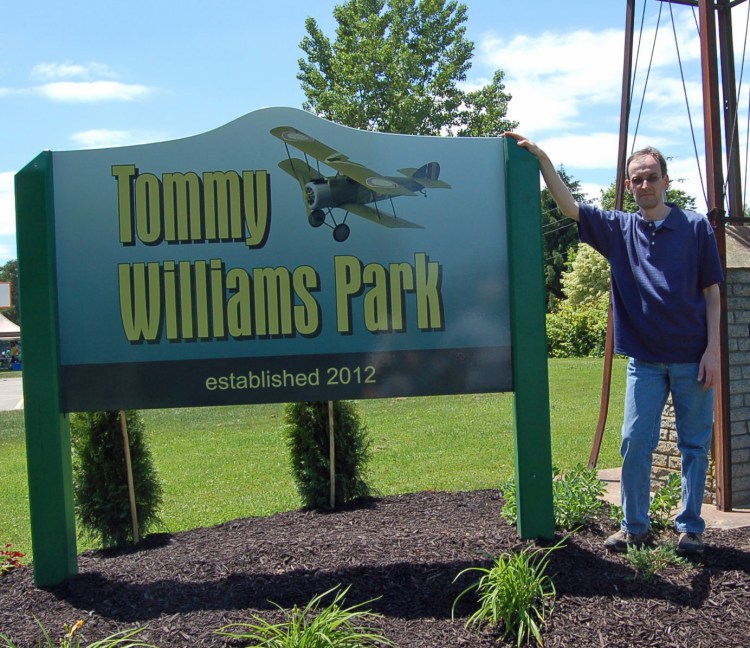
Williams continued to travel and engage with the aviation community until his death. On July 25, 1985, he passed away in Woodstock, Ontario, just months shy of his 100th birthday. In June 2014, a park in Sweaburg, Ontario, was named Tommy Williams Memorial Park in his honour.
 johnmilner.ca