For more articles on NASCAR, visit https://johnmilner.ca/track-talk/ and talk about them – and anything NASCAR-at https://www.facebook.com/profile.php?id=61569092154997.
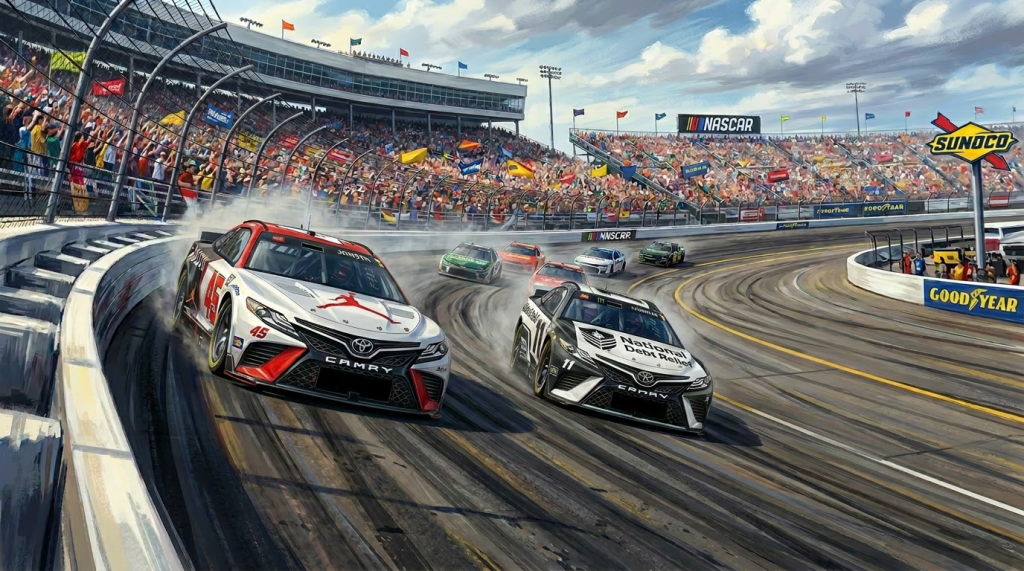
Tyler Reddick parked his #45 23XI Racing Toyota in Victory Lane for the fifth time this season, this time in Kansas as the winner of the AdventHealth 400. With the win, he is already drawing comparisons to Dale Earnhardt’s 1987 season, who also won five of the first nine races that year.
With the victory, Reddick enjoys a 105 point lead over the driver who, ironically, finished second at Kansas and who is his team co-owner, Denny Hamlin.
I think it is important that we stop and take a moment to remember that Hamlin does have an ownership role at 23XI. While the media, social and otherwise, is quick to hype any win by Reddick seemingly as a win by Michael Jordan, there are other people in play here. Hamlin is applying his knowledge of racing while Reddick is the one behind the wheel, to say nothing of his pit crew.
I would also like to point out my own personal bias regarding Reddick. I want to like this young driver who has two O’Reilly Auto Parts Championships (with JR Motorsports and Richard Childress Racing) to his credit. His departure from RCR, just days after his win in the Brickyard 400 AND with over a year before he planned to leave for 23XI Racing, has always left a bad taste in my mouth. This has nothing to do with him driving a Toyota or his team having an alliance with Joe Gibbs Racing. If this was Ryan Blaney or Brad Keselowski or Carson Hocevar, I’d probably still maintain the view that I am going to write about here.
As the title suggests, there is a downside to Reddick’s early season success, much like there was when Connor Zilisch and Corey Heim were logging wins in double digits last year in the Xfinity Series and the Camping World Truck Series, respectively.
On the surface, having a season where one driver, no matter who they are or what team they drive for, achieves a great deal of success in NASCAR’s lower series is not a huge detriment to the sport. Far from it, actually, because it shines a spotlight on that driver and, to a degree, that series. While NASCAR, it could be argued, didn’t do a great job of cashing in on the success of the two young drivers achieving the success they did, there was definitely an opportunity for NASCAR to point to Zilisch and Heim as “the future of NASCAR.”
The fact that Zilisch is currently 33rd in the Cup Series standings while Heim isn’t even on the board (despite a 15th place finish this past week in Kansas) and is back trying to figure out if he can run for a Truck championship or not isn’t the point I’m trying to make.
Late last year, I recall thinking that, for all the success that Corey Heim (and I suppose I could/should have extended that train of thought to Zilisch) was having, it might actually be a bad thing for the playoff format. While Mark Martin might have been taking every opportunity on social media to demand a revert to the full-season point system, he was far from the only one. My suspicion was that if Heim or Zilisch failed to convert that success and the wins to a championship, the detractors of the playoff system would use that as evidence that the system was flawed and the voices demanded a full-season point system would grow louder.
As it turned out, it was the Xfinity Series Championship going to Jesse Love and not Zilisch that was used to fuel that fire…at least for about 24 hours. When Denny Hamlin didn’t win the Cup championship in the same season he got his 60th Cup win and for his ailing father, that was enough for NASCAR to change a system that for 12 years had seen the eventual champion be in the mix for the race win coming down to the final lap of the season.
When they rolled out the return of the Chase format this past January, I called it “a temporary appeasement,” a way to delete the maligned Playoff format but not quite take things back to the way they were prior to 2004. While the detractors of the Playoffs, who were most likely detractors of the original Chase format, may be silent for right now, I can’t see where this new Chase has completely pleased them to the point where they are going to put their quest to take NASCAR back to “the good old days” to bed permanently.
A year where a driver like Tyler Reddick begins on such a hot streak but doesn’t parlay that into a championship is going to be the opening they need to restart their demands for a full-season point system, one that may seem great on the surface (rewarding consistency over wins) but has its pitfalls (having a championship all but decided with multiple races left to go).
*** Note: It was here where I remembered a bit of information about the 1985 Cup Season, which saw Darrell Waltrip win his third championship, despite Bill Elliott’s historic season, that my opinion regarding the full-season points system vs. the Chase began to change. I will have another article up about this in the near future.
For the time being, however, Reddick’s streak to start the season could be seen as a positive. As much as I would hope that people are reminded that there is more to 23XI Racing than Michael Jordan, his involvement in the sport does have the opportunity to draw more eyes on the sport. If NASCAR can capitalize, by creating exciting racing, the fans that tune in to see “Michael Jordan’s team” might stay to watch week in and week out.
It would be similar to the celebrity involvement in the first Wrestlemania. While many fans tuned in to see Mr. T. and Cindy Lauper, a good many stayed to see Hulk Hogan, “Rowdy” Roddy Piper, Ricky Steamboat and Randy “Macho Man” Savage. And much like many wrestling fans expanded their wrestling repertoire to discover Ric Flair and the NWA, Nick Bockwinkel and the AWA, the Von Erichs and WCCW, these newly-minted race fans might discover what the O’Reilly Auto Parts Series, the Craftsman Truck Series, the ARCA series, to say nothing of their local short tracks.
No matter how Reddick’s early season streak plays out with regard to his championship hopes, it’s something special and something worth tuning in for, and that has to be a good thing for NASCAR.
P.S. The image was created by WordPress’s AI and man, what a fantastic job! I assumed I would just get a bunch of generic stock cars but it came up with actual NASCAR imagery. (I had to eliminate the #18 and #1 and change Denny’s logo but in short order I got an amazingly accurate image.)
 johnmilner.ca