Track Talk

Predictions for NASCAR in 2026 – An annual tradition here at John Milner’s Track Talk, I make some predictions for what we could see in NASCAR in the coming year, from the winner of the Daytona 500 for the champions of all three major series, to who steps into the iconic #3 car and who gets their first career wins.

Six Drivers Who Could Become NASCAR Superstars in The Years to Come – Let’s take stock of what NASCAR has going for it, and who might be on the horizon to help lead NASCAR over the course of the next few years.
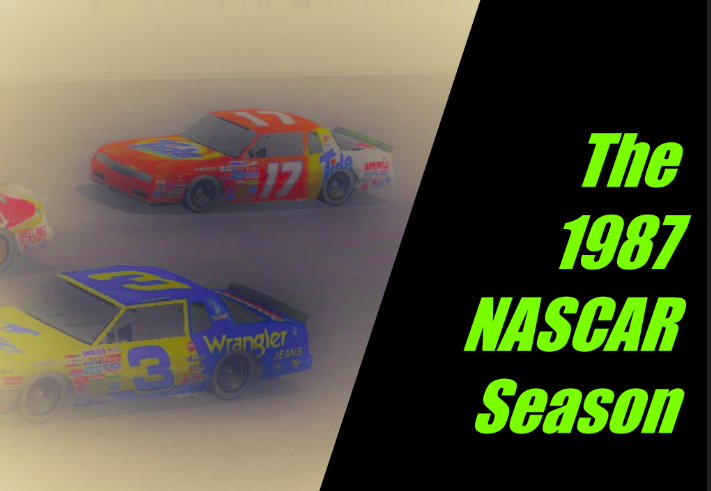
How I Stopped Being a Hater and Will Back Hamlin as 2025 Cup Series Champion – After achieving his 60th career Cup win, I’ve decided that Denny Hamlin is my pick to finally win his first Cup championship, because he’ll be doing it for his ailing father.


Talladega 500 – Elliott and Allison race “for the whole banana” at NASCAR’s biggest track.

Summer 500 – Can Kulwicki outrace Earnhardt at Pocono as “the Intimidator” tries to pad his points lead.

Pepsi Firecracker 400 – NASCAR makes the return trip to Daytona with race coverage that’s cutting to other sports more than it’s covering NASCAR and ends with one heck of a confusing finish.


Carson Hocevar: What Is and What Could Be?

It’s a sad fact: Some people just don’t like to see other people succeed where conventional wisdom says they shouldn’t. There are certainly many examples in politics to say nothing of the world in general, and NASCAR has a few of its own.

The best current example has to be Carson Hocevar. While Hocevar has been a hot topic due to his so-called aggressive driving, I believe the reason that Hocevar finds himself under a microscope goes much deeper than that.

Currently, Hocevar drives the #77 Chevrolet for Spire Motorsports. Spire, as an organization, has one Cup Series win, the July 2019 Daytona win by Justin Haley. Beyond that, the organization has just a dozen Top 5s since the team’s first Cup start in 2019, two of which came in runner-up finishes by Hocevar earlier this year.

To put it bluntly, Spire Motorsports is never in the conversation when experts to gather to talk about their picks to win next week’s race – not on the intermediates, the road courses, the short tracks or even the superspeedways.

And yet here’s Carson Hocevar running up front. One could certainly point to this race or that incident and say that Hocevar had to ruffle a few feathers and bend a few bumpers along the way. But along the way as well, Hocevar has taken a car that probably should have routinely topped out in the Top 20 and put it in the mix. Including the two runner-up finishes (Atlanta and Nashville), he’s finished in the top dozen in a third of the first 30 races of 2025. Not too shabby but why is he condemned and not beloved?

In a sport that honours the hard chargers of the past, is it less about how Hocevar gets to the front and more about that fact that he’s at the front?

While the Penskes, Gibbs (along with 23XI) and Hendricks of NASCAR may have struck an uneasy understanding that they’ll share time in Victory Lane, there is the sense that they’re not too keen on letting others join their power group (hence the demise of Michael Waltrip Racing and Furniture Row Racing over the last decade).

A similar situation happened a couple of years ago when Ross Chastain and the upstart Trackhouse Racing. Chastain was another hard charger with a smaller team that was getting to the front. The result was that just about every week, every wreck was blamed on Chastain and Denny Hamlin seemed to make it his personal mission to bully him out of the sport.

No one is specifically targeting Hocevar. It just seems like if the #77 is on the same straightaway as the wreck, every driver caught up in the incident’s first reaction seems to be to see how they can blame Hocevar. A lot of the media types surrounding NASCAR are ready to do the same.

Some of these incidents, upon retrospect, can legitimately be blamed on Hocevar but the question I want to ask: Is Carson Hocevar the victim of being in the wrong place at the wrong time or is he just in the wrong equipment at the wrong time?

If Hocevar’s #77 was a Toyota and rolled out of the JGR, how much of a different reaction would he get?

And this raises another question: how much more success would Hocevar if he was driving for JGR, Penske, or Hendrick? As much as I love a good underdog story, there have been times this season where I’ve seen Hocevar running at the front but it became evident that he just didn’t have the equipment under him to take the next step in his career and win a Cup race.

But remember, this is a driver with an organization that, perhaps for the most part, is lucky to run in the Top 20 in only his second full season in the Cup Series. Instead of spending his time having to worry about going a lap down, Hocevar is in a position to focus on about what he needs to do to win.

If he was battling Hamlin, Kyle Larson or Ryan Blaney in equal equipment, I believe Hocevar has the talent and the drive to be able to make the important passes for position, for the lead and eventually for the win.

It may be that Hocevar’s reputation for “reckless driving” may spoil the chances that one of these larger teams would give him an opportunity at the quality of ride that would solidify his future in NASCAR. In a sport that continues to talk about how it sorely needs drivers with personality, Hocevar is such a driver that has personality is spades. His is not the type that goes out of his way to alienate large portions of the fanbase. Instead, he comes across as the fun-loving, boy-next-door type who just enjoys driving race cars for a living.

NASCAR needs more of these types going to Victory Lane. The question is: will Carson Hocevar ever get that chance and what could he do with it?


Predictions for the Xfinity Series Playoffs

Watch the video version at https://youtu.be/qV5cJ3Nd4D8.

A couple of weeks back, I was all set to post a blog with my picks for the Xfinity Series Playoffs (the final playoffs under that particular title sponsor). Instead of typing up my picks, I ended up having to try and fix a glitch on my laptop. So, one frustrating day (well, one frustrating day due to the computer issues, anyways) and a new laptop later, and here we are – back with another prediction blog.

Luckily, this is an off-week and last week’s race, at Bristol, was won by a non-playoff driver, Aric Almirola. I can’t remember how my original picks played out so I have come up with new ones. As always, if these come up right, you’ll never heard the end of it. If I’m completely wrong, we’ll never speak of this again.

Eliminated After the Round of 12

  • Nicholas Sanchez
  • Jesse Love
  • Harrison Burton
  • Sammy Smith

Eliminated After the Round of 8

  • Austin Hill
  • Sam Mayer
  • Carson Kvapil
  • Taylor Gray

Final Four

  • Sheldon Creed
  • Brandon Jones
  • Justin Allgaier
  • Connor Zilisch

2025 Xfinity Series Champion: Connor Zilisch

Notes: Much like the Craftsman Truck Series with Corey Heim, this was an easy pick for the championship. I wish I could put Austin Hill into the Final Four, but I think NASCAR’s tendency to screw over RCR is going to catch up with him. I will say I think his grit and determination will get him through the first round but no further. The toughest part for me was deciding who was going to be eliminated after the first round. (I flipped Mayer, Kvapil, Smith and Burton around.) Creed and Jones might be long shots for the Final Four but I’m not sure who you could argue would eliminate them. For once, I didn’t go completely gut instinct and actually checked in on the point situation.


Zilisch, Not SVG, has the Brighter Future in NASCAR

With five wins so far in 2025, Trackhouse Racing must be feeling pretty optimistic about the team’s future in NASCAR’s Cup Series. After all, Ross Chastain won a crown jewel race in the Coca Cola 600, and Shane van Ginsbergen has won four races (Mexico, Chicago, Sonoma and Watkins Glen), tied for the most victories on the season with Denny Hamlin.

While Trackhouse is set to say goodbye to Daniel Suarez at the end of the season, they have already signed Xfinity sensation Connor Zilisch to drive for them full-time during the 2026 Cup campaign. While it hasn’t been officially announced as of press time, Zilisch will most likely pilot the #99 Chevrolet that Suarez is departing.

Van Ginsbergen has certainly captured his fair share of headlines in 2025, mostly because his wins have come in the Cup Series. Zilisch has made just three starts in Cup, all in 2025 and all for Trackhouse. His best result saw him finish just outside the Top 10 (in 11th) at Atlanta.

As of September 2, 2025, van Ginsbergen has the better career results in the Cup Series, of the two. However, if I were a betting man, I would suggest that it will be Zilisch and not van Ginsbergen who will have the more successful career in the Cup Series.

While van Ginsbergen’s four wins ties him for the most in the Cup Series, Zilisch has eight wins in the Xfinity Series. This ties him with another up-and-coming phenom, Corey Heim, for the most wins in any of NASCAR’s top series.

But such a record, especially just over the course of one season (and not even the full one yet at that) is not the reason I give Zilisch the nod. (Nor is it the fact that, while doing research for this piece, I found out his mother is originally from Thornhill, Ontario, making Zilisch half-Canadian.)

When it comes to road course racing, Van Ginsbergen is now the odds-on favourite for the win in the Cup Series. He’s taken the title of Best Road Course Racer in NASCAR away from Chase Elliott and Martin Truex, Jr., who in turn had taken it from Jeff Gordon and Tony Stewart. 

The problem is: he’s only winning there.

He has led at the superspeedways like Daytona and Talladega, but he hasn’t come close to winning. In fact, he’s had nine Top 10s in his Cup career and all nine have come at the road and street courses. His average finish for that particular genre of racing is 8.2. His next best track type is the two-mile intermediate tracks where his finish is 18th. (Of course, that result is a little deceiving, as he’s raced at a two-mile intermediate exactly once, at Michigan in June.) Van Ginsbergen has had eleven starts at mile-and-a-half intermediates and has an average finish of 25.6.

It has been often said that the longest distance in sports is that between the Xfinity and Cup garages. Therefore, to compare van Ginsbergen’s Cup wins to Zilisch’s Xfinity wins might be a tad presumptuous. However, it needs to be stated that while four of Zilisch’s eight wins have come on road courses (COTA, Sonoma, Watkins Glen and Portland), three others have come on ovals, including Dover, Indianapolis, and Pocono (which is oval-ish).

(I’m not sure how to categorize his win at Daytona. I mean, he started the race but then gave way to relief driver Parker Kligerman, which allowed for one of the best feel-good stories of 2025.)

But it bears examining the fact that Zilisch has experience winning on ovals in NASCAR while van Ginsbergen does not. While NASCAR has increased the number of road courses (presumably to try and draw fans over from F1 or to dispel the stereotype that all NASCAR drivers can do is turn left), the schedule is still dominated by mile-and-a-half oval tracks. In order to succeed in NASCAR, you have to be good on the mile-and-a-half ovals.

It’s similar to how the talents of drivers like Austin Hill (in Xfinity) or Ricky Stenhouse, Jr. and Michael McDowell (in Cup) are largely questioned because most, if not all, of their success have come on the superspeedway/drafting tracks.

(This could – and perhaps will – be the topic of an upcoming Track Talk. Why is NASCAR so ready to elevate any “road course specialist” to superstar status but downplays anyone whose biggest success comes on superspeedways? Personally, I think you should be the NASCAR equivalent of a “five tool player” to be considered among the elite.)

Don’t get me wrong. I think SVG is great guy and good overall for the sport of NASCAR. At a time when people demand diversity, he’s a New Zealander in a sport dominated (not unexpectedly) by Americans. And much like Kyle Larson has been lauded for competing in other genres of motorsports (sprint cars, the Indy 500), SVG should be given the same respect for coming over from the Australian Super Cars series. It definitely makes NASCAR look good when stars from other areas want to compete in the Trucks, Xfinity, and Cup Series.

However, if you want my take on which of the two recent signees to Trackhouse has the brighter future, right now it certainly appears to be Connor Zilisch.


Dodge, Kaulig & the Craftsman Truck Series: More is Less

Back in June, after years of speculation, NASCAR announced that a new manufacturer would join Ford, Chevrolet and Toyota. While not exactly new to NASCAR, it’s been since 2012 that Dodge had competed in one of the sport’s top three series. (They had come back in 2001 with Bill Elliott piloting the Ray Evernham ride and stayed until Brad Keselowski delivered Roger Penske a championship.) Dodge wouldn’t be headed straight back to Cup, however, but instead would make their start in the Craftsman Truck Series.

So far, so good. First of all, great to see another manufacturer in NASCAR (although the Canadian Tire/Pintys series featured Dodges for a number of years after they left Cup). Secondly, smart to use the Truck series as a first step to bring Dodge back to NASCAR in another year or so. Get all the bugs worked out, if possible.

However, this past week, Dodge and NASCAR made another announcement: Kaulig Racing will field up to five (5!!!) entries for Dodge next year in the Truck Series. That’s where I had to give my head a little shake and wonder why someone making a whole lot more money than me didn’t do the same.

It would be one thing if an established team made the switch to Dodge. ThorSport, for example, has a lengthy tenure in the Series dating back to 1998. They’ve switched manufacturers on multiple occasions. They also currently field five teams. A situation like that would have made sense.

Kaulig, on the other hand, has never logged a lap in the Truck Series. Some years ago, they exploded onto the scene in the Xfinity Series with Justin Haley, A.J. Allmendinger. Seemingly overnight, they became the feel-good team of the series and able to hold their own – and then some – with Gibbs, JR Motorsports, and RCR.

But then, Kaulig decided to focus on the Cup Series and just go “trophy hunting” in Xfinity. As quickly as they had risen to prominence, Kaulig started to stumble. Not only did their Cup program never get out of the starting blocks (save Allmendinger at the road courses and Ty Dillon in 2025’s In-Season Challenge) but bringing in the odd Cup guy to run Xfinity derailed all of their progress with their regulars in the Xfinity Series.

As I’ve stated before, Kaulig went from being the small team that could to being the small team that doesn’t. If running two series has done this, what makes anyone think that diving into the Truck Series full force is going to be a successful venture?

If Kaulig was still semi-dominant in the Xfinity Series and was even achieving Trackhouse levels of success in the Cup Series, I could perhaps see someone getting the bright idea of trying out a single Truck team for Dodge. However, with them being mid-level entries in two series, I’m not sure how adding up to five more rides in a third series they have no experience in is going to garner even one iota of success.

If someone had asked me a year ago about the Kaulig situation (although I’m not sure why someone would), I would have suggested they scale back. Bring the focus back to Xfinity and maybe just run Ty Dillon on the superspeedways and Allmendinger at the road courses in Cup. And, at most, maybe run one truck for Dodge.

There is already talk of Dodge being back in Cup by 2027 or 2028. 2026 will not just be a chance to get their feet wet in the Truck Series and contend in the series in a year or two before heading to what will be the O’Reilly Auto Parts Series and then eventually Cup.

Sorry, Dodge. Sorry, Kaulig. Sorry, NASCAR. This is going to be a classic example of too much, too soon. You are asking a team that is struggling to double the number of rides and head into a series it’s never competed in, so you can take a returning manufacturer to the top level of NASCAR a year from now?

I hope I’m wrong but I think this move will stretch the already over-stretched resources of Kaulig Racing and cause Dodge to stumble right out of the gate. They need to walk before they can run and they’re trying to run the Boston Marathon before they’re sure they can take their first steps.


Predictions for the NASCAR Cup Playoffs

Ryan Blaney won the Coke Zero Sugar 400 this past Saturday and with the checkered flag flying, the field for the 2025 Cup Series Playoffs has been set. Cody Ware, my darkest of dark horse picks (just to see people’s heads explode when he made the playoffs, led about half of the second stage, but finished 20th. Cole Custer, Justin Haley, Daniel Suarez and Erik Jones, with a combined total of 0 wins this season, filled out the top 5 but because Blaney, a repeat winner, won, it allowed both Tyler Reddick and Alex Bowman to get in on points. Reddick had solidified his playoff spot when Bowman retired from the race following “The Big One,” leaving the driver of the #48 to watch the rest of the race before learning his playoff fate.

With the playoff field set, that means it is time for Track Talk to deliver our predictions regarding out the playoffs will play out.

Eliminated After the Round of 16: Shane Van Gisbergen, Austin Cindric, Bubba Wallace, Josh Berry

Eliminated After the Round of 12: Alex Bowman, Ross Chastain, Chase Briscoe, Austin Dillon

Eliminated After the Round of 8: Kyle Larson, Chase Elliott, Ryan Blaney, Joey Logano

Championship 4: William Byron, Christopher Bell, Denny Hamlin, Tyler Reddick

2025 Cup Champion: Denny Hamlin

Notes: This was one of the easier playoff predictions to fill out, even when it came to eliminating all the big names after the Round of 8. I can see a few discrepancies between those eliminated after the Round of 16 and the Round of 12. (Maybe Cindric replaces Briscoe, for example.) However, I feel very confident in the drivers I have advancing to the Round of 8. And, as big as the names are that I’m eliminating after the Round of 8, I just don’t see who I would eliminate from my Championship 4. Picking the eventual champion was tough and, if I’m being perfectly honest, Hamlin is probably the guy I’d like to see win the least of all four. Hamlin’s a guy with a lot of other things going on in his life and career. He’s also the guy who falls victim to pit road miscues: his own and his crew’s. (Hence the reason he’s been vocal about not liking the NASCAR season coming down to one race.) However, maybe Hamlin can use the noise not as distraction but as inspiration and make 2025 the year he finally wins that championship. I guess we’ll find out over the course of the next 10 races.


Reaction to three big news items

Today, August 18, 2025, was a fairly big news day impacting all three national series, with two major announcements and speculation on how the fallout from Richmond will impact Daytona. Track Talk will take a look at all of this and provide our (or rather my!) analysis.

Austin Dillon wins at Richmond: As a completely-biased RCR fan, I was jazzed about this! At the same time, you could not have scripted a better redemption story. After being ousted from the playoffs due to accusations of rough driving (and I’m guessing more because he roughed up Denny Hamlin than Joey Logano), Austin Dillon came back to the same track and once again won. Only this time, the victory sticks and Austin Dillon will be a part of the 2025 Playoffs. At the same time, he led 107 laps, becoming the first RCR driver to lead that many laps since Dale Earnhardt won the 1998 Daytona 500. Storybook!

Next Saturday night, the 2025 regular season will come to an end for the Cup Series. 14 drivers have won their way into the playoffs. Tyler Reddick and Alex Bowman are currently in on points but a new winner could change that.

I, for one, have no issue with a long-shot, dark-horse, under-dog driver going to Daytona and getting the Hail Mary win. In fact, that’s what I like about superspeedway racing. It gives those teams that need a boost that opportunity. Sure, if Justin Haley or Ricky Stenhouse, Jr. or Carson Hocevar win at Daytona, odds aren’t great that they’ll be celebrating a championship at Phoenix, but for those teams, this gives them something to take to a sponsor. “Hey, our driver made the playoffs last year with a ‘walk-off’ win at Daytona!”

At the same time, rather than just going through the motions with eleven races left to go with the playoff picture limited to three or four drivers still in contention. As Mike Joy once said about the Daytona 500, every driver wakes up thinking “I can win this race.” Veterans like Kyle Busch and Brad Keselowski can win, as can AJ Almendinger and Ryan Preece. Heck, Harrison Burton, the young driver whose season with the Wood Brothers was so bad they told him he was being let go at the end of the season, goes out and wins Daytona and makes the playoffs.

If a Preece, Allmendinger, Busch, or anyone else below the cutline wins, it means that the cutline divides Reddick and Bowman, currently separated by 29 points. If Preece is leading, all of a sudden, most (if not all) eyes are on where Riddick and Bowman are running and what the point situation is. And I’m not a fan of “The Big One” (even though as a NASCAR fan, I’m told I am) but a big wreck mid-race will change everything. Eliminate some drivers. Provide opportunities for others. And with pack racing so prevalent at Daytona, it’s not like the finish will be all but determined with 20 laps to go. With 14 previous winners in the field, there’s a chance someone like William Byron or Denny Hamlin will win, but there’s also a chance that a new winner will come across the finish line by mere inches to claim their spot in the playoffs.

And yet there are still those who will claim this playoff system needs to be changed.

Matt Crafton to retire: This was not a complete surprise. Crafton, a three-time Truck Series Champion, began his career in the Truck Series in the season finale of the 2000 season. His full-time career started a year later, meaning he has spent a quarter-of-a-century in the Truck Series, including a stint in 2005, driving the #6 Chevrolet for Kevin Harvick Incorporated, where his sponsor was no less than GM Goodwrench. However, Crafton will be better remembered for his 23-year partnership with sponsor Menards in the #88 truck for Thorsport.

When he climbs from that #88 truck for the final time in Phoenix, Crafton should take some time to reflect and start writing that Hall of Fame speech because his induction, following Ron Hornaday, Jr. in representing the Truck Series, is inevitable.

I will be sad to see Crafton go. When I first started watching the Truck Series, Crafton was the man, winning back-to-back championships in 2013-2014 (with a third coming in 2019). The series just won’t be the same without him but it’s probably time. 2024 was the first season since 2006 that he didn’t finish in the Top 10 and, after failing to make the playoffs after Richmond, he probably figured it was time.

In a strange move, Ty Majeski, defending series champion, has been announced as the driver of the #88 for 2026. Majeski currently drives the #98 for Thorsport so it’s strange that they didn’t just keep him there and name a new driver for the #88. Could it be that Thorsport is contracting their stable and will “retire” the #98 but wanted to keep the historic #88 on track. Time will tell.

Xfinity Series to rebrand as the O’Reilly Auto Parts Series in 2026: Ironically, I had only just heard, from Bob Pockrass, perhaps, that Xfinity’s run as the title sponsor for NASCAR’s “Junior Series” was going to come to an end. I didn’t expect news of this sort to be put together so quickly, by here we are! I don’t really expect too much to change other than people will stumble over calling it the Xfinity Series for a while, much like we called this the Nationwide Series and, for that matter, continue to refer to it as “the old Busch Series” from time to time. That’s what happens when there’s a title sponsor for eleven years, such as Xfinity was. I guess we won’t hear the drivers talk about how “the car was as fast as Xfinity internet” after this year.

The good news is that NASCAR has found a new sponsor, even as the old one departs. Having an auto parts store as the title sponsor for a NASCAR series makes sense, even if the name is a bit long. I suspect most will end up calling it the O’Reilly Series in casual conversation.


Predictions for the 2025 Craftsman Truck Series Playoffs

With Corey Heim’s win at Richmond, the 2025 regular season for the Craftsman Truck Series is over and the field for the playoffs is officially set. (Stewart Friesen, injured in a fiery wreck in a dirt modified race, declined a medical waiver and gave Kaden Honeycutt, in on points, his ride.) And so it is time for me to make my predictions for the playoffs. As always, if I am right, you’ll never hear the end of it. If I am wrong, you’ll never hear about this again.

Oh, and one more thing, I picked Ty Majeski to win last year’s championship and “I was right, I was right!!!” Anyways, on with the picks.

Eliminated after the Round of 10: Daniel Hemric and Tyler Ankrum

Eliminated after the Round of 8: Jake Garcia, Rajah Caruth, Ty Majeski, and Kaden Honeycutt

Championship 4: Corey Heim, Layne Riggs, Chandler Smith and Grant Enfinger

2025 Craftsman Truck Series Championship: Corey Heim

Notes: Okay, if you read the following article, you’ll note that my feeling is that Heim basically HAS to win this championship. Otherwise, it’s going to be a horrible look for a playoff system that already has a lot of detractors. (Not that I’m one of them.) The addition of Riggs and Smith in the Championship 4 feels like a no-brainer. (Keep scrolling down to hear my thoughts on them as well.)

I almost went with Majeski to complete the foursome but decided to go with Enfinger. (Enfinger would be the feel-good story of 2025 if he upset “The Big Three” and claimed the title.)

I think the question of who will be eliminated in the first round might be the most interesting. The success of Heim might also be seen as coming at the cost of any momentum from most of the others in the field. Hemric and Ankrum could be replaced by any combination of Caruth, Garcia and Honeycutt. I actually had Honeycutt out after the first round instead of Ankrum but decided Honeycutt running on behalf of Friesen would be enough to get him through to the Round of 8. (No matter how Honeycutt does, he’s going to be this year’s version of Layne Riggs, but just coming out of nowhere to make the playoffs.)


Could Corey Heim’s Dominant Season Have Playoff Implications?

August 17, 2025

Corey Heim drove his #11 Toyota to Victory Lane at Richmond on Friday night for his seventh win of the season. 2025 has been a dominant season for the driver from Tricon Garage. No less an authority on the subject that NASCAR.com stated that “If his regular-season dominance translates (into the post-season), the title might be his to lose.”

I haven’t checked around but I would suspect that most pundits, when they fill out their brackets, will pen (not pencil) in Heim as their expected winner. To suggest he won’t at least make the Championship Four is ludicrous. (In fact, depending on when you read this, there may be a post directly above this where I outline my predictions for the Craftsman Truck Championship.)

If Corey Heim leaves Phoenix with the championship trophy, all will be right with the world. This will mark the ascension of one of the brightest young drivers in NASCAR who may very well lead all three top series in wins for 2025. While most media pay little attention to the Trucks, Corey Heim is deserving of more headlines for being the most dominant driver in NASCAR right now.

However, if Layne Riggs, Chandler Smith, Ty Majeski, or another playoff driver takes home the crown, this will spark the usual outrage about the failure of the current playoff system. “The most dominant driver didn’t win the championship. Change it back to the old points system.”

Anyone who’s been reading along knows I like the current playoff system. I like the fact that smaller teams can snag a “wild card” win and make the playoffs, a boon to their sponsorship efforts and overall career. I like the fact that the season comes down to the final race. I like the fact that there are still four drivers still in contention for a championship heading into the final race of the season. I like the fact that, by having four playoff drivers still eligible, there’s a pretty good chance that everyone can find someone they can cheer for, even if it’s not their usual favourite driver. I like the fact that in literally 90%+ of the championship races over the last ten years, the driver who won the championship. had to also step up and win the race.

But I get it. As I said, Corey Heim is, with all due respect to the rest of the field, the most dominant driver in the series. Under the old points system, he would be cruising to the championship. If he has a mechanical issue or gets caught up in a wreck at Phoenix, it’s going to be seen as a fallacy of the current playoff system.

Unfortunately, that’s the risk we take. But don’t take that as a warning to NASCAR to curtail Corey Heim’s run in 2025, to start making rules that would put him at a disadvantage. Let this kid get as many wins as he can and hope for the best in the playoffs.


News and Views About This Week’s Xfinity Announcements

July 31, 2025

A couple of news items hit the NASCAR interweb the other day:

  • As expected, after contact with Joe Gibbs Racing’s Aric Almirola, Richard Childress Racing driver Austin Hill was suspended for one race (along with losing all of the playoff points he has earned or will earn between now and the end of the regular season. Another RCR Austin, Austin Dillon, will fill in for Hill at Iowa.
  • In slightly less expected news, Kaulig Racing has parted ways with Josh Williams, effective immediately. A number of drivers will climb behind the wheel of Kaulig’s #11 car during the remainder of the season, starting with Carson Hocevar at Iowa.

I wasn’t going to touch on Hill’s suspension but why not? There have been a couple of suspensions in the Cup Series over the last few years that have sparking some controversy. In 2022, Bubba Wallace wrecked Kyle Larson at Michigan and was suspended for a race. A year later, Chase Elliott wrecked Denny Hamlin at Charlotte and received the same punishment. Of course, in both cases, there was over-analysis, first of why Bubba was suspended and then if Chase received equal punishment and in as timely a manner. (Guess what? The answer to both concerns is “Yes!”)

So, if it was determined that Hill indeed wrecked Aric Almirola with intention, then the one-race suspension is warranted and there is precedent. (I might have argued that Hill was simply over-correcting or lost control after being struck by Almirola but that’s for NASCAR to decide, not some guy at his keyboard.) However, it’s the decision to strip Hill of all of his playoff points. This smells less of a punishment for an on-track incident and more of somebody wanting to all but eliminate Hill from the playoff picture.

I’m not saying that’s what this is, but it sure seems strange that the precedent has always been a one-race suspension. Not sure what the meaning behind the loss of ALL playoff points is supposed to be.

On to the next part of this conversation, the backlash RCR is receiving seems less about Hill’s actions or the penalty and more about the fact that Austin Dillon, and not Kyle Busch, is going to fill in for Hill for Iowa. To the best of my knowledge, RCR has not revealed why they chose Dillon over Busch so it’s all just conjecture at this point.

In my opinion (and since this is my blog, mine is the only one that counts), it shouldn’t be Dillon or Busch. Dillon, Busch, Hill and Jesse Love are the current members of the RCR roster in Xfinity and Cup. Eventually, at least one of them will be moving on. Busch signed an extension with Childress but he’s either headed to retirement or, in a move that would make his fans cream themselves, another team. Jesse Love is rumoured to be headed to Legacy Motor Club for 2026. Even if he doesn’t go there, short of an RCR Cup ride opening up, Love will eventually be moving on.

Iowa, and the suspension of Austin Hill, provided an opportunity for RCR to plan for the future. Go scour the Truck Series or the ARCA series. Find a driver that, in a couple of years, would be looking for an Xfinity ride. Tyler Ankrum, Kaden Honeycut. Connor Mosack. Brenden Queen. Lavar Scott. And those are just Chevy drivers in Trucks and ARCA. Don’t forget that, before singing with RCR, Jesse Love was driving for JGR and Toyota in the ARCA Series. There’s nothing that says you couldn’t steal someone from Toyota or Ford. Give some young driver a one-off start in your Xfinity car and, if he/she does well, you’ve got the start of the next wave of RCR on your radar.

As for the announcement regarding Josh Williams – disappointing but not surprising. I think Josh Williams’ “Park It’ brought him a lot of notoriety and raised his profile in NASCAR. With the mullet and bringing pizza when he was called to the NASCAR trailer, he was a real character, a good guy that people could root for. I remember thinking, at the time, he’d either be out of NASCAR in a year or he’d be in a top-level ride. When he was signed to Kaulig, I figured this might be a great story. That loveable good ol’ boy who took “being parked” a little too literally was going to get a chance to compete for wins and a championship.

Unfortunately, it was like when Frank Thomas became a Toronto Blue Jay in the mid-2000s. It was a great idea in theory, but the timing was off. By the time Williams joined Kaulig, the shine had worn off the little team that could because they thought they were a big team, more focused on the Cup side of things. The feel-good Ty Dillon In-Season Challenge story aside, Kaulig would fail to be more than a mid-pack team in Cup. Meanwhile, their Xfinity program, which had been one of the best stories in NASCAR when this come-outta-nowhere team was suddenly challenging and beating the JGRs and JR Motorsports of NASCAR, was fading away.

Like so many “Was it the car or the driver?” questions in NASCAR, the true measure of how good Williams was or wasn’t will likely never be known. Personally, I think he was a top 20 driver who went from top 30 equipment to top 20 equipment. He got the most his level of talent could get out of the level of equipment he was in. As a promo guy, to steal a wrestling term, he was somebody that a new fan might hear and think “That guy’s cool. I’ll cheer for him!” But Kaulig still believes it’s the Kaulig of four or five years ago and when he wasn’t battling for the win, they got frustrated and eventually let him go.

My initial thought was that they should have waited until the end of the season to make that announcement or let Williams run to the end of the season. However, I can kind of see the point of making the #11 Chevrolet an “open car” and make the rest of the season a series of tryouts.

Of course, who’s the first driver they put in the car: a Cup driver in Carson Hocevar. Don’t get me wrong, I like Carson Hocevar. In fact, he’s probably my favourite current driver in the Cup series. But, much like the situation at RCR, I would have preferred Kaulig bring in a driver from the Trucks or ARCA series. In fact, I believe there is more imperative for Kaulig to have gone to one of the lower series for Williams’ replacement. Because while Hill will be back in the Xfinity series for the race at Watkins Glen, Kaulig will not only need another replacement for that race, it will need one for the 2026 campaign.

As a Chevrolet team, Kaulig should be looking at the same drivers that RCR could have been looking for. While they may not have the history that RCR has, they would offer a long-term (at least a season or so) chance to move up.

Now it’s possible that Hocevar, much like Dillon, was just a quick and easy temporary fix. “The best they could come up on such short notice,” as it were. The smart thing to do is to get things in place for the future and not just spend the rest of 2025 “trophy hunting” as Kaulig has referred to their Xfinity efforts over the past several years.

Like a lot of people in NASCAR, they need to be thinking long-term gains, not short-term glory.


Why NASCAR needs Corey Heim vs. Layne Riggs vs. Chandler Smith

July 30, 2025

Back in 2020, in the days just before COVID-19 changed the world, there was a spotlight shone on the Truck Series (I can’t remember what they were calling it back then, can you?). Normally, this might have been a good thing. What a lot of people don’t realize is just how entertaining the Trucks can be, when they are allowed to be. They don’t draw as much as the Cup Series and often get the short end of the resources when it comes to NASCAR’s marketing.

However, the list of Cup drivers who first found success in the Truck Series is, to borrow a quote from Jim Cornette (about injuries inflicted in Skywalkers matches), “a list as long as my arm,” from Carl Edwards and Greg Biffle to Ryan Blaney and Bubba Wallace. To say nothing of those like Ron Hornaday and Matt Crafton and (possibly) Ben Rhodes who spent the majority of their NASCAR careers competing behind the wheel in the Truck series.

Still, the Truck Series has always been a distant third (how distant is a matter of personal opinion) in the grand NASCAR scheme.

That temporarily changed in 2020 when Kyle Busch was doing Kyle Busch things, which is to say heading down to dominate the lower series in what Joey Logano once termed “a very special car.”

While this is a damaging scenario that has been allowed to play out since the start of both the Xfinity and the Truck Series, someone got the bright idea to conjure up “The Bounty.”  For a few seconds there, it seemed like there might have been a positive. The idea seemed to give the series regulars a shot at some big bucks (courtesy of Kevin Harvick and Marcus Lemonis, CEO of Camping World) for proving they could hang with Kyle Busch.

Turns out that part of “The Bounty” was quickly squashed. It soon became a challenge for OTHER CUP DRIVERS to come down and try to defeat Kyle Busch. The move was tantamount to NASCAR telling the teams, the drivers, the fans and perhaps most importantly in NASCAR’s current financial situation, the sponsors that there was no series regular who could possibly compete with Kyle Busch. Talk about creating second class citizens.

In the end, Chase Elliott came down from the Cup Series, won the race at Charlotte and the $100 grand. Every other driver, including eventual champion Sheldon Creed and runner-up Zane Smith, among others, was treated as an afterthought. You can imagine what a potential sponsor must think when they’re contemplating investing in a driver in the series.

Sponsor: You keep talking about Kyle Busch, can I sponsor him?

NASCAR: LOL! No, Kyle’s got all the sponsorship he needs. But there are some

Sponsor:

(Give credit to Chris Larsen, owner of Halmer Friesen Racing who offered a $50,000 bonus to any Truck series regular who finished ahead of Busch in the race. I also won’t knock Lemonis too much because he spent a lot of his own money to sponsor those drivers who needed it.)

Fast-forward to 2025 and there’s another opportunity that has arisen for NASCAR to make it right and prove to the world (especially those willing to spend money on NASCAR) that there are some drivers who can do more than just fill the field while the Cup drivers get their egos stroked.

Corey Heim won the Fresh from Florida 250 at Daytona (after Parker Kligerman failed post-race inspection) to start the 2025 Craftsman Truck Series season and has added four more wins, almost a third of the season. (That percentage gets higher when you consider three of the races were won by Cup drivers.) Through the first 16 races (up to last weekend’s race at IRP), he’s had 10 top 5 finishes.

Corey Heim is the type of driver that a storyline about a bounty should be developed around. Have a Kyle Busch, a Kyle Larson or even a Carson Hocevar (the three Cup drivers with Truck wins this year) say that they’ve heard about the success of Heim and want to test their skills about this young and up-and-coming driver (who has already been tabbed by 23XI Racing to be their reserve and developmental driver). Unfortunately, the likes of Busch, Larson and Hocevar are promoted as just being there for extra seat time, as if the entire series has been built as a couple hundred laps of Cup series practice.

And, instead, outside of the Truck broadcasts, the name Corey Heim is rarely mentioned. There’s been no attempt by NASCAR, as a whole, to further showcase this kid who could be the next big star on the horizon.

Thankfully, the racing gods seem to have thrown NASCAR a bone in the form of Layne Riggs. Layne Riggs is to the Truck Series what Kaulig Racing (at least for a moment a few years ago) was to the Xfinity Series. He was not even a blip on the radar a year ago. He came out of nowhere. He went from mostly mid-pack results to winning back-to-back races at Milwaukee and Bristol.  In 2025, he has two wins (Pocono and IRP) and eight top-5s. According to NASCAR.com, he is third in the points, with Chandler Smith in between in second.

Smith is another good story in the Truck Series. He’d been heading upwards, going from a couple of rides in the Xfinity Series with Sam Hunt Racing in 2022 to full-time rides with Kaulig Racing in 2023 and Joe Gibbs Racing in 2024. Despite finishing fifth in the Xfinity Series last year (with wins at Phoenix and Richmond), JGR decided that wasn’t good enough and Smith was without a ride.

He headed down to the Truck Series and found a home with Front Row Motorsports (ironically, the same team that Riggs drives for) and has a win at Bristol and four top 5s (but 12 top 10s).

While Heim is obviously the favourite for the championship in 2025, he’s got (at least) two worthy contenders to that title that will surely spark some fierce battles over the course of the playoffs. There is no need to engrave Heim’s name on the trophy just yet as Riggs and Smith (to say nothing of Daniel Hemric and Grant Enfinger and others) will certainly have something to say about this.

See, these are the stories NASCAR should be telling about the Truck Series. With his ties to 23XI and their ties to Joe Gibbs Racing, Corey Heim might just be the next big star in the sport. (Of course, we said this about Zane Smith and he got shuffled to a mid-level Cup ride and forgotten about. Same with Noah Gragson. Same with Erik Jones.) Even if the road to a Cup ride takes longer for Chandler Smith or Layne Riggs, their reputations will be enhanced by people (and people being future team owners, fans and potential sponsors) remembering that they battled Heim (and perhaps even beat him) for the Truck Championship.

The future of NASCAR is in the rivalries between series regulars who could be the future of the sport, not marketing Cup Series regulars as dominating lower-rung divisions. A rivalry (albeit friendly and professional) between young stars is what the Truck Series – and NASCAR – needs.


1987 Miller American 400

I watched this on Classic Stock Car Racing’s YouTube Channel.

Talk about the race on my Facebook page: John Milner’s Track Talk

I’m not sure when the last time I visited the 1987 NASCAR season but I figured it’s always a good time to head back there and see how Dale, Bill, Tim and the rest are doing. This time we are coming close to my neck of the woods at Michigan International Speedway.

Right off the bat there’s some good news as Ken Squier is back behind the mic for this raced. Bill Elliott is looking to win his fourth straight race at Michigan and Tim Richmond is looking to get his third win in a row this season. With Davey Allison (starting next to his father, Bobby) having won two races, there’s also a talk about a youth movement versus the established veterans.  Despite qualifying second, Derrike Cope will not be racing due to a mechanical issue that could not be fixed. They talk about how unfortunate that is. Don’t feel too bad about Cope’s luck until you watch the last lap of the 1990 Daytona 500.

Rusty Wallace leads the field to green for his first career pole. Wallace leads the first few laps, but Bill Elliott makes it up to second, leaving Ken Schrader and Dale Earnhardt to fight it out for third.

The first car with any significant issues is Cale Yarborough, whose car begins to smoke after several laps. The crew believes it’s a tire rub moreso than an engine or oil issue, and while they said Yarborough would stay out. However, he soon pits and the crew goes to work on the engine, not the tires.

While they are focused on Yarborough, Elliott passes Wallace and while it looked like Elliott was going to pull away, Wallace is still keeping it close. While Wallace is in second, it looks like Schrader and Earnhardt are drafting to try and close up on the leaders. Bobby Allison was fifth but pitted due to tire problems. While he was in the pits, he had an engine failure and appears to be done for the day.

Terry Labonte is the latest car to need to pit, with an expected drive train issue that will end his day. Yarborough is still running but he’s making multiple pit stops and was even black-flagged by NASCAR.

“The King” Richard Petty has an in-car camera and he is giving us a great view of the mid-pack action with Buddy Baker and Benny Parsons battling for position. While a lot of cars are having mechanical issues, H. B. Bailey is the first to have an on-track incident as he slams the wall in Turn 2 on lap 33.

Bailey hits the wall hard and brings out the caution but is okay enough to be interviewed by a young Mike Joy. Squier and Ned Jarrett talk about how everyone likes Bailey, characterizing him as a quiet man who just loves to race.

Bobby Allison is still racing at Michigan, by the way, not done for the day. Ken Schrader brings the field back to green but it will be Earnhardt quickly gaining the lead on the restart. While they continue to monitor Yarborough’s troubles, Earnhardt leads over Rick Wilson, who is eventually passed by Elliott.

Earnhardt is out to a substantial lead over Elliott and in the Winston Cup standings and while he won six of the first eight races, he hasn’t been able to win in the second half of the season thus far. In an in-race “promo” (previously recorded), Earnhardt says they’ll get it turned around.

While it always seemed that Richard Petty’s career started to decline after his won his 200th race in 1984, he’s actually running well here today, in 7th after 55 laps. His in-car camera is watching Tim Richmond advance through the field, up to 8th.  While that is happening, Michael Waltrip’s car is smoking and he’s heading to the pits.

Chris Economaki talks about the response that certain drivers got during introductions. Well, rather about how Dale Earnhardt, Darrell Waltrip and Bill Elliott all got booed. Okay, Earnhardt in 1987 I get. Waltrip was a heel until the dust-up with Rusty Wallace in 1989….but Bill Elliott? What is this? An ECW crowd???? Who boos Bill Elliott????

Earnhardt is racing at a little over 168 mph which surprises the commentators. They argue that usually the drivers, at this late in a run, are driving significantly slower than their 170-mph qualifying speed. As they go to break, we see Kyle and Richard Petty battling for position, and when we come back Bill Elliott is in for his pit stop while Dale Earnhardt has already completed his.

Meanwhile, the pit cycle has put Tim Richmond out in front, at least until he makes his pit stop a lap or so later. Ken Schrader assumes the temporarily lead until he pits as well. Geoff Bodine is the next to get a temporary lead. By the time pit stops cycle through, we’re at Lap 86 and Earnhardt is back in the lead.

Richard Petty is in 8th spot and talks about having to miss races due to injured ribs. He says that, as he’s gotten older, the injuries are affecting him more.

At the front, Earnhardt is battling Geoff Bodine not for the lead but for Bodine to remain on the lead lap. Squier and Jarrett discuss public opinion about Earnhardt, his battles with Bodine and also the comparison between Dale and Ralph Earnhardt. “He put a bumper to you a few times, Ned,” Squier says.

Trouble for two of the all-time greats: Richard Petty and Bill Elliott. Petty got tapped and almost put in the wall by Rick Wilson. Elliott is in second but has lost a cylinder and is starting to fall back.

By the time they get to Lap 113 of 200, Elliott is back to 9th with Earnhardt leading Rusty Wallace, Tim Richmond, Kyle Petty and Davey Allison as the top 5.

Pit stops begin with Rusty Wallace and later Earnhardt. Earnhardt retains the lead with Richmond and Davey Allison starting to catch up, and eventually there is a battle for the lead between Earnhardt and Richmond.

As Elliott gives up the race and heads to the garage, Davey Allison takes the #28 Ford to the pits. After battling Earnhardt for the lead, Richmond heads to the pits for fuel and right side tires. With Earnhardt leading and Elliott out, they review the point standings and Earnhardt has about 200 points over the driver of the #9.

At Lap 133, Earnhardt leads Rusty Wallace, Ricky Rudd, Morgan Shepherd and Ken Schrader. With pit stops done, Allison is no longer in the Top 10 but Richmond has come back to sixth. Wallace’s car is smoking and starting to fall back.

As Earnhardt battles Phil Parsons to keep Parsons on the lead lap, Mike Joy talks to Richard Childress who says the #3 is a little loose but Earnhardt will continue to run as hard as he can. Earnhardt is noticeably not running as well as he was and is drafting with the lap car of Shepherd to try and distance himself from Rusty Wallace who has cut about a second off Earnhardt’s lead.

Debris brings out a caution and it brings everyone to the pits. Earnhardt will lead Wallace, Richmond, Kyle Petty and Davey Allison to the restart with 50 laps to go. Richard Childress is questioned about fuel, and he says it will be close. Richard Petty and Rick Wilson topped off with fuel and will be able to make it. Is this the strategy to get Petty or Wilson the win? (Well, we know the answer to one! And indeed, Petty has to pit after a collision with the wall.)

Morgan Shepherd scraps the wall and nearly causes a huge wreck but they sort it out and continue. (Shepherd has to pit and it is revealed he has a brake issue.)  But it’s not Petty or Shepherd who brings out the caution, but Alan Kulwicki. Earnhardt gets fuel and the leaders now can make it to the finish.

On the restart, Rick Wilson’s engine blows and so the caution comes out again. Wilson is lucky he didn’t wreck the field or get hit by another car. 

Earnhardt once again leads the field to green and takes off from the field, with Rusty Wallace and Kyle Petty racing for second. Darrell Waltrip offers the most challenge to Earnhardt but that’s for DW to get his #17 Chevrolet back on the lead lap. It actually helps Earnhardt to drop with Waltrip and pull further away from the battling Wallace and Petty.

The battle between Wallace and Petty becomes a draft and those two start to close in on the leader, Earnhardt.  Back a little further, Bobby Hillin, Jr. (#8) and Davey Allison (#28) are running fourth and fifth in a draft of their own.

Wallace gets black-flagged due to the grease billowing out of the car. Wallace does a stop and go in the pits and that’s okay’d by NASCAR because they didn’t want him running in traffic, apparently. (Personally, I would have had Wallace come in and fix the problem but I guess that’s why I am not a NASCAR official.) Wallace departure from the second place position allows Tim Richmond to move into the Top 5.

With about 15 laps to go, the caution comes out due to some debris on the track. Earnhardt retains the lead with just about 11 laps to go. Kyle Petty is second and Davey Allison is third but by the time they come to 10 laps to go, Allison has passed Petty and starts to catch up to Earnhardt.

As the laps wind down, the lead continues to shrink. Earnhardt is able to extend the lead in Turns 1 and 2 but down the backstretch, Allison is able to gain. With four to go, Kyle Petty has gained on Allison and threatens to take the runner-up spot, but only temporarily.

As they come to the white flag, it appeared that Earnhardt had a comfortable lead but down the backstretch, Allison comes on strong and goes high to try and get around Earnhardt. However, as they come out of Turn 4, Earnhardt has just enough of a gap to come to the start-finish line and get his first Michigan win and 25th overall.

The #28 team celebrates a great run and are happy to get the runner-up finish. However, it is Dale Earnhardt picking up his 7th win of the season with a victory at the Miller 400 at Michigan. He led 151 of 200 laps and had to overcome a fuel issue on the last lap to hang on for the win.


My Picks for the In-Season Challenge

July 1, 2025

Okay, I am late to this particular party. I always enjoy a good tournament, harkening back to the Stanley Cup tournament we used to do at one of my past workplaces and, even further back, the one-and-done WWF Wrestling Classic from 1985. However, I just never got around to making my picks.

Before I get too far into this, I want to reveal something. I think THIS is how the NASCAR Playoff system should go….with one tweak. Let the first three rounds (32->16, 16->8 and 8->4) be three races each, with the cumulative points acquired through the round deciding who advances. The final race would be the same, a four-driver shootout with the driver with the best finish being named champion.

There would be multiple advantages to this. First of all, such as this In-Season Challenge is supposed to provide, it would give fans that March Madness feel where they could be further engaged with the races and the results. They could challenge friends, even including those who don’t regularly watch NASCAR. (Sorry, but you can’t tell me that everyone who fills out a March Madness bracket for an office pool is a die-hard college basketball fan.) In fact, this might create more full-time NASCAR fans.

Including 32 drivers would allow more teams and more drivers a chance to increase their exposure and, hopefully, leading to more sponsorship. In a sport where a handful of teams seem to control 90% of the money, allowing the smaller teams an opportunity to grow and improve would be good for the sport as a whole. And yes, I know some (not all) fans would complain if a driver ranked #25 upset a team ranked #5 but likely by the second round most of the backmarkers would have been eliminated. And if a driver ranked in the 20s made a run in the playoffs, how amazing would such an underdog story be?

While some drivers (and fans and experts) may not like the one race finale, I would counter that football fans don’t seem to have an issue with weeks of the regular season and the playoffs come down to a single game (uh…the Super Bowl!) to decide the NFL championship. I would further suggest that the 2024 season coming down to a fantastic battle between two drivers, teammates even, over the last twenty laps is a lot better way to crown a champion than the days of the top driver needing to only finish in the Top 20 or being crowned champion a race or two before the finale.

Anyways, enough of my rambling of how I’d run NASCAR. Instead, let me present my picks for the rest of this In-Season Challenge.

Round #2

  • Keselowski over T. Dillon
  • Bowman over Wallace
  • Elliott over Nemechek
  • Stenhouse Jr. over Jones
  • Gragson over Preece
  • Hocevar over Reddick
  • Allmendinger over Gibbs
  • Buescher over Smith

Round 3

  • Keselowski over Bowman
  • Elliott over Stenhouse, Jr.
  • Hocevar over Gragsson
  • Buescher over Allmendinger

Round 4

  • Keselowski over Elliott
  • Hocevar over Buescher

Champions Round

  • Hocevar over Keselowski

As much as I like Hocevar (he’s become my current favourite driver), I can’t believe I just typed that he is going to win this tournament. I will say my pick of Keselowski over Elliott might be the most controversial in my brackets, but I didn’t want to go too obvious. (It’s always easy to go with the most recent winner, but Brad K is starting a resurgence and I think will get some good finishes going forward.) Meanwhile, Hocevar is punching far above his weight and could pull off the shocker.


A Tale of Two Races

NASCAR was in Homestead-Miami Speedway this weekend for all three of it’s national touring series. To say that all three races were an embarrassment would be an understatement. To say NASCAR sh#t the bed would be an understatement.

If NASCAR announced today that they had planned to do whatever it takes to make Kyle Larson appear to be the most dominant driver in the sport today, it would not surprise me in the least. The problem is that (a) the result of the attempted trifecta at Homestead failed miserably, and (b) produced some of the most horrendous racing I’ve seen in sometime.

Let’s just forget the Cup race. Yes, Larson won the Straight Talk Wireless 400 but he was hardly the most dominant driver. Sure, he led 19 laps and eventually cruised to victory 1.2 seconds over teammate and pole sitter Alex Bowman. Bowman, Denny Hamlin and Bubba Wallace both led double digit number of laps, along with Carson Hocevar, Zane Smith, Josh Berry and William Byron all of whom lead a handful of laps.

However, in terms of laps led, it was Ryan Blaney who led 124 of the 267 laps before his engine expired. Now, there is something to be said about only having to led one lap – the last one. And if NASCAR was trying to write the story about Larson sweeping the weekend, they bookended the weekend’s races with Larson in Victory Lane.

As for the racing itself, I suppose one could argue that it got better as the race went on. However, when the driver in 9th (Bubba Wallace) was 20 seconds back at lap 50, pardon me if I don’t get as excited about Homestead as the drivers seem to be.

What was I saying about forgetting about the Cup race? Okay, moving on.

Almost from the moment the Truck race coverage went on the air, they tried to make it the Kyle Larson Show, with a side helping of Ross Chastain. They tossed Corey Heim a bone after a few minutes, just to – you know – let people remember that there were some series regulars trying to win a championship.  As it turned out, it was a good thing they reminded us about Heim, because his was the dominant truck of the night.

Sure, Larson was among the leaders for much of the night, and Chastain’s truck seemed to fire off on restarts but faded on the long run. However, there were other series regulars (Stewart Friesen, Grant Enfinger, Kaden Honeycutt and especially Layne Riggs) who seemed like they might have a shot for the win.

For a while, I was fooled. I thought “this is the way it should be!” I will never be a fan of Cup regulars competing in the lower series! EVER! However, if NASCAR’s thought process is that there needs to be Cup drivers in the field to draw more fans or to teach the young drivers how to compete against Cup drivers, then at the very least ensure that the equipment that the Cup drivers are running is at least in the same postal code as the series regulars.

And throughout much of the race (maybe 90% of it) that’s what was happening. Yes, Larson and Chastain led laps, but it appeared that Corey Heim was going to walk away from the race with a lot of momentum because he had taken the best of two Cup guys – to say nothing of, you know, the actual Truck series regulars!

However, it was not to be. Heim started having power issues late in the race and while he held on as best he could, he would eventually lose the lead to Layne Riggs. It’s not NASCAR’s fault, not Hendrick Motorsports’ fault, not Kyle Larson’s fault. Just an unfortunate turns of events.

Meanwhile, Larson had spun out with 45 laps to go. It sure seemed like the star of the show was going to have to step aside for a series regular. But then a funny thing happened. With about a dozen laps to go, Larson went from the back to the pack to the front, seemingly like he had a rocket tied to his *ss. It would have been obvious to everyone, even a NASCAR newbie, that something had been done to Larson’s truck. Yes, fresh tires can be an asset but not to that degree.

And so, what could have been a great race that propelled a driver, whether it was Heim, Riggs, or someone else, forward in their career, ended with just another installment of the “Cup Driver Spotlight.”

If the truck race was an example of the decades-long systemic failure to properly promote the next generation of drivers, the Xfinity race was even worse. At least, up until Larson hit whatever switch he needed to, the truck race allowed the series regulars to be competitive on Friday night. On Saturday afternoon, the Xfinity regulars were put in their place. The message to the drivers, teams, the fans and, of course, the sponsors was that Kyle Larson was going to win, and by a good margin. At one point, Larson was almost seven seconds over second-place Sam Mayer who, in turn, was at least that far ahead of the rest of the field, a field that had only about a dozen cars on the lead lap.

Now, I’m a guy who will watch just about anything NASCAR-related. I’ll watch all three national series, practice, qualifying, stuff from back in the 80s. I’ll watch the ARCA series, for crying out loud. (Actually, if ARCA would stop being yet another attempt at Joe Gibbs getting his name on a trophy without actually getting behind the wheel of a car, ARCA has enough great characters and stories to be a compelling series…if the actual racing wasn’t pathetic!) On Saturday afternoon, I seriously considered turning the race off. It wasn’t even worth watching.

As it turns out, Kyle Larson’s attempt at a weekend sweep ended with a few laps to go. On the last restart, Larson lost the lead and Justin Allgaier won. Unfortunately, it was almost immediately seen as less of a win for the reigning Xfinity Series champion and more of a loss for Larson. On the Cup broadcast a day later, Allgaier was barely mentioned. Instead, it was all about Mayer hitting Larson on the final restart and causing him to lose momentum to the eventual winner.

To quote Jim Morrison, “The program for this evening is not new. You’ve seen this entertainment through and through.” To quote the Who, “Meet the new boss; same as the old boss!”

In years past, it was Kyle Busch. This past weekend, it’s Kyle Larson.  The stands are empty for these races. When a Cup guy is in the field, everyone knows who will win. When they’re not, nobody cares to watch the also rans. And so it goes!

On to Martinsville.


1987 Budweiser 400

Note: I watched this race on SMIFF TV’s YouTube Channel

Talk about the race on my Facebook page: John Milner’s Track Talk.

NASCAR, often caricaturized as just a bunch of redneck hillbillies (and all that entails) who just turn left, will be turning both left and right as they head to the road course at Riverside California. Riverside was, at different times, both the first and last race of the NASCAR Cup season. In 1987, it was in the middle – and this MIGHT have been the final Cup race ever held at NASCAR. I read just a few weeks ago that the 1987 edition of one race was the final one but I’m not sure if that was just for that particular named race or NASCAR at Riverside altogether.

Richard Petty will not be part of this race as he has given way to Joe Ruttman. Petty will be in the booth to provide commentary. Terry Labonte, meanwhile, will be on the pole. Not sure who wins this race but I know it won’t be Dale Earnhardt. Earnhart only had one road course win to his credit and it was at Sear’s Point in 1995, I wanna say. Darrell Waltrip is in the first several rows but I bring it up because they mention that Jeff Hammond has moved over to become DW’s crew chief.

I wonder if they knew how to road course race back in the day. I’ve watched a fair amount of road races in modern day NASCAR – and even a bit for Indy car and I have to say “Road courses SUCK!” It’s literally  one car driving away by five seconds and by the fifth spot, the driver is 10+ seconds back. It’s not racing, it’s just guys driving around.

Terry Labonte leads the way but Geoff Bodine is hanging strong with him. Bill Elliott is in third and Tim Richmond is fourth and they are probably what one would call “within striking distance.”

As Richard Petty makes his way from the track to the booth, son Kyle has taken his #21 Wood Brothers car into the pits with some kind of issue. George Fullmer brings his car to the “infield” smoking badly. Rusty Wallace coasts into the garage area. None of these issues  has brought out a caution.

The commentators are mentioning the Winston West 500, which takes place in November and I believe THAT is the race for which 1987 was the last running. 

Well, far from being one car just driving away, Labonte – thanks in part to a slide through one turn – is being seriously challenged by Bodine.  Elliott and Richmond are still a ways back. Meanwhile, some excitement further back as Waltrip slides off the course, Bobby Allison and Neil Bonnett are involved in the incident. While Allison and Bonnett are able to make it through relatively unscathed, Waltrip has significant damage and is headed to the pits.

Back at the front, the leaders have come up on Ron Esau, driving the #6 for D.K. Ulrich (step-father of Hollywood star Skeet Ulrich), and that give Bodine a chance to get right up behind Labonte but the pass for the lead doesn’t take place yet. Tim Richmond, meanwhile, has taken third from Elliott. Esau, meanwhile, looks like he’s driving Kevin Harvick’s car from later in his RCR years.

Oh…okay, with a pass on Dale Earnhardt, they are saying Elliott has come up to 7th. So, I’m not sure where Elliott went but he’s on his way back to the front.  And speaking of the front, Bodine finally passes Labonte for the lead and Richmond is right there in the mix as well.

By the time Richard Petty makes his way to the broadcast position and we hear from Darrell Waltrip, who says his team will get the car repaired and they will be back out, perhaps 15-20 laps down, Tim Richmond is now driving up to the back bumper of Hendrick teammate Geoff Bodine.

Ruben Garcia spins and that brings out the yellow flag. (Garcia is one of the many Winston West series drivers in the race so every time there’s a mention of them, I have to Google it to see if I can find their name, and I don’t accidentally spoil the ending.) Bodine stalls the car in the pits and he loses the lead to Terry Labonte.

Labonte has the lead for quite a while but gives it up to Tim Richmond, with Bodine fairly close in third.

Meanwhile, Paul Williams joins the broadcast position. Paul Williams is an award-winning musician but I’m sorry, I will always remember him as Little Enos Burdette in the Smokey and the Bandit movies.

Geoff Bodine is heading to the pits for an unscheduled pit stop, possibly due to a cut tire. Pal Williams discusses his lover for NASCAR and racing in general. Bill Elliott heads to the pits perhaps a bit early, it’s thought, but Ricky Rudd and others start to come in.  Eventually everyone from Richmond and Labonte to Bonnett and Ruttman head to the pits.

Richmond’s teammate Benny Parsons has slowed on the track but no caution. Richmond has a good lead over Bill Elliott, Rudd and Labonte.

And speaking of Smokey and the Bandit, director Hal Needham is also at the race. The car owner for the #33 Harry Gant is also the spotter. 

Michael Waltrip is up in smoke, literally, and that will bring out a caution and Tim Richmond to the pits.

On the restart, Ricky Rudd gets by Tim Richmond for the lead. Meanwhile, it appears Terry Labonte has a lot of damage to the front of his car. Harry Gant and Rick Wilson spin and it appears Gant’s going to have some undercarriage damage.

As Petty announces we have 25 laps or so to go, Richmond battles Rudd for the lead. It took him a time or two but the #25 Chevrolet takes the lead. Despite the damage, Labonte is right there as well. As Richmond pulls away, Labonte is able to challenge Rudd for the runner-up position.

Alan Kulwicki misses one corner and spins out, bringing out the caution.  Almost everyone pits. Bill Elliott takes two tires compared to others who took four and is the first out of the pits, but Phil Parsons stays out.

On the restart, Elliott and Richmond battle for second and try and chase down Parsons with ten laps to go. New tires, in 1987 as in 2025, are a huge advantage, and Richmond soon passes Parsons and begins to drive away. Parsons manages to stay ahead of Elliott and Rudd.

Geoff Bodine hits the concrete barrier and while the commentator says it’s not a hard hit, it is enough to bring out the caution. Or does it? There is discussion about Parsons perhaps coming in to get tires but instead everyone just keeps racing. This is back before the caution freezing the field and the lucky dog, so I know they race back to the start-finish line but geez, how long does that take?

Doesn’t matter as Parsons doesn’t actually get back to the start-finish line or the pits anyways as he spins out from second place. Richmond still has a commanding lead, while Rudd, Elliott and Bonnett are battling for the second spot.

One thing I haven’t mentioned but the commentators have is the success of Joe Ruttman. To begin the broadcast, Ruttman took over for Richard Petty (no official reason was given during the broadcast) so he started last but now is up into the fifth or sixth spot.

Turns out, Ruttman was fifth and I only know that because as soon as I typed the above paragraph, Labonte passes the #43 and Ruttman is back to sixth.

With just a couple of laps to go, Richmond has a lead of about two-and-a-half seconds. He was off for several months due to whatever NASCAR was calling AIDs at the time and won at Pocono a week ago. In his first two races of 1987, Richmond gets two wins.

We hear from Richmond and Neil Bonnett (who finished third) before the video ends.


1987 Miller High Life 500

Note: I watched the race on the NASCAR Classics YouTube Channel.

Talk about the race on my Facebook page: John Milner’s Track Talk.

As my Dad used to say (on one of our family trips to Gettysburg) “There’s nothing like being in Pennsylvania in the morning!” NASCAR heads to the three turns of Pocono and Tim Richmond is back on the NASCAR circuit.

Terry Labonte and Benny Parsons (“nice hat, Benny!”) are on the front row. Richard Petty will be starting the race but then Joe Ruttman will be substituting. He broke two ribs and injured his knee in a wreck at Dover a couple of weeks ago.

Wow! Five different makes of cars in this race, including Ford, Chevrolet, Pontiac, Oldsmobile and Buick.

Labonte takes the green flag and the lead, with the Folgers cars – that’s right… cars – of Richmond (#25) and Parsons (#35). Cool visual from what looks like a helicopter, kinda like the drone shots we see today.

Some early trouble as Rusty Wallace heads to the garage and Jim Bown skids off the track to bring out a caution. Darrell Waltrip pitted too early and has gone a lap down. His crew chief, Waddell Wilson, says the #17 car isn’t running well enough to make up the lap.

Dale Earnhardt, Bill Elliott and Tim Richmond jump out ahead of the pack on the restart. There’s a great battle at the front with Richmond passing Elliott and challenging Earnhardt for the lead, with Terry Labonte in the picture in fourth.

Richmond overtakes Earnhardt for the lead but the battle rages. Richard Petty checks in about having to watch Joe Ruttman drive the #43 car. Weird because usually the substitute drivers go a lap down and are out of it. In this case, however, Ruttman is moving forward.

Scheduled pit stops take place at lap 60. Jimmy Horton has an issue and brings out the yellow, which totally screws up the pit strategies, especially for those who (like Earnhardt and Richmond) had already pitted.

Ricky Rudd leads over Bill Elliott and Morgan Shepherd as they restart. Tim Richmond had fallen back on the restart but soon passed Shepherd and starts to challenge Elliott for second. However, Elliott passes Rudd for the lead and Richmond comes with him.

Michael Waltrip has an issue (spinning out?) and that brings out the caution. Everyone hits pit road but Terry Labonte goes one step further and is in the garage and out of the race. He says the car started to seize up. As they go back to green, Tim Richmond heads back down pit road for an unscheduled pit stop.

Bill Elliott has the lead, with Earnhardt and Neil Bonnett making up the rest of the top three. Tim Richmond’s Team Manager Harry Hyde says the #25 car bent a shifting rod. Hyde seems to think they can live with it and even win, if they can get back on the lead lap.

The battle becomes Richmond and Elliott not for the lead but to keep Richmond on the lead lap. Richmond has the better of that battle when Benny Parsons spins and hits the wall. Benny got loose and spun in front of his brother Phil but there was no contact between the two.

Earnhardt has the lead on the restart. He gets a decent lead over Kyle Petty, who is driving for the Wood Brothers. Earnhardt has about a fifteen car length lead over Petty when Shepherd has an engine issue to bring out the caution.

A little while later (sorry, was on Facebook liking people’s Christmas posts) and Joe Ruttman slams into the wall and brings out the caution. On pit road, Richmond manages to get service and out ahead of Earnhardt for what they are calling final pit stops.

I should point out that this version of the race is only about an hour long. If you aren’t really paying attention (like me), it hasn’t been noticeable until this YouTube commercial break about 44 minutes in. After seeing that segment on Richmond and Earnhardt taking pit stops just before the break, they interview Harry Hyde who says Richmond didn’t come in for pit stops because Earnhardt didn’t.

Anyways, they’ve got five laps to go. Richmond takes the lead, with Elliott passing Earnhardt for second. Earnhardt continues to fall as Kyle Petty challenges and then passes him for the third spot. Earnhardt would end up falling back to fifth.

As they take the white flag, Tim Richmond has a commanding lead and wins his third straight race at Pocono and his first race back from illness. Richmond is emotional in Victory Lane but hey, you come back from “double pneumonia” and a lap down, you’d be emotional too.


The 1987 Budweiser 500

Note: I watched the race on SMIFF TV’s YouTube Channel.

Talk about the race on my Facebook page: John Milner’s Track Talk.

The broadcast opens with a music video of NASCAR clips set to the Fabulous Thunderbirds’ Tough Enough and some clips set to Bruce Hornsby’s The Long Race as we get set for ESPN’s coverage of the Budweiser 500 at Dover. This is an acknowledgement of the length of the race and just how tough it will be today.

As the coverage begins, they’re talking about the heat, Earnhardt’s six wins (but has never finished on the lead lap at Dover) and Bill Elliott being on the pole.

Okay movie fans, D.K. Ulrich (step-father of Skeet Ulrich) is starting on the 17th row.

Elliott takes the green flag and starts to pull away from the field almost immediately. Bobby Allison and Ken Schrader are second and third.

Meanwhile, there are some issues for some notable drivers. Alan Kulwicki has a tire going down and has to head to pit road. Darrell Waltrip is running on seven cylinders and fading back in the field. D.K. Ulrich has scraped the wall and lost some spots.

Speaking of notable drivers having issues, Earnhardt heads to the pits with a tire issue. The crew changes all four tires and Earnhardt loses a lap. There was a tire blister on the #3 car. Ron Shepherd, a Modified driver from New York, starts smoking and that brings out the caution. Elliott and Allison and others head to the pits.

Ken Schrader and Harry Gant stay out and assume the top two spots. Earnhardt, a lap down, gets past Schrader and is back on the lead lap. I can honestly say I don’t think I’ve seen that happen too many times. Usually, the lap down cars can’t run with the lead lap cars.

Curtis Markham loses his engine and brings out another caution and that will help Earnhardt out. Schrader still doesn’t pit so he still has the lead. There’s a moment where the current 7-time champion Richard Petty and future 7-time champion Dale Earnhardt are battling for 15th position as the #3 makes his way back through the field.

Eventually, Elliott catches and passed Schrader who slows and heads to the pit with a tire issue. Benny Parsons and Neil Bonnett come in as well.

While Elliott leads and Earnhardt tries to come back from his early issue, Richard Petty has slapped the wall with a big wreck to bring out the caution. Elliott and the rest of the field heads to pit road. Once pit stops are complete, ESPN shows a video of drivers talking about how to avoid wrecks. Mostly it’s “stay calm” and “look for an opening.” I will say the fact that they show a couple of drivers causing wrecks and then ESPN compliments them on their responses kinda lessens the impact.

Ken Schrader leads them to green but he’s not on the leader. He’s starting ahead of Bill Elliott. Strange because I thought the leader on the lead lap led the field to green. I don’t know?

In a weird turn of events, just after D.K. Ulrich is involved in a major wreck and is engulfed in smoke and dust, we see that Elliott has been blackflagged, probably for not leading the field to proper speed under the caution.

The field comes down pit road and ESPN does a quick profile of Earnhardt’s Jackman David Smith. D.K. Ulrich is okay and this is the largest crowd in Dover’s history. Apparently, Elliott thought he was racing Schrader back to the start/finish line and that’s why he got black flagged.

It appears Dave Marcis has the lead when they go back green. He’s trying to keep Benny Parsons a lap down. Back in the pack, Rick Wilson and Neil Bonnett almost get together much to the former’s chagrin.

With Brett Bodine in second, the big battle is between the two Allisons, Earnhardt and Morgan Shepherd for third on back.

Eventually Bobby Allsion and Earnhardt get by Marcis. The younger Allison will as well and also makes it past Earnhardt for second. However, before anything more can happen Morgan Shepherd wrecks and Mike Potter spins and crashes into Shepherd. (I had to look up how to spell Shepherd so as not to confuse him with the actor the late Morgan Sheppard who was in Gettysburg among other works.) Rick Wilson also gets caught up in the wreck as well.

Back to green and Dale Earnhardt who, as the commentators remind us, was almost two laps down, has the lead. Benny Parsons is heading to the pits. Earnhardt’s time at the front is short-lived as Davey Allison takes the lead with father Bobby ready to take over as well.

But before he can do that, the caution has come out because someone (Shepherd, perhaps?) has to go to the hospital and they need to let the ambulance leave the track.

Back under green, Bobby Allison is the leader and the story is Bill Elliott falling back.Terry Labonte and Ken Schrader are battling for the second spot.

Initially, the Elliott camp made it sound like the #9 was falling back to save his equipment but shortly after Harry Gant calls it a day, Elliott joins Geoff Bodine in heading to the pits.

Turns out, Elliott and Bodine are the frontrunners for this next round of pit stops. Schrader comes in to, among other things, clean some paper off the grill. Bobby Allison’s crew has a tire get away on them but apparently, it’s not the issue it would be in 2024. Kyle Petty has hit the wall but manages to get it to pit road.

Meanwhile, there are eight cars on the lead lap, led by Davey Allison. Or at least until the commercial break and then Davey pits and his dad takes back the lead. Earlier in the race, they were talking about Ayrton Senna winning in Monaco. The reason I bring this up is that Nelson Piquet, father of Julia Piquet and therefore is Daniel Suarez’s father-in-law.

The eight drivers on the lead lap becomes four and then Bobby Allison goes to work on trying to put Dale Earnhardt (in fourth) a lap down. It takes him 10 laps but he finally does. That leaves just the younger Allison, Davey, and Terry Labonte on the lead lap.

Ricky Rudd and Geoff Bodine are both on pit road with engine issues. A little bit later, Rick Wilson’s smoking car sits in the pits.

Remember how I said there were three drivers on the lead lap? Make that two as Bobby gets past Terry Labonte. Bobby does eventually pit, giving up the lead to Davey and allowing Phil Parsons (temporarily) and Dale Earnhardt to get back on the lead lap.

As the race continues, ESPN airs a segment on some of the bad blood between competitors, most notably Dale Earnhardt and Geoff Bodine and Earnhardt and Bill Elliott. The weird part is that they use Howard Jones’ “You Know I Love You, Don’t You?” as the background music. I say “weird” because that song jumped in my head about two weeks ago and me not thinking about it in decades.

The two Allisons hit the pits. Davey has a good pit stop but Bobby is having an overheating issue so he has a lengthier pit stop. Davey keeps the lead.

Bobby Hillin, Jr. starts to smoke and has enough of an issue to bring out a yellow flag, even before the #8 car (no, not Dale Earnhardt, Jr. or Kyle Busch) spins. This brings everyone down pit road but right now Davey Allison and Terry Labonte (who was about 10 car lengths from being lapped) are the only cars on the lead lap.

Yikes! And I get upset if the leader has a lead of over two or three seconds nowadays!

On the restart, Ken Schrader gets bumped and finally spins out -without collecting anyone – to bring out the caution. But Earnhardt has gotten back on the lead lap as he beats Davey Allison back to the start-finish line.

The battle once they go green, however, is between Labonte and Earnhardt for second while Allison is driving away.

With about a hundred laps to go, Rusty Wallace and Phil Parsons are involved in a wreck that brings out the caution. Davey Allison pits which the commentators find interesting since he can’t make it to the end from here. Meanwhile, Bill Elliott is back on the lead lap.

Going back to green, Elliott takes second from Labonte. The Elliott camp says he can go the rest of the race on fuel but the Allison camp says “no way!” Earnhardt gets by Labonte who reports he has lost a cylinder.

So a fairly lengthy segment of everyone just riding around, with Allison leading and the commentators checking in on different drivers regarding their overall seasons.

That ends, with just over 50 laps to go, as the #3 car of Dale Earnhardt heads to pit road for what is not a scheduled pit stop. Others head to the pits as well, including Buddy Baker and possibly Ken Schrader and Michael Waltrip. A few laps later, Earnhardt is back down again but the commentators completely no-sell it, as if it’s a routine stop.

Looks like it will come down to Allison and Elliott. Looks like Earnhardt had another blistered tire and that has ended his shot at a win today.

First of the leaders to come down pit road is Elliott, who does a gas-and-go and gets back on track but is just 10 car lengths from being lapped. However, as Davey Allison goes to pit he comes in too fast and has to check up and wait for another lap. He makes it on the next attempt. He gets three seconds of fuel and back on the track.

It looks like Allison has survived the miscue and retains the lead by about five seconds over Elliott with a dozen laps to go. Alan Kulwicki has scrapped the wall but the race remains green as he makes it to the pits.

The laps wind down and Davey Allison will get his second win in just his 15th career Cup start.


The Coca-Cola 600

Note: I watched the race on SMIFF TV’s YouTube Channel.

Talk about the race on my Facebook page: John Milner’s Track Talk.

After the Winston, NASCAR stayed in Charlotte for their longest race of the year: The Coca-Cola 600.  The version I am watching is the original raw satellite feed, meaning you can hear the commentators when they go to commercial. I’m not sure what they’re showing when the start the show but there’s a big wreck that must have involved Geoff Bodine because he’s shown in the pits. (There’s no sound for the first five minutes so I can’t tell what’s happening.)

The broadcast of the Coca-Cola 600 is sponsored by Coors which is … interesting.

Okay, as the commentary begins, they note that the race is 236 laps into the scheduled 400, which explains why the video is less than 2 hours and the wreck we just saw.

Bill Elliott has been dominate today, we are told, and running the same car he ran in the Winston. The wreck we saw was between Geoff Bodine and Alan Kulwicki. Phil Parsons is running second and Dale Earnhardt is 50 laps (!!!) down, due to his cutting a tire on the first lap.

Parsons is looking for his best career finish and has Andy Petree as his crew chief. Davey Allison comes from sixth to second by the time they are finished their first commercial break. They also show how the wreck between Bodine and Kulwicki occurred, from Kulwicki’s in-car camera. Looks like Bodine either got loose or tapped by someone. Kulwicki tries to avoid him but got collected, hit by several people including Dave Marcis and his day was done.

As Davey Allison tries to chase down Bill Elliott, Harry Gant and Benny Parsons are having issues. Gant is in the garage and Parsons is on pit road.

After a commercial break, it turns out that Gant and Parsons aren’t the only ones having issues. Bill Elliott goes behind the wall, although he just kinda stops in the middle of everything. After 186 laps led, it appears the #9 Ford lost power.

This leaves Davey Allison and Kyle Petty battling for the lead. A rather large of debris on the track brings out a caution. Petty gets off pit road before Allison and so he will lead the field to green on the restart.

The commentators tell us that no rookie driver has ever won two races in row at the Cup level.  Allison won the last race (at Talladega) and will restart third. Meanwhile, in terms of things not seen, Morgan Shepherd, who gave way to Sterling Marlin due to a burn on his leg, was set to get back in the car but it didn’t happen on this particular pit stop apparently.

The race is barely back underway when Phil Parsons, Brett Bodine and Ricky Rudd are caught up in a wreck to bring out the caution. As they go back green with approximately 100 laps to go, they’re already talking that Kyle Petty winning this race.

Brett Bodine has spun out again in the #1 car but no caution comes out. During the commercial (they’re showing the commercials now), Bobby Allison has taken his car behind the wall and into the garage. We later hear that Brett Bodine is taking his car off the track.

We see a “battle” between Neil Bonnett and Rusty Wallace but it’s not for position. Bonnett is in fifth and is a lap down. Davey Allison, who has regained the lead, Kyle Petty, Rusty Wallace and Phil Parsons are the only four cars on the lead lap.

But Allison’s time at the front is short-lived as he is starting to slow. They believe Allison may have lost a cylinder. Meanwhile, Kyle Petty takes the lead. Speaking of engine problems, Bobby Wawak’s engine has let go and that will eventually bring out the caution. The leaders head to pit road and they take a look at Allison’s engine. He gets a long pit stop and Joey Knuckles tells Mike Joy they dropped a cylinder.

Rusty Wallace gets by Kyle Petty on the restart. Apparently, Petty and Wallace had a disagreement of some sorts after the Winston. What is with Wallace and the Winston? It seems someone’s upset with him after every one of those races. If it’s not Petty in 1987, it’s Darrell Waltrip in 1989.

Richard Petty may be getting a relief driver – none other than Bobby Allison. Stay tuned. If the elder Allison does take over for the elder Petty, he won’t be on the lead lap. In fact, only two cars (Kyle Petty and Rusty Wallace) are on the lead lap. Morgan Shepherd is back in the race, Davey Allison is out, as his car’s issues got the best of them.

With 20 laps to go, it’s a two-car race…until Rusty Wallace starts to shut off and slow. However, a spinning Neil Bonnett brings out a caution. Bonnett hit the wall pretty hard after his engine blew. Everyone needed one last splash of fuel so they have come in.

On the restart, Wallace slows and it is apparent whatever gremlins have hit the car. Kyle Petty is the only car on the lead lap. You might think “Well, Kyle Petty has got this in the bag” but given how many leaders from Elliott to Allison to Wallace have had something go wrong, let’s see how it turns out.

At the end of lap 400, Kyle Petty is still in the lead as he crosses the start/finish line to win the Coca Cola 600. In a nice bit of irony, the car directly behind him is the #43 still driven by his father, Richard Petty.


The 1987 Winston

Note: I watched the race on the NASCAR Classics YouTube Channel.

Talk about the race on my Facebook page: John Milner’s Track Talk.

For the uninitiated, “The Winston” is what NASCAR used to call the All-Star Race. It was made up of all the Cup Winners from the 1986 Daytona 500 (Geoff Bodine) through to the 1987 Winston 500 (Davey Allison), plus the 1987 Winston Open (Buddy Baker) They also tossed in a number of drivers who won in 1985 and even 1984, plus Benny Parsons who had won the 1986 Atlanta Invitational (basically that year’s Winston Open) to ensure there was at least 19  (actually 20) cars in the field.

The Winston was historically run in Charlotte (which by the way is where I think they should continue to hold it today) but I think in 1986 it had been run in Atlanta.

The 1987 Winston remains infamous today because of the poster that NASCAR produced. It included a group shot of all the driver, including Tim Richmond who returned from having “double pneumonia” and may or may not have exposed himself in the photo. Believe it or not, I have seen the poster “out in the wild” on two occasions and saw a photo of it being for sale as part of a recent yard sale. (I didn’t see the posting for the yard sale until it was too late to attend.)

The ABC broadcast is sponsored by Chevy Trucks, AC Delco and Budweiser. Now, those were sponsors for a NASCAR race. Keith Jackson, better known for his college football and World Series broadcasting, explains there will be three segments: 75 laps, 50 laps, and 10 laps. The starting lineup is set by qualifying speeds but in the second and third segments will be set by number of times they assume the lead. Jackson and Donnie Allison also discuss the mandatory pit stops. The drivers involved also discuss what they think about the format with mixed reactions.

Bill Caudill is announced as giving the command to start engines. I’m not sure if I got the name right but is it possible that former Toronto Blue Jays pitcher Bill Caudill gave the command. Wikipedia says he was with the Oakland Athletics but broke his hand after punching a man who was reportedly trying to accost his wife in a hotel parking lot that year. Whoever it was gave a damn good command.

Bill Elliott has the pole with Tim Richmond sharing the front row with him. It would be interesting to figure out how many wins, championships and Daytona 500s are collectively in this field. Weird to hear them talk about Morgan Shepherd as a young driver.

As the race gets underway, Bill Elliott holds the lead. Geoff Bodine gets loose and almost takes out Earnhardt on the first lap.Man…the mile and a halfs ran in the 80s just like they do in 2024, if not worse. Elliott is just driving away and has about a five second lead. Rusty Wallace is in second with a small lead over Tim Richmond.

Greg Sacks is the first to make a mandatory 2-tire pit stop under green. Initially, there is speculation it might be strategy but it turns out he had a tire issue. Dr. Jerry Punch reports that the leaders are coming in around Lap 60. Just as the commentators follow-up on the Sacks pit stop, in comes Davey Allison for his pit stop.

Meanwhile Geoff Bodine has taken second place as Wallace falls back to fourth. Richmond remains in third.  

Lap 42 and Elliott has an 8.5 second lead. Meanwhile, Joey Knuckles, Davey Allison’s crew chief and owner of one of the coolest looks in NASCAR history, talks about how Davey was going backwards and the pitstop was designed to help him out. Bobby Allison is in but has a bad spot. He may get saved as Bill Elliott comes in to pit (along with Parsons and I think Earnhardt.)  Elliott had a 12 second pit stop while Bobby Allison had a 22-second pit stop, due to a gun jamming, it’s believed.

Geoff Bodine assumes the lead. The first lead change of the race but he pits within a lap or so as almost everyone comes down for their pit stops. I saw almost because Kyle Petty stays out to lead a lap.

Jackson and Donnie Allison discuss why Bodine and Earnhardt took left side tires. Allison doesn’t have an answer. Jerry Punch has Bodine’s crew chief, Gary Nelson, and Nelson says It was quicker to take left side tires and tire wear wasn’t an issue.

Elliott resumes the lead but we are soon under caution as Richard Petty and Neil Bonnett collide. Petty is able to drive his damaged car back to the garage but Bonnett’s car is still on the track and an ambulance arrives with a stretcher.

Richard Petty reports that Bonnett blew an engine and Petty was going to try to go below. However, Petty wasn’t able to get by Bonnett and clipped him, sending him into the wall.

The restart has Geoff Bodine trying to keep up with Elliott as Waltrip and Earnhardt in third and fourth. Elliott hangs on to the lead as the first stage comes to an end.

It appears Bodine got a push from Hendrick Motorsports teammate Darrell Waltrip on the restart and that’s how Bodine was able to keep up with Bill Elliott. Report on Neil Bonnett says Neil is awake and alert but is being taken to a local hospital just for some follow-up examinations.

During the 10-minute break, they air a rather cringy song about Bill Elliott that Bill sings himself.  This is followed by a short documentary piece about Elliott and Dawsonville (with footage of the local pool hall.) I’m taking it as a sign that footage of Dawsonville includes somebody driving down the street in a 1965 Ford pickup. (IYKYK!)

The 10 minutes is up and people are still trying to get their cars in place and, in the case of Davey Allison, working on their cars. There was a rule that if you weren’t out on the track by the time the leader took the green flag, you were out of the race. As the cars head out, Allison and Greg Sacks are still in the pits but they do make it out.

The second segment starts off the same way the first stage ended, with Elliott and Bodine leading the field. Elliott starts to draw away and Bodine has to worry about Earnhardt, who will quickly take second place from him.

After we hear a tale of Cale Yarborough’s exploits as a turkey farmer (you read that right), we find out that Buddy Baker is out of the race. I guess when Elliott has a 4-plus second lead over Earnhardt, you have to find entertainment where you can get it.

Okay, when all these NASCAR experts tell you how great the racing was “back in the day” point them to this race. Sure, if you’re a Bill Elliott fan, you’re probably loving this…but for the rest of the field, it’s a snooze fest!

Jackson throws it to Jerry Punch who is with “Dick Childress”. Wait..who? Oooohhh. Richard Childress!

With three laps to go, Elliott is looking to put Bobby Hillin, Jr. and Greg Sacks another lap down. Harry Gant is headed to the garage but they’ve forgotten that Baker is also out of the race.

Elliott wins the second stage. During the break, they air another documentary-style piece, this time on Dale Earnhardt and his relationship with his father, wife and children. Then they go to Indy for an update on qualifying for the 1987 Indy 500 (won by Al Unser, Sr.)

The final segment – 10 laps – gets underway, and again it’s Elliott and Bodine on the front. Earnhardt looks like he’s pushing Bodine to the lead but as push comes to shove, Bodine spins, Elliott doesn’t quite get collected but slows down. Earnhardt goes low and drives away with the lead until the caution comes out.

When they go back to green, Earnhardt assumes the lead with Elliott giving chase. (But not “Chase”) Elliott gets right to the back bumper of the #3 car.

And as they come to seven to go, Elliott taps Earnhardt sending the latter into the grass but Earnhardt gathers it up, gets back on the track and maintains the lead. And thus the legend of the Pass In the Grass is born.  Through turns 3 and 4, Elliott and Earnhardt get together. This forces Elliott to drop back and Earnhardt loses the lead for a moment to Terry Labonte. Elliott has an issue and starts to slow on the apron and heads to the pits, with a flat tire.

As the white flag comes out, Earnhardt has the lead. Labonte looks like he might have a shot but the #3 car holds on to take the win. Elliott gives him a slam in the driver’s side door on the cool down lap.

In Victory Lane, Earnhardt delivers one of the coolest promos, talking about Elliott “tried to spin me out twice. I didn’t take it!”

So the legendary 1987 Winston was, I hate to say it…boring! Seriously, great to demonstrate the dominance of Bill Elliott and the #9 car of that era but really, he stunk up the joint. If you go back and read the recap, there’s Elliott, with Earnhardt, Bodine, and maybe Tim Richmond and Terry Labonte battling for the runner-up spot through most of the race, as Elliott just drove away from the field.


1987 Winston 500

A few years ago, I was looking for something to do during the off-season and decided to watch – and chronicle the 1987 NASCAR Cup season. The only problem is that to sit and watch a 2.5 – 3 hour race and have to pause it every few minutes to write or type something down made for a long afternoon.

I’ve decided, however, to pick up where I left off with the 1987 season but this time, I’m just going to hit the highlights. A summary, if you will, rather than the entire play-by-play. Ironically, I am starting with the 1987 Winston 500 from Talladega, which ironically has a few highlights to speak of.

I’m watching this on NASCAR Classics’ YouTube channel, in case you’re interested in following along.

Normally whenever I see a date from 1949 onward, I always like to look it up on Driver Averages to see what the result of the closest race was. This time, however, I am quick to point out that this race took place the morning after a Saturday Night’s Main Event took place. WWF Champion Hulk Hogan was not in action but I believe that was the episode where he and Andre discussed their Wrestlemania III match.

As for the race, Bill Elliott sat on the pole with his record-setting qualifying speed of 212.809. Bobby Allison (who we lost last weekend) shares the front row and his son Davey is in the second row.

There’s a bit of irony in the opening lap as Bobby Allison drops back and commentator Bob Jenkins talks about Davey “chasing” Bill Elliott, so we get a Chase Elliott reference in NASCAR eight years before he was born.

The racing at Talladega was a lot different in 1987 than it is in 2024. There’s no pack racing, at least to start. Elliott and Davey Allison started to get away from the rest of the field but within a lap or two there are about a half dozen cars running single file.

Chet Fillip, who ran for over 28 years including in CART and USAC, had a mechanical issue to bring out the first caution.
Another difference between the years, we have single file restarts. (I personally like the double-file restarts as it gives drivers a chance to battle for the lead, at least for a few seconds before the leader drives off into the clean air.) Phil Parsons seems to have gotten a hell of a good start and battles Elliott for the lead for a few minutes but then settles back to sixth.

Geoff Bodine is out with an engine issue.

With Elliott, Davey Allison and Terry Labonte your top 3, they announce the pace at 208 mph and the attendance is 135,000. Labonte was third but in a matter of a few laps, he is taking the lead from Elliott.

And even as they talk about the battle for position between Bobby Allison and Buddy Baker, it happens. Allison’s engine blows. He runs over the debris and at the speed the cars were going, he pirouetted across the catch fence. This triggered a multi-car accident and tore out part of the fencing.

A couple of things:

  • While Phil Parsons did make contact with Allison while spinning, there were at least a half-dozen cars that went right past the #22 on either side of him at full speed. How Allison didn’t get t-boned on multiple occasions is beyond me.
  • I had heard people talk about this before but this was my first time really paying attention to it. Harold Kinder, the flagman, does not flinch. Kinder, who died in 1991, just takes the yellow flag up and continues to do his job.
  • The crowd gave Allison a great ovation as he climbed out of the car.

The red flag that followed the wreck lasted for 2 hours and 26 minutes. Labonte’s crew was claiming they had been in the lead at Talladega longer than any other car in history…which is true if you think about it.

Holy crap! Looks like most of the cars are heading down pit road…and the pit crews’ sign guys are standing out in the middle of pit road with the signs to direct the cars into the pits. And this is 1987 when drivers were able to come down pit road as fast as they thought they could and still make it into their pit stall. (Also, dressed in short sleeves and no helmets!)

Benny Parsons has the lead when it goes back green but Terry Labonte gets back to the front by the time they hit the backstretch, with Elliott and Davey Allison in second and third. Elliott soon regains the lead.

Alan Kulwicki, who had damage due to the Allison wreck, heads to the garage area just before a caution comes out due to debris. Neil Bonnett takes the opportunity to come in and get some work done.

Jenkins references Ken Schrader and Buddy Baker having some “quiet time” together earlier in the week. Wait? WHAT???? Actually, it sounds as if they were discussing working together in the draft at ‘Dega.

Speaking of Baker, by lap 46, he’s running third as Elliott and Davey Allison are the leaders. It looks less like a superspeedway race and more like a mile-and-a-half with a couple of guys (three in this case) in the lead driving away from the field.

After a while of that, some fuel issues crop up. Dale Earnhardt leaves the pit area with his catch can still attached. The can ends up on the track so the caution comes out. Meanwhile, it appears that Bill Elliott ran out of fuel so he loses the lead and might have gone down a lap had the caution not come out. Ernie Elliott, Bill’s brother, crew chief and a 7/25er (born July 25th) says it’s a bigger issue than just fuel.

Obviously, that “quiet time” (Wha???) between Schrader and Baker worked because Schrader is leading, Baker is third and Allison is second as they get the restart. That doesn’t last too long as Allison gets the lead back.

A few laps later and they start talking about someone engine’s blowing. The first claim is that it’s Davey Allison. In which case, that means the ending is a lot different than I’m expecting. Turns out it’s Buddy Baker.

They finally talk about Dale Earnhardt who has come in for a 24 second pit stop. 24 seconds!!! In 2024, you have a 24 second pit stop and you’re firing your pit crew. They also talk about how he was going for a fifth straight win.

They interview a very dejected Buddy Baker in the garage area and note that he’s 46. Holy crap! He’s probably the oldest (or one of the oldest) drivers in the field and he’s NINE years younger than me. God, I feel old!

Davey Allison is just driving away from the field and they interview his crew chief, Joey Knuckles. Every time I see a reference to Knuckles, I wonder if he’s any relation to Tazz’s friend, Joey Numbers. (Probably not.) 

Harry Gant spins and collects Ricky Rudd brings out the sixth caution and brings everyone down to pit road. The restart lasts less than a lap before Dale Jarrett in #18 has mechanical issues.

With another restart, it’s still Allison and Labonte in the lead but Elliott and Earnhardt battle for third. Elliott comes up the winner and eventually gets to second.

At Lap 115, there are 10 (TEN!) cars on the lead lap. What is this? An ARCA race? Make that nine as Greg Sacks is heading to the garage.

Debris caution brings everyone to the pits. Another major change between 1987 and 2024, several cars went past Allison as they came to pit row. Earnhardt comes out of the pits first with Rusty Wallace second and Allison is back to sixth.

Wallace gets the lead within a lap or so. Earnhardt gets help from Allison and Wallace gets help from Elliott, until Elliott takes the lead and then Allison is back to the front. Once Davey gets to the front, he drives away.

For the most part it’s been Davey, Elliott and Labonte at the front, but Earnhardt, Wallace, Bobby Hillin, Jr., and Kyle Petty are now in the picture, so to speak. (Really, it seems like they’re all racing for second to Allison who is up to a six second lead at 208 mph.)

Future Daytona 500 and Talladega winner Michael Waltrip’s engine has let go but he is able to get back to pit road without drawing a caution.

There is a question of whether Elliott could catch Allison but those questions are answered when Elliott starts to slow on the racetrack. Talk in his pit stall is that he has dropped a cylinder.

With the win pretty much assured for Allison, they start talking about the points. Earnhardt is leading with Elliott in second. Neil Bonnett is in third and Richard Petty (who you think of being in the twilight of his career) is fourth.

Allison comes down for possibly his final pit stop of the day, takes just right-side tires in 17 seconds! In 2024, it’s sub-five seconds to take right side tires.

Speaking of Petty, he is out of the car and has been overcome with carbon monoxide fumes. He is getting oxygen and medical attention, with Greg Sacks taking over in the #43.  But wait, if Petty’s car was leaking carbon monoxide into the cockpit, wouldn’t that mean Sacks would be breathing that in as well.

Ken Ragan, father of future Talladega winner David Ragan, wrecks in turn 2 and that brings everyone down pit road. Earnhardt and Allison come out 1-2 for the restart. While there are 21 laps in the scheduled race, NASCAR has announced there will be 10 more laps run and the checkered flag will fly.

This is due to approaching darkness and I have to ask (and if anyone knows the answer, please toss me a message on my Facebook page) why are there no lights, even 55 years later, at Talladega?

Allison gets past Earnhardt quite soon and it is business as usual as he drives away leading Labonte, Earnhardt, Hillin, Jr. having to battle for second. By the time they come to four laps to go, the second through fifth or sixth-place lap cars are largely single file. One would think (at least from a 2024 perspective) they should be able to draft up and past Allison but the battles for position that creep in are probably costing the runners-up.

As expected, Davey Allison hangs on and gets his first Winston Cup victory at Talladega. Dale Earnhardt shows his congratulations as he drives past on the cool down lap. On Pit Road, Davey’s crew greets him and he takes them to victory lane in a move that I believe got his team fined. Oh well!

A day that could have been tragic for the Allison family turns into a joyous occasion.


The Good, the Bad and the Heartwarming from Las Vegas

Two words: Las Vegas

Three letters: W. T. F.

I’m usually not a fan of the “action” at the cookie-cutter mile-and-a-half out in Nevada. For one thing, there were too many years where all the focus was on the dastardly Busch Brothers duo. Ironically, one of my favourite race winners of recent memory was Kurt Busch at Las Vegas (mostly because my Dad decided that he was glad to see Kurt win) and today, I was hoping this might be were Kyle Busch would break his long – and well-publicized losing streak.

Indeed, the Cup race at Las Vegas was rather entertaining – if not always for the right reasons. On the plus side, this week’s gridwalk featured Michael Waltrip interacting with Jimmy Hart and the Backstreet Boys, and the race included appearances by WWE Superstar Chelsea Green, John Schneider, and Morgan Freeman.

Okay, stop the horses! While not the worst pre-race command ever (that “honour” would go to the Olympic ice skaters at Michigan some years back), Freeman’s command felt a lot more like a suggestion. Yes, I understand that he’s 87 years-old but he sounded more like he was having a conversation with the cameraman than addressing tens of thousands of people. With this being probably the biggest mainstream celebrity (wait…does Trump count?) that NASCAR has had in that position perhaps in its history (well, maybe the Rock) and this was a huge missed opportunity. Swear to God, they need to get Larry Mac to give these celebrities some pointers!

If they were like WWE (or WCW back in the day) and hoping the celebrities would get new eyes on the sport, NASCAR didn’t exactly seem like they were bringing their A-Game…at times.

Instead of Las Vegas, perhaps the 2025 Pennzoil 400 should have been at Pocono, just to give the right setting for a race that seemed to be run by the Keystone Cops. There were about a dozen penalties on pit road, two loose wheels rolling around the track, and at least one pit stop that lasted over 30 seconds.

The story of Christopher Bell started out being him looking to win a rare four-in-a-row and should have ended with him being penalized a hell of a lot more than starting at the rear of the field after pitting outside his pit box. And when I say “outside his pit box,” he pitted several stalls away, in that of Joe Gibbs Racing teammate Chase Briscoe. I feel for those guys who get penalized for stopping an inch of two outside their pitbox and lose all that track position, trying to back into their stall.

But in all seriousness, if this doesn’t result in a bigger penalty for Bell and his team, let’s just say this will be undeniable proof that the fix is in in favour of Joe Gibbs Racing.

Speaking of JGR, there was another edition of “Let’s Blame Carson” when Ty Gibbs blocked Carson Hocevar as he was trying to get out of his pit stall and then later, cut Hocevar off, resulting in the #54 being spun out. Rather than admonishing Gibbs for lack of situational awareness, the commentators fell all over themselves blaming everyone from spotters to crew members to, of course, Carson himself. Oh, and when I say everyone, I mean everyone on the #77 team. Gibbs shall remain blameless.

But while there was plenty to frown upon at Las Vegas, the racing got better as the day went along. The race set a new record for lead changes (32 among 19 drivers) at Las Vegas. While many veterans and the usual suspects (Logano, Larson, Byron, Reddick) were up front, we also saw some less regular names up there as well. Austin Cindric won the first stage and finished in the Top 10 along with Ryan Preece, Daniel Suarez and AJ Allmendinger. Alex Bowman and Ross Chastain have returned to the Top 10 for the first time in a while (or so it seems).

But the trip to Victory Lane went to Josh Berry and the Wood Brothers. It was Berry’s first Cup win and the Wood Brothers’ 101st. It was a feel-good win for a small but historic team and a driver that made his way through grass-roots racing and got a shot in the Xfinity Series thanks to Dale Earnhardt, Jr. and made the most of it.

The win makes both driver and team eligible for the playoffs. Berry is only the third driver to make the 2025 playoffs (circumstances notwithstanding, of course). He’s probably the third most likely to win the championship but could 2025 be the year, the first in decades, that the Wood Brothers might log multiple wins in a season. Berry may be the dark horse in the championship picture but he might just have the grit and determination to make things interesting.

And in a sport where the big money teams rule all, seeing a small team, especially one with the history of the Wood Brothers, do well would warm the heart of this NASCAR blogger.  


Is Carson Hocevar the New Ross Chastain?

I know I’m probably late to the party on this particular topic but I still wanted to weigh on this particular topic.

I’ve been a fan of Carson Hocevar since his days – not all that long ago – in the Truck series, so I might be a bit biased (but aren’t we all?). He used to hang out with Michael Waltrip to film several segments that were shown during the pre-show and he proved himself to be quite the colourful character, never one to shy away from having fun – often at his own expense. He’s one of those guys who seems to be “living his best life” as the hip kids say.

Ever since he’s come to the Cup series, however, he’s been criticized for being too aggressive, making bad blocks, causing wrecks, etc. Last season, the NBC broadcast team of Steve Letarte and Jeff Burton spent about five minutes chastising him for his actions on the track. Admittedly, I have seen Hocevar make a few moves that perhaps warrant a few frowns but there are also times when I wonder “Are other drivers getting upset because this kid isn’t willing to just pull over and let the elder statesmen of the sport pass him?”

The treatment that Hocevar finds himself on the receiving end of reminds me of Ross Chastain. It wasn’t all that long ago that Chastain was the driver that everyone seemed to blame for any on-track issue that took place.


Like Chastain did, Hocevar has started his Cup career in mid-level equipment. No offence to Spire Motorsports (which, ironically Chastain made five starts for in 2020) but Hocevar isn’t exactly running in Hendrick Motorsports or Joe Gibbs Racing-level equipment.

Ironically, Chastain was one of the drivers who had an issue with Hocevar after the recent race at Atlanta in which Hocevar finished second. Chastain then went out this past week at Circuit of the Americas (COTA) and turned Chase Elliott in the first turn of the first lap of the Cup race.

It does raise the question: what is acceptable aggressive driving? NASCAR has gotten tremendous mileage out of the “Rattle His Cage” footage of Dale Earnhardt turning Terry Labonte. It has overlooked incidents such as Ty Gibbs turning his own teammate Brandon Jones at Martinsville to bring out a caution and win at Martinsville in the Xfinity Series in 2022, as well as Austin Cindric turning Ty Dillon at COTA this past weekend. Is it a case where if you are part of one of the larger NASCAR teams, things get swept under the rug and forgotten about? Because each of the incidents I just mentioned seemed a lot more deliberate and risky that a mis-timed bump of Ryan Blaney or sliding up in front of Kyle Busch?

Meanwhile, I would argue that Hocevar knows that he can either hang out in the mid-pack and have a mid-level career or he can make the most of every chance he has and gain ever spot and every point he can.

I’ve never driven a race car so I can only draw on my experience playing video games. However, if NASCAR Cup can give contracts to the kids playing iRacing, and these same video game producers can put them in video games, I can use my experience playing NASCAR Heat 5 and NASCAR 21: Ignition for a blog that probably no one will read.

I’m not knocking people who spend time unwinding after a busy day hanging out and playing NASCAR Heat 5 with their friends and complete the entire 500 miles at Daytona ro Darlington or whathaveyou. I just don’t have that time, so I’m more likely to set the length to 5% which ends up being 7-10 laps. As with anyone else, in the beginning of career mode, I’m running for one of the lower-level teams. That means I can either be patient and spend the entire season finishing 30th in the Truck Series…or I can force my way as far to the front as possible from the drop of the green flag.

And that, in a nutshell, is what Hocevar is doing. He is getting everything out of the equipment that he has underneath him. He’s not intentionally wrecking anyone. He is simply doing what he feels he needs to do.

And yes, that will ruffle a few feathers (much like Chastain did) but in speaking to Jamie McMurray before the broadcast on Sunday, Hocevar said something very interesting. I’m paraphrasing but he said that the other drivers don’t want to see another car at the front.

And that is probably – almost certainly – true. The established teams and drivers want to keep everything status quo. They want to hold on to their spot at the top. All of a sudden, here’s this newcomer from a mid-level team (267 races with 1 Cup win and 6 truck wins) and a newcomer who has decided not to race for Top 20s but for the win whenever he gets a chance.

Again, this reminds me a little of Chastain, and Trackhouse Racing as a whole, who – with some help from Chip Ganassi Racing leaving NASCAR – managed to shock the world and ended up, at least for a season or two, alongside the top tier teams. And as he did so, Chastain became the target of criticism from multiple drivers and teams?

Sound familiar?

So the question becomes, is Hocevar really too aggressive or is he suddenly appearing in the rear view mirrors of those drivers accustomed to racing at the front with a usual cast of characters, much to their chagrin?

Carson Hocevar is exactly what NASCAR needs, a young, colourful, hard-charging driver who isn’t content with hanging back and letting the drivers from the big teams grab all the headlines.

Will Carson Hocevar win the championship this year? No. Will he make the playoffs? Probably not unless he wins ‘Dega in a shocker (much like – yes – Ross Chastain did for one of his early Cup wins). However, the rise of Carson Hocevar will be good for the sport as a whole if his arrival as a regular contender is, if not 2025, then perhaps 2026 or 2027.


Starpower Shouldn’t Be More Important than Horsepower

William Byron is a two-time Daytona 500 champion.

And thankfully, according to certain drivers (I’m looking at you, Denny Hamlin!), Byron – and by extension, Hendrick Motorsports – had the star power it took to legitimize the race win.

As with any superspeedway race, and especially the Daytona 500, there were wrecks late in the race. On the last lap of the Daytona 500, every driver left in the field and on the lead lap echoes ARCA Menards series driver Andy Jankowiak, “I’m just gonna put my foot on the floor and I’m not lifting until I see God or a checkered flag!” This inevitably leads to cars getting tapped and taking a hard right or left turn and wrecking the field as the field races forward, everyone wanting to get the best finish they can.

And this, of course, inevitably leads to every driver (and by extension their fans) who thought they were on the verge of contending for the Daytona 500 and instead ended up in the wreck to criticize superspeedway racing, other competitors, NASCAR in general and even going so far as to knock the entire NASCAR fanbase (as if we don’t get enough criticism from outsiders).

“It doesn’t take skill. It’s just luck!”

“Anyone can win at Daytona and Talladega!”

I’m not going to touch the first sentiment. I’m just some fake-ass fan who has never driven a race car, so it’s one of those topics I’m probably not allowed to have an opinion on. I will say, however, that it sure seems like the same drivers (Hamlin among them but Miichael McDowell, Ricky Stenhouse, Jr., Joey Logano, Brad Keselowski and a few others) who always seem to run up front at the superspeedways.

As for the second sentiment, why do drivers, fans, and so-called experts keep repeating this mantra like it’s a bad thing? Instead of condemning superspeedway racing for giving everyone in the field a chance at a win, why are we not asking ourselves “Why do we go to so many tracks where it’s only a select few – drivers from Joe Gibbs Racing and 23XI Racing, Team Penske and Hendrick Motorsports – who seem to have any shot at winning?”

Apparently, the answer, according to Denny Hamlin and his podcast, is because this ensures that the driver who wins the race has enough star power to legitimize the finish. In critiquing the finish, Hamlin said that Byron winning would keep many criticisms away but the same might not be said if John Hunter Nemechek had won the Daytona 500.

I can be honest. If I’m looking at the Top 10 finishers of this year’s Daytona 500, there were probably a couple of drivers (7-time Cup champion Jimmie Johnson and JR Motorsport’s Justin Allgaier) who I would have rather seen win the Daytona 500. However, a Nemechek win would have done wonders for the young man’s career, for Legacy Motor Club, and, by extension, for NASCAR.

Is John Hunter Nemechek on par with Jimmie Johnson or Denny Hamlin or, for that matter, eventual 500 winner William Byron, in terms of “star power”?

No. If you scroll down a little ways, you’ll see I’ve already opined that a Daytona 500 win doesn’t elevate you to among the elite in NASCAR. As I stated (spoiler alert!) that status only comes through a body of work. John Hunter Nemechek, to date, hasn’t accomplished that.

But while a Daytona 500 win wouldn’t immediately have elevated Nemechek to the level of a Jimmie Johnson or Denny Hamlin, it could have paid dividends for the 2025 season. He (or anyone else who found himself in that position) would have qualified for the playoffs and while a championship was probably a longshot for Nemechek, it would have helped legitimize his time in the Cup series and, as a Daytona 500 champion, helped with future sponsorship at a time when every sponsor dollar is hard-earned.

Every race and I don’t care if it’s Daytona, Dover or Darlington, should be a race where “if you’re in it, you can win it!” If someone can get enough sponsorship together to bring a car to the track, it should be up to the skill of the driver, the crew and the team to determine how well they finish.

NASCAR has long been of the mindset that “you must be this rich to compete.” The superspeedway racing has just as long been the one outlet where a smaller or a team with less funding can get the win they need to, at least temporarily, propel themselves up the proverbial ladder in NASCAR. Perhaps that’s why drivers and teams and fans and the media frown on this style of racing, decrying that it allows “backmarker teams” to make the playoffs.  

This is part of what I love about superspeedway racing (the other being that there are constant battles for the lead, not one car driving away to a multi-second lead immediately after every restart) is that it levels the playing field and provides opportunities for everyone. Hey, isn’t inclusiveness supposed to be a thing nowadays?

(And no, it’s not the wrecks! While that’s a well-accepted stereotype that even NASCAR drivers and crew chiefs seem willing to advance, it’s not true in my case. Any time there’s a bad wreck, I’m less interested in seeing 20 different replays and more interested in ensuring that each driver drives away, gets out of the car or at least has the window net down.)

I’ve often wondered “why is NASCAR not doing more to make the intermediates more competitive?” Perhaps, the mile-and-a-halfs are run exactly the way these big teams want them to run. Maybe that’s the approved narrative that the big money teams wants: create an environment where only those three or four teams can be competitive and let the rest show up to log laps.

And if Denny Hamlin or Joey Logano or Kyle Larson is your driver or Joe Gibbs Racing is your team, you have no issue with that. If it’s not broke for you, don’t fix it for anybody else. The thought process is that fans will show up and keep watching and like what they’re told to like and if they don’t…well, all NASCAR fans do is complain anyways.

The problem is that, for the casual fans (who are just going to watch Cup races, and not bother with practices or qualifying or the Truck series or ARCA, etc.) whose favourite driver runs for Trackhouse or Richard Childress Racing or Front Row Motorsports, eventually they’re going to clue in on the fact that until NASCAR goes to Talladega or Daytona or possibly the road courses, their driver is not really going to be in contention to win on a consistent basis.

Another issue is that teams aren’t competitive forever, and teams don’t last forever. Look at RFK Racing. Yep, great to see that Brad Keselowski has helped the team find some speed and some more competitiveness, but it’s a long way from running with Gibbs or Hendrick. Look at where Roush Racing was two decades ago. Five cars and all were making the playoffs. As recently as five years ago, going to Roush-Fenway was basically a death sentence to one’s career. Look at Stewart-Haas Racing or Chip Ganassi Racing. Both were highly competitive teams that stumbled and then closed down. For that matter, look at all the “other” Toyota teams that started getting competitive and suddenly were forced to close up shop. Furniture Row Racing went from the best story in NASCAR to winning a championship…and then lost a major sponsor and closed up shop all within a year.

Now, I’m sure there are some stories behind some of those teams I just mentioned but the fact remains that NASCAR needs to do everything in its power to bring new drivers and new teams into the sport and giving them as much opportunity to win and succeed as possible. This is not to say that NASCAR should just leave teams of a certain calibre to their own devices or create rules to hinder those teams.

But…

Drivers retire. Teams fold. NASCAR could be left with a void. NASCAR needs to prepare for that.

And deciding that only drivers with enough star power should be celebrated is not the way to go. Instead, they need to put as many drivers in position to win races and championships as possible. Let the cream rise to the top. Let the drivers who can drive become successful, no matter which team they drive for. It will benefit those drivers, those teams, the fans, the sponsors and NASCAR as a whole in the long run.


The importance of the Daytona 500 – One race does not a career make

NASCAR has never taken a page from Wrestlemania and dubbed the Daytona 500 “The Showcase of the Immortals.”

However, even a NASCAR novice will quickly get the sense that a win in the Daytona 500 will change the life, to say nothing of the career trajectory, of the driver that hoists the Harley J. Earl Trophy. They will forever be known as a Daytona 500 champion. No matter how many more races or championships they win, this will be the biggest win of their career.

But the reason I write today is to ask the question: What does being a Daytona 500 champion really mean in 2025? Can one truly argue that a win in the Daytona 500 places that particular driver among the elite in NASCAR? And, for that matter, does not winning the Daytona 500 leave a massive gap on a driver’s resume?

Let’s start with the second question. Among the drivers in the Top 10 in all-time Cup Series wins, only Kyle Busch (as of 9:39 a.m. on February 16, 2025) does not have a Daytona 500 win. One could take that as an argument that the most legendary drivers in NASCAR (save one) have all won the Daytona 500. 

Meanwhile, there are seven drivers in the Top 20 without a Daytona 500 win. Should one take that as an indication that a Daytona 500 win elevates some drivers to the all-time elite in NASCAR?

I wouldn’t suggest that. After all, Richard Petty had 200 Cup wins and while seven Daytona 500s puts him head and shoulders above all other drivers, he logged 193 wins that weren’t in The Great American Race. David Pearson, second on that list, had 105 wins but only went to Victory Lane for the Daytona 500 once, in 1976. Petty and Pearson are both legendary drivers, but their respective inductions into the NASCAR Hall of Fame (Petty in 2010 and Pearson in 2011) were for their accomplishments over the course of their career (10 championships and 305 Cup Series wins between them). This is not to diminish their Daytona 500 wins, it’s to point out that it was not the be all and end all of their careers.

Let’s move on to the third question. Prior to February 15, 1998, Dale Earnhardt, with his seven championships, was already entrenched in the conversation about who the greatest driver in NASCAR history was. He had 70 wins and 7 NASCAR Championships, tying Richard Petty for the most all time. However, he had been unable to win the Daytona 500. He had come close, in 1986, 1989, 1990, 1993, 1996, and 1997…but something had always happened to rob him of that Harley J. Earl Trophy. And so, when Earnhardt won the Daytona 500, at long last, in 1998, it made the win that much more special. To this day, Earnhardt’s win, Mike Joy’s call of “20 years of trying, 20 years of frustration, Dale Earnhardt will come to the caution flag to win the Daytona 500” and the arrival of “every man on every crew” to the edge of pit lane to congratulate the driver of the #3 Richard Childress Racing Chevrolet is still remembered every time one talks about the Daytona 500. But certainly no one thought, coming into the 1998 Daytona 500, that Earnhardt, while a fine driver, would never be remembered unless he got that trophy.

So let’s go back to that first question:

Dale Earnhardt: Daytona 500 winner.

Ricky Stenhouse, Jr.: Daytona 500 winner.

Can one truly argue that Stenhouse, 88th on the all-time wins list with 4, is on par with Earnhardt? Or for that matter, should he be considered better than Tony Stewart (16th with 49 wins and three championships but no Daytona 500 win)? Of course not! Nor would you rank Austin Cindric or Michael McDowell or, at this point in his career, William Byron above Stewart, or Mark Martin, or Rusty Wallace. While Stenhouse, Cindric, McDowell and Byron all have Daytona 500 wins, they have not had the overall wins or, more importantly, the impact on NASCAR that Stewart, Martin and Wallace have had.

For Stenhouse, McDowell, and Cindric, the glow of the Daytona 500 win faded rather quickly. By the end of each season, it was difficult to remember they’d even won the 500. This can be attributed to the fact that none of those three won another race that season and have 8 career wins between them.

Even if you want to suggest that we’re comparing apples to oranges by comparing the drivers of today to the starts of yesterday, let’s take a look at Kyle Larson. While I’m not a huge fan of the guy, no one can deny the impact that Larson has had on this sport and what a representative of NASCAR he has been in other disciplines of racing, from the Chili Bowl to the Indianapolis 500. (One could argue he’s probably more a representative of sprint car racing in NASCAR but…)

A former Cup champion, Larson is already in the Top 30 on the all-time Wins list but much like Kyle Busch, however, as of the morning of February 16, 2025, he has not won a Daytona 500. Does this take away all of the other wins, across all these different disciplines? No! Kyle Larson is still lauded as one of the great drivers of our era, not because he’s won a Daytona 500, but because he is successful no matter what type of car he gets in.

For Dale Earnhardt coming into 1998, not having a Daytona 500 win was a huge blank spot on his resume. For Kyle Busch coming into 2025 and for Tony Stewart during his career, that win in the Daytona 500 was still the big prize that has continued to elude them. I remember hearing Danny “Chocolate” Myers, gas man on Dale Earnhardt’s crew, talk about how the RCR crew tried to tell themselves that the Daytona 500 was just another race, as far as the points go. That it wasn’t a big deal.

That all changed on February 15, 1998.

Still, at the end of the day, a Daytona 500 win doesn’t make or break your career. It’s a highlight, the cherry on top of the sundae, so to speak. The winner of today’s race will have to carve out an entire career in order to be remembered as one of the all-time greats, not just have one good day at the track.


The Clash Sucked – But That’s Okay

Last weekend, the 2025 NASCAR season began in earnest with the Cook Out Clash at Bowman Gray Stadium.

Before everyone reading this starts jumping on me for the admittedly controversial take referenced in the title, let me be clear: I was in favour of the Clash being held at Bowman Gray Stadium before the first lap was run at the L.A. Coliseum in 2022. With the Next Gen car being debuted at the first Clash at the Coliseum, NASCAR used Bowman Gray as their test track, to see how the cars would handle.

At the time, I thought “Well, this track (located in Winston-Salem, North Carolina) is in the heart of NASCAR’s traditional fanbase, why not just run it there?” I understood NASCAR’s thinking, they wanted to introduce their product to a new audience, the always lucrative Los Angeles/ California/West Coast market.

The problem was that, after spending over $1 million (I’ve heard it was closer to $2 million) on a track they ran on for two days and started demolishing the day after, they also had to import musical acts such as Ice Cube, Cypress Hill, Wiz Khalifa and others in an attempt to get fans to show up.

The problem was…it showed. The lasting image I will always have of the Clash is a shot of a fan, chin in his hand, looking about as bored as possible.  To say nothing of the dead silence throughout driver introductions and the steady line of people heading for the exits as soon as the last musical act finished their set. While I’m sure there were many fans who attended the Clash at the Coliseum as their first NASCAR experience and became long-term fans, there seemed to be a heck of a lot of attendees who saw the race as something they had to sit through in order to attend a concert.

Meanwhile, I kept thinking “they’re putting all that money into a track they’re tearing up tomorrow morning?” I also questioned the impact on NASCAR as a whole if the money being used to build the track at the Coliseum was put into a track like Bowman Gray Stadium. If you scroll down, you’ll see that my most recent article was about my love of the Tubi platform. In the run-up to the Cook Out Clash, Tubi aired some of the past NASCAR-sanctioned races including in the K&N Series and the Whelan Modified Series. The track has also hosted races in what is now the Xfinity Series, as well as the Grand American, Dash Series and Convertible Series. While the Cup series ran their last race in 1971 (back when it was the Grand National Series), the track has continued to promote racing since 1949. It could certainly be argued that every dollar spent on Bowman Gray Stadium would be worth ten times the money spent on the Coliseum, because there is a greater chance for there to be drivers who end up winning races in the Cup Series that learned their craft at Bowman Gray Stadium.

In 2025, the three-year experiment in California came to a close and NASCAR returned to its roots and brought the season-opening Clash to Bowman Gray, to a packed house of racing fans, all of whom were there to see NASCAR, not some 90s rap group. They wanted to see cars on track.

The end result was a lot of excited fans and maybe some racing that made the highlight reels, just not for the right reasons.

In the four one-hundred lap heat races, there was not a single pass for the lead. Those who qualified on the pole for their heat race led every single lap. For about 90% of those races, there wasn’t even a battle for the lead. The Last Chance Qualifier was a different animal. It seemed as if the drivers, concerned they might not make the main event, put in a little bit more effort and produced the best racing of the weekend. As for that Main Event, there were two passes for the lead. Chase Elliott led the first 90 laps or so and then got passed by Denny Hamlin and fell back to third. Hamlin led until he was passed by Elliott who led the rest of the race.

The on-track battles for position were further back in the pack. And yes, I know there’s arguments to be made that any battle for position can be exciting but let’s be realistic, a battle for 12th is nowhere near as exciting as a battle for the lead.

As for the “excitement,” that came from drivers banging into each other and spinning out. It doesn’t exactly make the drivers in the race seem like ‘the most skilled race car drivers in the world” and professionals with years of experience. It seemed more like the high-speed demolition derby that detractors of the sport so often describe it as.

Sooo… yeah, the first Clash at Bowman Gray Stadium, when you really stop and analyze it, kinda sucked.  But that’s okay. It was their first time there in Cup cars since literally every person in the field was born. It can be defended by the fact that the Cup cars were running on the shortest track they’d run on with more horsepower than has probably ever been run there. At the same time, they’d only had 20 minutes of practice before the heat races started, with about a third of the number of cars on track at any given time.

It will get better. The 2026 Cook Out Clash from Bowman Gray Stadium will be that much better and the 2027 Clash will be even better than that. The fact is that NASCAR went back to their roots. It’s great to explore new markets and draw new fans, but the core fan base needs to be remembered and catered to as well.  


For Ryan Blaney, the Loss Will Sting

Let me preface this by saying I was happy to see Joey Logano win his third championship at Phoenix this past Sunday, in part because history was made and Logano become one of ten drivers to win three or more NASCAR Cup Championships.  But it was also in part because Logano is my Mom’s favourite driver (because he’s always smiling!) and it was great to see her get excited when Joey won.

Still…it was hard not to feel for Ryan Blaney in the aftermath of the NASCAR Cup Series Championship race, better known as…wait…that was the name of the race “NASCAR Cup Series Championship”? I mean, I guess it fits but geez, it kinda harkens back to the original XFL (you know, the really bad football league because it was run by a “wrasslin’” promoter….not to be confused with the totally legitimate XFL that was run by the Rock?) when they called their championship game “The Big Game At the End!”

Anyways, in the words of the Rock “It doesn’t matter what you call the race” because Ryan Blaney had to be feeling it as he climbed out of his #12 Team Penske Ford. He had come close to catching the 2024 NASCAR Cup Series Champion Joey Logano,  but as our friend Mean Gene says, close only counts in horseshoes and hand grenades. And so, Ryan Blaney’s streak of championships was halted at one – and it had to hurt.

Now, you might ask yourself, why would Blaney’s loss in Phoenix sting more than the other two members of the Championship 4, William Byron or Tyler Reddick, both of whom were looking for their first championship?

Two reasons.

First, neither Byron nor Reddick were really in contention to win the race – and thus the championship – in the closing laps the way Blaney was. Byron finished third, a little over five seconds back, and would have been in position to challenge for the title if there had been a caution in the last dozen or so laps, especially if the Penske duo of Logano and Blaney had been the cause of the caution. Reddick, the fourth of the four championship contenders for most of the day, did finish sixth but would have also needed a caution.

Blaney, on the other hand, had spent the last dozen laps slowly but surely chewing into Logano’s lead. There were times when he was within a tenth of a second and it seemed it was just a matter of time until the 12 passed the 22 and claimed the lead and the title. But then Logano seemed to gain new life – or Blaney’s car started to fade. Not by much but enough. Three tenths of a second to be exact.

It’s one thing to know you haven’t got the car to compete with the eventual winner and maybe Reddick or even Byron can find solace in that. It just wasn’t their day. But for Blaney, well…which corner could he had found one tenth of second here, another three. Obviously getting to Logano might have been one thing, passing him another. They are both teammates at Team Penske after all. The Captain wouldn’t have appreciated having to soothe hurt feelings instead of being able to celebrate a championship. Therefore, a bump and run was out of the question…probably.

Blaney must now find himself in the same position as Carl Edwards after the 2011 season. You may recall that as Tony Stewart crossed the finish line to win the Ford 400 at Homestead-Miami Speedway, he was in a tie in playoff points with Carl Edwards, who ironically had finished second in the race. The tie – and the championship – went to Stewart who had more wins on the season.

I don’t know Carl Edwards personally, so I’ve never been able to ask him just how many nights he’d laid awake, not necessarily worrying about not winning Texas or Phoenix (in which he finished second) but about finishing ahead of Truex at Martinsville. That’s how minute the distance was between Carl winning a championship and leaving Homestead empty-handed. He gets around Martin Truex, Jr. and finished 8th instead of 9th at Martinsville and he’s announced as 2011 Cup Series Champion Carl Edwards. Something as small as one spot higher in any of the previous 35 races and Edwards wins the championship.

And that’s where Blaney finds himself, except that instead of a tiny fraction of improvement over the course of a season, it was three tenths of a second over the course of 15 laps. And much like you could say that all Edwards needed was for Tony Stewart to finish one spot lower over the course of the season, all Blaney needed was for Joey Logano to run 3/10ths slower.

You can’t tell me that won’t eat away at Blaney much like I’m sure it did to Edwards.

But, turning to the second reason this loss will sting at Blaney moreso than it will Byron or Reddick is that at least they won’t have to show up to their shop and have to face constant reminders that someone else won the 2024 Championship.

If Blaney had lost to Byron, even by such a slim margin as three-tenths of a second, when he went back to Team Penske’s shop, the men and women that the drivers always thank would have gathered around him and congratulated him on a great effort and told Blaney the other guy didn’t deserve the win as much as he did.

But at Penske, that “other guy” was one of their own: Joey Logano. While Blaney will certainly be congratulated on a great effort by everyone from Roger Penske on down and even Logano, he’ll also have to watch as his team celebrates someone else’s victory. He’ll see the images on social media, the banners at the shop, and all the marketing material for next season trumpeting Joey Logano as the reigning champion.

Honestly, it’s going to be like one of those rom-coms! You know, the one where the guy is best friends with the woman he’s totally in love with, but she’s marrying someone else. And he has to go to the wedding and smile and pretend to be happy but deep down he knows she should be with him.

That’s going to be Ryan Blaney.


What Could Have Been for Parker Kligerman…and NASCAR

To say that Saturday’s Xfinity race from the Charlotte Roval was a rollercoaster of emotions would be an understatement. For a few brief shining moments, it seemed as if we would be presented with one of those “feel good” wins that we see so rarely. In a sport where it’s whoever has the almighty dollar that usually takes home the checkered flag, here was a truly heartwarming story being played out on the twists and turns of the track.

Parker Kligerman is, I suppose, what one might call a journeyman. He’d had rides in all three of NASCAR’s top series. He was basically on the outside looking in a few years ago, taking a pit road reporters job. Then a few Truck rides and a win at Talladega got him back in the Xfinity Series, driving for the underfunded Big Machine Racing.

To suggest his 2024 season was under the radar would be an understatement. He did enough to make the playoffs but entering the Charlotte Roval, he was so far under the cutoff line that he was in a must-win situation. At the same time, approximately a month ago, Kligerman announced that he was stepping away from full-time racing at the end of the season.

No one expected Parker Kligerman to beat the JGRs, the RCRs, the Kauligs, and the JRMs and win the championship. There are some Cinderella stories that just don’t come true no matter how much we want them to. But when he took the lead at the Roval with a handful laps to go, it seemed like there was a reason to – at least for a moment – suspend your disbelief.

Maybe, just maybe, we could belief that Kligerman was going to get his first Xfinity win and advance in the playoffs. However, it wasn’t going to be easy. Sam Mayer, driving for JR Motorsports and with a Charlotte Roval win on his resume, was coming ever so closer to catching Kligerman.

Even someone who didn’t follow NASCAR had to understand what we were on the verge of seeing. This was a true underdog story that was about to be played out on the Charlotte Roval. For a sport that is often accused of manufacturing drama and storylines with the playoffs, stage racing and overtime (all of which I am in favour of, by the way), this was a story that didn’t need any manufacturing. It was going to be one for the ages.

And then, suddenly, it all went away. Instead of a storybook finish, we were left with more controversy. The Blue Checkmark Brigade may accuse NASCAR fans of doing nothing but complain but on this occasion, we fans have every right to be upset.

When Leland Honeyman’s car ended up all but embedded into one of the tire barriers as Kligerman – putting adequate distance between himself and Mayer – approached the start-finish line, the feel-good story began to unravel. Kligerman’s crew chief or spotter yelled at his driver to “Get to the white! Get to the white!”

The rule is that once the leader (Kligerman) sees the white flag, the next flag will end the race. Not the next light. The next FLAG. Parker Kligerman drove under the white flag with the lead. I should know because once I saw Kligerman drive under the white flag, my immediate thought was “Okay, you can throw the caution now!”

And with that, the CW broadcast chyron went from green to yellow. The caution had come out! Parker Kligerman had recorded his first Xfinity win and would advance in the playoffs!

Except…the broadcast kept showing that there were still 3 laps to go (which would mean one pace lap and two laps of overtime). Then came the word that the race would go to overtime.

Why?

The caution light had waved before Kligerman crossed the start-finish line. Five feet. Six one-hundredths of a second.

In a year where NASCAR can brag (and rightfully so) about how many close finishes it’s had, perhaps the most damning one was the photo finish between Parker Kligerman and the caution light.

Almost immediately, fans took to social media to express their displeasure. The Honeyman wreck had been shown on TV and even on the video screens around the track. Obviously the teams on pit road knew of the wreck because one of them (whether it was his crew chief or his spotter) was telling Kligerman to get back to the start-finish line before they threw the caution. And yet, NASCAR claimed they initially didn’t see the wreck and that was the reason for the delay.

Give Kligerman and his team a lot of credit. They put their disappointment aside and refocused as best they could. There had been at least one previous instance where the caution had been called as the lead driver was mere feet away from the start-finish line. The 2023 All-Star Race. Ryan Blaney had taken what he thought was the white flag and then the caution came out. He thought he’d won the All-Star Race going so far as to take his window net down.

When Blaney heard the news – and once he got the window net back up – he refocused and went on to win the All-Star Race and the $1 million pay cheque. Unfortunately, the same scenario did not play out for Kligerman. He gave Mayer a good run and for a moment it looked like just maybe…

Instead, Kligerman had to settle not even for second but for sixth as Mayer went on to win the race and advance in the playoffs.

Great if you are a Sam Mayer fan (which I am not) or a JR Motorsports fan (which I am). But as an overall NASCAR fan?

This is a bad look for NASCAR. It looks like NASCAR officials were guilty of incompetence and then doing some mental gymnastics to cover their tracks. The sequence of events should have been the caution coming out, THEN the TV coverage finding Honeycutt’s wreck and saying that was the reason for the caution.

I’m not going to go so far as to say that NASCAR wanted Sam Mayer to win because he drives for JR Motorsports which has an alliance with Hendrick Motorsports, which is among the biggest teams in the sport.

I saw a lot of people voice their disappointments on social media stories about Sam Mayer, who came into the Roval one spot above Kligerman in the standings and equally needing a win, did nothing wrong. He didn’t wreck Kligerman to gain the lead. He simply ran his race and did what he needed to do for his season and his career.  I will say that if Sam Mayer wins the 2024 Xfinity Series Championship, somewhere in the back of his mind (and many people’s minds), one has to think what might have been if Honeycutt hadn’t slammed into the tire barrier and – eventually – brought out the caution.

After the race, Kligerman talked about how he’d wanted to cry on the last lap, how he felt gutted. Who can blame him? Everyone who watched the race and was cheering for Kligerman felt the same way.

But Kligerman’s chances for the win fell away the minute Honeycutt’s car wrecked. He’d had some distance between him and Mayer – who had some issues late in the race. Kligerman was doing the best he could in the equipment he had. Side by side, however…well, we say the results.

As I said earlier, NASCAR is a sport where it seems like money talks and everyone else has to walk. It’s a sport where the best – whether it’s a driver, a crew chief, a pit crew member, an engineer, etc. end up at the teams with the most money. Each year, the media that covers NASCAR talk about how many winners they’ve had, especially in the Cup Series. The problem is that, for the most part, the winners are all from the same teams: Gibbs (and it’s 23XI affiliate), Penske, Hendrick. Yes, Trackhouse, RFK Racing and RCR grab a few wins as well. The Wood Brothers pulled off a sentimental win at Daytona with Harrison Burton.

But the #21 team was the last real win by a small team that NASCAR has enjoyed.

A win by an underdog would have done wonders for NASCAR. It would have given them a feel-good story they could have milked for years.

And they did nothing wrong in calling the caution. They simply did it too late and then made the situation worse by calling it just as the lead car took the white flag. In doing so, NASCAR robbed its fans and itself of a win it so richly deserves and needs right now.


My Predictions for the 2024 Cup Series Playoffs

NASCAR is heading to Atlanta this weekend and so, in addition to visiting one of the most exciting tracks on the schedule, they will also be starting the Cup Series playoffs. And thus, time to break down how I feel the playoffs will shake out. If I’m right in 10 weeks, you’ll never hear the end of it. If I’m wrong, we’ll never speak of this again.

Out After the Round of 16

  • Harrison Burton
  • Austin Cindric
  • Daniel Suarez
  • Martin Truex, Jr.

Out After the Round of 12

  • Chase Briscoe
  • Ty Gibbs
  • Alex Bowman
  • Chase Elliott

Out After the Round of 8

  • Brad Keselowski
  • Tyler Reddick
  • Joey Logano
  • Denny Hamlin

Championship 4

  • Kyle Larson
  • Christopher Bell
  • William Byron
  • Ryan Blaney

2024 NASCAR Cup Series Champion: William Byron

Yeah, I picked Byron at the start of the season and I’m sticking with him! Honestly, there were about six guys I could have seen eliminated after the first round (including Chase Briscoe and Alex Bowman. I flipped Keselowski and Elliott and Logano and Larson from my first draft of this list. With Elliott in the final 8, I would have said any one of them could have made the Final Four. With Chase out and Brad in, it just doesn’t feel that way. (And yes, that raises the question of why demote Chase to being out after the Round of 12. Gut instinct. I just see Brad making one last charge/Chase not performing well but the Round of 8 is as far as he goes.) I had Hamlin in the FInal Four, almost replaced him with Reddick but went with Blaney instead. Larson is who probably will win but decided to stay with Byron.


Nobody’s Right If Everybody’s Wrong

Well…well…well…nothing like a wild finish to get people talking and that’s exactly what the finish to Sunday night’s Richmond race did. When Austin Dillon sent both Joey Logano and Denny Hamlin spinning on the last lap, that sparked a whole lot of very passionate conversation on both sides.

I’m an RCR guy so I’m going to be biased, but unlike most people, I can admit to that bias. Having said that, I can also admit that I see where the anti-Dillon backlash is coming from. To wreck someone on the last lap of the race is obviously going to stir up a hornet’s nest, but to wreck two people is…well, what we’re seeing now.

It’s fine to play Monday Morning Crew Chief and say that your favourite driver wouldn’t have done that. Guess what, though, your favourite would have done that because they have done that.

And, as much as NASCAR fans, drivers, crew chiefs, officials and the gaggle of the Blue Check Mark Bunch want to compare NASCR to WWE every time something they don’t like happens, ther is no Ricky Steamboat/Tito Santana/John Cena-type “do no wrong” babyfaces. Every driver has, at one point or another, has done the equivalent of using a foreign object to get a win or a position of a play-off spot.

Every. single. one.

Sometimes it’s the equivalent of a handful of tights; other times it’s an NWO run-in. (To put it in non-wrestling jargon, sometimes it’s a small thing that the officials don’t see; other times it’s a major violation that everyone is talking about.)

And every single time, the respective fanbases for both (or in this case all three) drivers immediately jump into their silos and start firing social media salvos, as if their favourite is completely innocent.

Don’t like my wrestling analogies. Okay, it’s like the elections. You’re going to have people swear up and down that their side is 100% right every single time, the opposition is 100% wrong every single time, and they will call the other side every name in the book if they dare present something that goes against the approved narrative. You can present data that proves Dillon intentionally wrecked Hamlin. You can watch video that shows Hamlin drifted up the track into Dillon.

Doesn’t matter. It’s fake news. It’s a conspiracy theory. Trust the science until the science doesn’t prove your narrative. Sound familiar?

At the end of the day, in NASCAR, as in politics, your opinion on the matter will depend on who you like. If you’re a Hamlin or Logano fan, you’ll scream for Dillon to be penalized, forgetting how many times Hamlin and Logano have wrecked drivers when the situation suited them. If you’re a Dillon fan, the fact that this is the second time he’s wrecked someone to score an important win won’t be part of the dialogue.

Every driver has wrecked someone. Every driver will justify their actions. Every fan base will be okay with it when it suits them, and demand punishment when it doesn’t.

And as Buffalo Springfield once sang, “Nobody’s right, if everybody’s wrong.’


What Does 2024 Say for Kyle Busch?

As the laps wound down at the 2024 Brickyard 400, it sure seemed like Kyle Busch was FINALLY going to have a good finish after weeks of disappointment and sub-par results. With three laps to go, he wasn’t going to win but it sure seemed like he had a shot to return to the Top 5 for the first time since Dover back in April.

However, it was not to be. He made contact with former teammate Denny Hamlin and the glimmer of hope was diminished. Busch would have to settle for a 25th place finish, doing more to ensure he’ll need a win at one of those “wild card” tracks on the schedule if he’s going to make the playoffs.

Meanwhile, in the 11 races since the Top 5 at Dover, Busch has finished outside the Top 20 a total of seven times.

Busch’s struggles are not something that only people crunching the numbers have noticed. The TV commentators on Fox and NBC have made it one of their recurring storylines and the blue checkmark “experts” on social media continue to weigh in on it.

But isn’t this Kyle Busch that many had anointed the most talented driver in the history of NASCAR? Doesn’t he sit atop the leaderboard with the most wins in the Xfinity and Truck series? And let’s not forget just how much hype was placed on his claiming the top spot in wins combined over all three national series!

So where is the Kyle Busch of old? Is it just possible that, for all the hype of him being “a wheel man who can drive anything,” it was not man but machine that made all the hype and stats possible?

Since the 2018 win by Joey Logano at Auto Club Speedway where he drove away from the field on old tires on what was, by Logano’s own admission “a very special car (LOL!),” it’s been impossible for me to take seriously any claims that the cars/trucks that Cup drivers drive in lower series are even close to equal to what the series regulars have. Of course, having Xfinity teammates

However, Busch does have 63 Cup wins, good enough to put him in the Top 10 all-time. However, all but seven were with the vaunted Joe Gibbs Racing team.  Four more came with Hendrick Motorsports, who is never hurting for money and resources either.

When it became obvious that Busch was headed out the door at JGR at the end of 2022, I was beyond shocked to hear rumours that he would land with Richard Childress Racing. Now, it’s no secret that I’m an RCR guy mostly due to the fact that Dale Earnhardt drove the bulk of his career for the team.

However, the narrative among NASCAR “experts” has always been that RCR was a mid-level team in terms of money and resources. I knew Busch had no friends over at Penske and there was no room at the inn, so to speak, with Hendrick. Stewart-Haas? Well, we didn’t know then what we know now. Still, I figured the “Kyle Busch to leave JGR” was just a wild rumour designed to screw with the fanbase.

While Busch showed up at RCR and won three races in his inaugural season with the team, but 2024 has been more notable for his fight with Ricky Stenhouse, Jr. and admission that “I suck, too!”

Actually scratch that…Busch’s 2024 has been most notable that the same media types that praised him to high heaven when he was driving away from the field in the Xfinity and Truck series – to the point of laughing at the idea of anyone else winning a lower-level series race he was in – are now writing him off as far as being any kind of championship contender goes.

But maybe, just maybe, the question of “What’s happened to Kyle?” is the wrong question. Perhaps the question should be “Is this the real Kyle we’re seeing?” For all the insinuation that Busch could take a mediocre car and make it a winning car, with every passing week, we’re seeing evidence to the contrary.

If there’s no denying that Busch’s Xfinity and Truck records were the equivalent of Barry Bonds’ home run records, should we now be reconsidering just how much of his Cup record is the result of JGR having those same “special cars”?

Perhaps not, but at the very least, Busch had the advantage of being with a team who had more resources than nearly every other in the field. With that advantage gone, however, has Busch’s true level of talent and ability been exposed?

The 2024 season isn’t quite finished yet. There are 14 races left to go. Busch might come back from the Olympic break with his run of bad luck over and grab a couple of wins, make the playoffs and take a shot at his third championship.

But if he doesn’t, should we not be asking some important if difficult questions?


Denny Hamlin’s Last Chance

With his elimination from this year’s Cup playoffs after Martinsville, Denny Hamlin has seen his final chance to win a Cup Championship – at least as a driver – disappear.

There may be a chance for him to win a championship as an owner of 23XI but that will be a few years away (due to the same internal politics moreso than a lack of talent). He may also make a few more Final Four appearances in the #11 Toyota. But, as in years past, it will be to serve as a placeholder.

Denny should be used to that. After all, in 2019, both he and Martin Truex, Jr. were tag-teaming in that role for Joe Gibbs Racing’s then-Golden Boy, Kyle Busch. Truex’s crew chief, Cole Pearn, had to watch as his crew fumbled THE Money Stop of the year and put tires on the wrong side. Denny didn’t have to suffer that humiliation, but he was merely given a Top 10 car when he needed a winning car.

With Busch shoved aside and headed to Richard Childress Racing, Denny temporarily became JGR’s New Kyle with their marketing types getting the media to refer to Denny as “polarizing” and “opinionated” when there are other words to describe his behaviour. However, the spotlight (not to mention JGR’s substantial resources and efforts) in terms of championships going forward will be the company’s new Golden Boy.

Sorry, Denny but blood is thicker than water and that honour goes to Ty Gibbs.

When he started the 2023 Daytona 500, Ty Gibbs was but two years removed from beginning his first full season in ARCA. That alone should tell you all you need to know about JGR’s determination to get the boss’ grandson to the top of the NASCAR world as soon as possible.

Ty’s failure to win in his rookie Cup season says more about his lack of experience and less about just how many resources were put into making that a reality. Going forward, every resource that can be squeezed out of the JGR coffers will be put into making Ty Gibbs not just a champion but a multi-time champion. Unfortunately, there’s not a damn thing Martin Truex, Jr., Christopher Bell or, indeed, Denny Hamlin can do about it.

Truex got his championship before he came to JGR. The reaction to another Toyota team (Furniture Row Racing) daring to encroach on Gibbs’ territory was so destructive, Furniture Row closed down a year after their title win. Christopher Bell is probably in the same boat as Truex was with Busch, not able to have more championships than the star of the team.

Denny is a JGR lifer, the type of loyalty not just rarely but barely seen in any sport in this day and age of free agency and chasing the almighty buck. While such loyalty is admirable and likely means that his JGR satellite team will survive longer than Leavine Family Racing or Furniture Row, it will ultimately leave him with an empty spot in his trophy case where a Cup Championship might have been.

November 1, 2023

When Austin Dillon came across the start-finish line at the end of a rain-delayed Coke Zero Sugar 400 ahead of teammate Tyler Reddick and Austin Cindric, the field was set for the 2022 NASCAR Cup Series playoffs. And with that, the guy who once predicted then-President Donald Trump would attend a NASCAR race in 2020 and that Cindric would win the 2022 Daytona 500 over two-plus months before he did, will present my predictions to just how those playoffs will shake out.

Speaking of which, I am on record earlier by saying Tyler Reddick was my “bold prediction” and Ryan Blaney was to be my “real” prediction. At one point on Twitter, I said that Ross Chastain was going to shock the world and win the championship. (I have thoughts on why this probably won’t happen.) And so, here are my updated predictions.

 As always, if I am right, you’ll never hear the end of it. If I am wrong, you’ll never hear about it again.

Eliminated after the Round of 16

  • Austin Dillon
  • Chase Briscoe
  • Austin Cindric
  • Daniel Suarez

Eliminated after the Round of 12

  • Kevin Harvick
  • Christopher Bell
  • Alex Bowman
  • Kyle Busch

Eliminated after the Round of 8

  • William Byron
  • Tyler Reddick
  • Ross Chastain
  • Joey Logano

Final 4

  • Chase Elliott
  • Denny Hamlin
  • Ryan Blaney
  • Kyle Larson

2022 Cup Champion – Chase Elliott


People Are Asking the Wrong Question about Kyle Busch’s Future

For the last several months, people have continued to ask just where, oh where is Kyle Busch going to be driving next season. Will he return to Joe Gibbs Racing? Will he go to another team? Will he retire? Will he hold up in his Truck Team?

Like so many other things in life, the answer is simple once you ask the right question. The problem is that everyone is asking the wrong question. The question isn’t where WILL he go, it’s where CAN he go?

For over a decade, NASCAR and it’s associated media has touted Kyle Busch as perhaps the greatest and most talented driver the sport has ever seen. A modern-day Earnhardt with better stats – supposedly – than even Richard Petty. He dominates every Xfinity and Truck race he competes in. Heck, in the few races Kyle loses in the lower series, the real story is that the winner “beat Kyle Busch” as if defeating the other competitors is nothing to hang your hat on. No matter how he may treat his crew, competitors, media and others, that’s just Kyle being Kyle and he’s to be at the centre of the NASCAR universe.

No wonder the guy has an ego the size of Talladega.

Unfortunately, that’s caused the issue that Busch finds himself wrestling with. For many a driver finding himself without a contract, there are some options. However, Kyle Busch’s ego is not going to allow him to sign with even a mid-level team. The rumours that Busch is going to sign with Richard Childress Racing or Kaulig Racing are ludicrous. You wanna talk fake news? There it is, and this is coming from someone who loves RCR and is a fan of Kaulig Racing, especially at the Xfinity level and really hopes they build to the same success at the Cup level. However, currently neither RCR nor Kaulig is considered one of NASCAR’s top Cup teams.

While Busch is lauded as the most talented driver in the sport today and many would want to rank him as perhaps among the most talented of all time, there is nothing in his history that would prove that. He has never had to take subpar equipment and had to use his skills to improve, especially at the Cup level where his resume only lists two employers: Hendrick Motorsports and Joe Gibbs Racing. In neither instance did he have to prove his ability to take a mid-pack car to the front. (And yes, I am sure someone will tell me how he ran a few races for some underfunded late model or Bandolero car when he was 14 and did amazing things.)    

If anything, COVID-19 and the brief foray into eNASCAR iRacing Invitational proved that, all things being equal, perhaps the Kyle Busch hype isn’t as real as Joe Gibbs Racing, NASCAR and some media outlets would have you believe. The series was set up to give NASCAR fans something to watch while the season was put on hold. As Mike Joy said, the cars have identical set-up and horsepower. That would indicate that the skill of the drivers would be the deciding factor, not the amount of money their teams could put into the cars. In the thirteen races between two seasons, Busch had three top 10s (and none in the inaugural season in 2020). Timmy Hill, who is lucky to even finish on the lead lap in the Cup series, had ten Top 10s, including a win.

Now one could certainly argue that Timmy Hill has more iRacing experience than Busch. However, the results make you wonder just where Kyle Busch’s career might be if he was not running top level equipment. (Also, where would Timmy Hill’s career be if he was?)


And thus, the question remains: where CAN Kyle Busch go? There are only so many teams out there that Busch would deem up to his standards, and unlike Brad Keselowski, Busch doesn’t strike me as the type of person who is going to take on the task of elevating a mid-level team.

And as an aside, may I just say that Brad Keselowski is not getting enough credit for the courage to embark on the career path he has taken in 2022 and going forward. Brad wanted to take on an ownership role in the Cup level. My understanding is that he approached Roger Penske about the opportunity and was rebuffed. Many a driver in Brad’s situation would have decided it wasn’t in the cards, at least at this time, shrugged off the disappointment and climbed back into the #2 Penske Ford and been a threat to win week in and week out and be a threat for the championship year in and year out.

Instead, he approached Roush-Fenway, at least a decade past the glory years of having five cars (back when NASCAR allowed that) and top drivers like Carl Edwards, Matt Kenseth, Mark Martin and others. Back in the mid-2000s, Roush-Fenway was definitely a team that Kyle Busch would have considered signing with. In 2022, even if Keselowski wasn’t a part-owner (given the history between them), Roush Fenway would not even be on Busch’s radar.

In leaving Penske for Roush-Fenway, however, Brad Keselowski saw an opportunity to become involved with something bigger than himself. He saw the opportunity to bring RFK Racing (as it is now known) back to the forefront of NASCAR but had to know that it wasn’t going to happen overnight. He had to know that it would mean sacrificing a long period in his own career to bad finishes, DNFs and struggles for the betterment of the team as a whole.

I don’t see Kyle doing that. He’s used to winning and he wants to keep winning. To do so, he needs to compete for a top-level team. What are his options?

Hendrick Motorsports – which has no room at the inn. NASCAR Cup teams are only allowed to have four full-time cars. So, another question: who does Rick Hendrick kick to the curb to take on Busch? Chase Elliott? Kyle Larson? William Byron? Alex Bowman? I don’t really see Hendrick getting rid of any of those drivers, especially for someone with the baggage Busch (ego, temper, etc.) would be bringing. Heck, the world figures Hendrick has to bring out the milk and cookies if Elliott and Larson trade a little paint, can you imagine how many people Busch would rub the wrong way.

Penske Racing – Sure, there would be a spot for Busch with Penske as there are only three cars in their stable (the Wood Brothers car doesn’t count, any more than 23XI’s two cars count towards JGR’s total). However, I really don’t see Penske wanting to have Joey Logano and Kyle Busch sitting next to each other at the competition meetings. However, maybe that’s why Penske signed Logano to a long-term deal, so he doesn’t jump ship if and when he finds himself with Busch as a teammate. I’m not buying it though.

Stewart-Haas Racing – The weird part is that even as the door to Stewart-Haas Racing looked to be opening, it was slammed closed. For the past couple of years, it appeared that SHR was no longer to be considered a front-runner for the likes of Busch. Then, in the last month, SHR’s top driver, Kevin Harvick broke a long dry spell and the team had already put a driver in the playoffs with Chase Briscoe. And with Aric Almirola retiring, the #10 ride opened up. Harvick was on record that he’d be happy to have Busch as his team-mate. But then…Almirola decided he was sticking around for a couple more years, and just like that, no ride for Busch with Stewart-Haas Racing.


23XI Racing – With Michael Jordan and JGR teammate Denny Hamlin as co-owners and with a lot of hype surrounding the team, maybe Busch is like a lot of us, drawn to the new and the shiny. The fact that his brother Kurt drives (or drove, depending on how you want to look at it) for 23XI probably doesn’t hurt either.  Hamlin even said that a third 23XI team is a possibility. There is just one issue: 23XI Racing is, for all the hype, a satellite team for Joe Gibbs Racing. There’s another article coming that will delve into this but all one needs to prove this point is that, when Joe Gibbs wanted some Cup seat time for grandson Ty (a 19-year-old just over a year removed from making his full-time ARCA series start), it was 23XI he went to. Would Kyle Busch be willing to drive for JGR’s farm team? Yeah, I don’t think so either.

And so, I will ask the question once again – where CAN Kyle Busch go in 2023?

There’s another question that needs to be asked: What happens with Kyle Busch Motorsports? I sincerely doubt that Toyota is going to support a race team owned by a guy driving for a Ford or a Chevy. At the same time, on the off-chance that Busch does sign with a mid-level team, are they going to have the resources to rehaul the team, since they’d have to basically start from scratch in 2023.

At the same time, where does that leave JGR and their development team? Sure, argue all you want 23XI is a satellite team for Gibbs but they would still need a place to develop young drivers to take over as older ones retire. Remember that Martin Truex, Jr. toyed with the idea of retiring at the end of the year. If Busch is gone for 2023 and Truex leaves before 2024, there’s two spots they need to fill. As I said in an earlier article, Ty Gibbs can fill one and perhaps Brandon Jones could get called up, but where does that leave their Xfinity program?

Some might argue that Busch needs JGR more than Gibbs needs Kyle. I’m sure that JGR would have no problem signing other talent from the Trucks and ARCA to fill spots in the Xfinity Series. However, one has to think that things might progress a lot more smoothly if they just brought in drivers from KBM rather than having to waste time scouting.

Meanwhile, perhaps all of this leads to the fact that the answer to the question of where CAN/WILL Kyle Busch go in 2023 probably needs to be “right back to where he is now.” Kyle Busch, Joe Gibbs Racing and Toyota will figure out a way that Busch is back in the #18 car in 2023.

Unless…well, that’s another story.


Drafting my Dream SRX Roster

Over the last six week and for the second year in a row, I’ve enjoyed watching the Superstar Racing Experience (SRX) series – even if I was hoping that Ryan Newman would win the overall championship, instead of Marco Andretti.

For the uninitiated, SRX is the brainchild of Tony Stewart and Ray Evernham and a throwback to the International Race of Champions (IROC) series that lasted from 1974-2006. IROC pitted drivers from various racing disciplines, competing in identical cars. While IROC competed mainly at major speedways like Daytona, Texas, Talladega, Michigan, Mid-Ohio and others, SRX has gone back to the roots of racing, holding races at famed local short tracks, including racing on dirt for several races.

The roster is made up of a dozen drivers, a mix of current Indy stars and NASCAR veterans (mostly retired) although several current drivers (Hailie Deegan, Chase Elliott and Ryan Blaney) have made appearances. Each race also features one local driver from the track being visited that week.

Watching the series gave me pause to wonder: if I was in charge of setting the roster, who would I want?

Like a lot of similar exercises, it was more difficult than you might expect. I liked the idea of having a dozen regulars and the one local driver, for a total of 13. However, I got to a point where there were just too many names and so I – initially – decided to add two more drivers to the roster, for a total of 15. However, midway through writing, too many more names kept cropping up, so I decided to have 13 full-time drivers, plus one local ringer, plus one “Special Guest” for each of the six races. I set out to make sure I didn’t make it a completely NASCAR-centric list and may have actually gone too far the other way.

  1. Lewis Hamilton – I don’t know F1 from anything and am not 100% sure what the difference between F1 and Indy car exactly is, although my next-to-next door neighbour Adam did enlighten me a bit. However, I know enough to know Hamilton is probably the most famous race car driver in the world right now.
  • Tommy Milner – Yep, first obvious bias to show up in this list. Tommy Milner is one of those marathon drivers who competes for Corvette Racing in 24 Hours of Le Mans and Daytona. Yes, he’s getting in on his last name but it would be fun to have a driver from that discipline in the series.
  • Ken Schrader – Schrader has some involvement in SRX already, mostly behind the scenes and competed in one race, held at a track he co-owns. However, he should be upgraded to a full-time ride. He’s a veteran of NASCAR but also still races in all sorts of series around North America. I think he’s racing in the Pinty’s Series at Ohsweken later this year.
  • Helio Castroneves – I didn’t want to just completely junk the current SRX roster and Castroneves is one of the drivers I wanted to continue to see race. He’s a four-time Indy 500 champion and just seems like he’s having fun racing.
  • Ernie Francis, Jr. – Another current member of the current SRX roster. One of the few issues I have with SRX is that it seems like it’s a lot of veteran drivers. Francis, Jr. is just 24 but is already a seven-time Trans Am Champion and is currently running the Indy Lights Series so he brings that experience, as well as starts in the K&N East and Xfinity Series.
  • Hailie Deegan – Deegan has raced in the SRX series on a few occasions but is a driver that could definitely benefit from competing full-time as much as the series would benefit from having her. She’s young, she’s female and she’s got a background in off-road racing as well as the ARCA Series and is currently competing in the Truck Series (which means not every NASCAR representative is a current or former Cup driver).
  • Danica Patrick – Patrick is retired, but is any driver really “retired”? She has transferred into a commentary role, including for SRX during Season 1 but would be another female in the field, as well as a driver who has experience in both open wheel and stock cars.
  • Kyle Larson – Probably the biggest current NASCAR name in the series. He’s also a driver who is racing more than he’s not in all sorts of rides from the Chili Bowl to the Daytona 500. He’d definitely be able to jump into an SRX car and be up to speed and competitive within a handful of laps.
  • Dale Earnhardt Jr. – This one might be tough. Certainly, SRX signs Dale Jr. and they’ve got a million eyes on their product. However (a) he retired due to suffering multiple concussions and has limited his racing to one short track Xfinity race a year and (b) he’s currently got a gig as an analyst on NBC which would mean he’s working weekends already and on another network.
  1. Bubba Pollard – Pollard was a driver that made one appearance as a “local driver” for SRX. However, his success as a Modified driver is such that even I had heard of him. Pollard brings another discipline of racing into the mix.
  1. Bill Elliott – You can add this one to the list of drivers I’m obviously biased for, since he’s my Dad’s all-time favourite driver. He raced full-time in SRX in Season 1 but cut back his appearances to just two in Season 2. It’d be cool to see Elliott back full-time in the series, representing other NASCAR legends that have competed including Michael Waltrip, Bobby Labonte, Greg Biffle, Ryan Newman, and Matt Kenseth (plus others that I am probably forgetting).
  1. Tony Stewart – You gotta have Tony! He’s the guy who helped start it all. He’s also had a lot of success at the track, including winning most of the dirt track features and the initial season’s championship. In addition to three NASCAR championships, Stewart is another driver who brings a lot of experience in many different styles of racing from Sprint Cars to Indy to stock cars.
  1. Leah Pruett – Above and beyond the obvious marketing bonanza Pruett’s inclusion in SRX would bring (more on than in a moment), she would also bring in experience from the NHRA and drag racing, in general. And of course, the story of Pruett and husband Stewart racing together would pretty much write itself.

Special Guest Drivers

  • John Force – drag racing
  • Michael Waltrip – NASCAR
  • Tony Kanaan – Indy Car
  • James Hinchcliffe – Indy Car
  • Bobby Labonte – NASCAR
  • Stewart Friessen – NASCAR

And even as I’m posting this, I’m thinking “Clint Bowyer for a one-off appearance? Jimmie Johnson to bridge the gap between Indy Car and NASCAR? Kenny Wallace – another veteran of NASCAR who continues to race anything and everything? Jeff Gordon – whose ties to Evernham would probably get him to come out???”


Why JGR must embrace a youth movement

Once upon a time, Hendrick Motorsports’ roster was filled with experienced drivers, with impressive resumes. Jimmie Johnson. Jeff Gordon. Dale Earnhardt, Jr. Cup Champions. Most Popular Driver. Daytona 500 winners.

A few years ago, however, with the retirements of HMS’s “old guard” of Johnson, Gordon, and Earnhardt came a new era. Names like Chase Elliott, William Byron, Alex Bowman, and finally Kyle Larson now grace the roster of Hendrick Motorsports in the Cup Series. Chase Elliott and William Byron made their Cup series debuts with Hendrick Motorsports after coming up through JR Motorsports, while Bowman had cups of coffee with other, less-funded teams and Larson came up through Chip Ganassi’s race team. As we pass the halfway mark of the 2022 season, all four drivers, once considered the young guns of NASCAR, are some of the established and experienced drivers in Cup, with championships, major wins and awards to their credit.

Rick Hendrick and his teams proved that, with the right equipment – not to mention talented drivers – one didn’t need a decade (or more) of Cup experience to compete for championships. And it won’t necessarily take several years of falloff in terms of performance while you got the youngsters up to speed about what it takes to succeed at NASCAR’s top level.

With the crop of young but now experienced drivers, Hendrick Motorsports is always discussed when it comes to which team currently rules the roost in Cup. Another one of those teams is Joe Gibbs Racing. JGR, it might be argued is where Hendrick was in 2014, with many drivers closer to retirement than their debut. Kyle Busch has lost his main sponsor (M&Ms) and has said a lot by saying a little when it comes to his future with Joe Gibbs. Martin Truex, Jr. has said he will be deciding his future plans in the next two weeks. Never mind his future at Joe Gibbs Racing, Truex is thinking about his future in NASCAR. With the rise of 23XI, it’s pretty clear than Denny Hamlin, one of the established statemen of NASCAR, is more concerned about the team he owns than the team he races for. I’m guessing he’s running out the clock on his current contract and then could take over the #45 car once Kurt Busch retires.

I can foresee a situation where, by the end of 2023, Joe Gibbs Racing may have lost at least two, if not three, of their Cup drivers.

So where does that leave JGR? With a youngster named Christopher Bell who was brought up with a lot of hype and then slotted into the fourth most important driver on the Cup roster. He has a win to his credit but has been overshadowed by his more experienced teammates to the point where he is in no position to lead a top team like JGR in their absence.

Meanwhile, I sincerely doubt that JGR would be willing to cut back to a one car team after years of multiple cars on the Cup starting grid every Sunday so there’s three spots open.

With the money and technology that JGR is able to put behind their drivers, there should be no shortage of resumes that will flood their Hiring Manager’s In box. The only question will be: in what direction does JGR go? Do they fill those seats with well-established veteran drivers who will bring sponsorship and a fanbase with them or do they take a page from HMS and help build the future of the company and the sport.

One might argue that the star of Joe Gibbs Racing’s “Youth Movement” is already waiting in the wings. There can certainly be no doubt that Ty Gibbs is being groomed as Kyle Busch 2.0. Gibbs is going to be moving into the #18 car once Busch leaves, whether it be at the end of this season or in 2024, should Busch sign a one-year extension (as has been rumoured).

However, that’s one solution for one car.  If Truex retires and Hamlin leaves for 23XI Racing (or retires altogether), there will be still two seats left to fill. If JGR decides to completely deplete their current Xfinity roster, they could bring Brandon Jones up to Cup. However, that gives JGR two problems: (1) Who fills the fourth Cup seat and (2) Who drives for them in Xfinity?

Additionally, a Cup roster of Ty Gibbs, Brandon Jones and Christopher Bell would knock JGR several spots down the rankings of the teams in Cup, something Joe Gibbs is not going to stand for. For that fourth team, I think the complete overhaul of JGR to usher in a “Youth Movement” needs to be put on hold.

Instead of scrounging around the Truck Series (and don’t forget, JGR probably loses Kyle Busch Motorsports and vice versa) or the ARCA series for some young driver who would need at least another year or two (or three) of seasoning before coming to Cup, perhaps Joe Gibbs finds a veteran driver who could provide some experience.

The next question is: who? In checking the NASCAR Cup roster, there’s no one in that sweet spot of being a veteran without being ready to retire at the end of their current contract. No one jumps out at you as being the guy who could give Gibbs, Jones, and Bell that leadership they need.

(This will segue nicely into my next column, discussing how, without anyone coming out and saying it, NASCAR has seen a changing of the guard. Long story short, the veterans are either gone or will be within a year or two. The drivers who seemed to be debuting mere days ago are now those veteran drivers.)

But all may not be lost. Could JGR convince Busch, Hamlin or Truex to stick around for another year or two and be the veteran leader? Of the three, Truex is probably the one who would be most likely to take on such a role. We’ve seen what having a veteran can do to the successful development of young drivers by taking a glance over at Kaulig Racing in the Xfinity Series. A.J. Allmendinger has definitely committed to that role, and it’s not like he hasn’t had his own share of success in the meantime.

And if we’re going to use Kaulig as an example, perhaps Corey Lajoie could be JGR’s answer to Landon Cassill, a talented driver with a fair amount of experience that could certainly benefit from having a top-notch full-time ride for the first time in his career. I’ve been excited to see what Cassill will do in Xfinity now that he’s with Kaulig and would be equally as intrigued to see Lajoie taking a seat in one of Cup’s top rides. If Brandon Jones isn’t deemed Cup level ready (or someone can tell Joe Gibbs that his grandson isn’t either) perhaps Lajoie fills the gap.

At the same time, if JGR could promote Christopher Bell up a few notches in the Cup roster rankings, he might be able to truly shine without being left in the shadows of his more experienced and storied teammates.

There is certainly some argument to be made that JGR may be on the verge of paying for the years of putting Cup drivers’ egos over the development of their next generation of drivers. However, if JGR plays their cards right, they may just find their way through the departure of their top stars.

Hendrick Motorsports did it. Joe Gibbs Racing must do it.


Top 10 Bold Predictions for the 2022 NASCAR Season

The 2021 NASCAR Season is in the rear-view mirror. The championships in all of the major series have been crowned, awards have been given out and now we begin the countdown to the 2022 Season.

As of this past Sunday, there are ten weeks until the Daytona 500.

And so, what better time to post 10 bold predictions for the upcoming season? As I said, these are “BOLD” predictions. If I get one right, you will never hear the end of it. If none of them come to fruition, you will never hear of them again.

  1. Austin Cindric will win the Daytona 500.
  2. Todd Bodine will win one of the six truck races he competes in. (I’m picking Texas on May 20.) By the way, how ironic is it that he will be driving for Halmar Friesen Racing?
  3. For the second year in a row, Tyler Reddick will finish ahead of RCR teammate Austin Dillon in the standings.
  4. Brad Keselowski will go winless in his first season at Rousch Fenway Keselowski Racing and miss the playoffs.
  5. Matt DiBenedetto will not race full-time in any three of NASCAR’s top series in 2022.
  6. Daniel Hemric will win multiple Xfinity races in 2022 but lose the regular season points title – by a landslide – to Ty Gibbs.
  7. Landon Cassill will win his first career NASCAR race and make it at least to the Round of 8 in the Xfinity Series.
  8. Stewart-Haas Racing will rebound from a dismal 2021 and put two drivers (likely Briscoe and Almirola) in the Round of 8 in the playoffs.
  9. Ryan Newman will announce plans to drive a part-time schedule in the Camping World Truck Series, splitting time with Taylor Gray in the #17 David Gilliland Racing Ford.
  10. None of the 2021 Series champions will repeat in 2022.

Bonus: Bold Predictions (and my real predictions) for all three national championships:

Cup: Tyler Reddick (Real Prediction: Ryan Blaney)
Xfinity: Landon Cassill (Real Prediction: AJ Allmendinger)
Trucks: Zane Smith (Real Prediction: John Hunter Nemechek)


The 1987 NASCAR Season – The Sovran Bank 500

Don’t worry if you don’t know what the Sovran Bank is. I didn’t either until I looked it up and found it was a bank that operated in Virginia between 1983 and 1990. I guess that makes sense that it would sponsor a race at Martinsville (as opposed to say Michigan or Talladega).

The version I will be working off is only an hour long so I’m guessing it’s a clipped version. Richard Petty says he’s expecting to win and it doesn’t matter whether it’s a short track or a superspeedway. Eli Gold and Dr. Jerry Punch talk about Earnhardt’s success so far this season but suggest his aggressive style has caused controversy. They call him “The Rambo of the Short Tracks” and there’s a marketing idea that never was. Earnhardt downplays the controversy (he spun Sterling Marlin at Bristol) but says he’s focused on winning. Marlin says it’s water under the bridge and he wants to try and win at Martinsville.

Back from a commercial (clipped) and they are interviewing Morgan Shepherd, the polesitter. Okay, ten minutes in and we’re still in the pre-race segments. Come on, let’s get to the race! Hey, Shepherd is driving a Buick. Long time since I’ve heard of a Buick in a race. Chevrolets, Pontiacs, Fords all in the field but only 31 cars in the field, with Bill Elliott starting last with a provisional. There was no practice due to rain in Virginia in the days prior to the race.

Shepherd leaves them to green but the battle is between Harry Gant and Terry Labonte for second. Jimmy Means is off the track but we stay green and Means gets back on track and keeps going. However, Means will bring out the first caution when he spins and collects Shepherd. No real damage to either car but Gold and Punch barely reference the fact that the leader just got spun.

Heading back from pit stops and commercials, Gant has the lead but Earnhardt is right on his back bumper, with Darrell Waltrip in third. Earnhardt makes a pass for the lead and DW comes with him. Gant has gone high and falls back to third. (Man, those ’87 Chevys look awesomely cool!)

Waltrip would dog Earnhardt for some time before making the pass. Shepherd, back in the pack, may have some continued issue. Bill Elliott meanwhile is heading towards the front. He started last, was 11th after the caution and is 6th as we head to break.

Hey! They referenced Larry McReynolds, but all you see is his back as they look towards the issues of polesitter Morgan Shepherd. With Darrell Waltrip leading, there are only ten or eleven cars still on the lead lap. Gant, who has been very loose in the corners, comes into the pits. It’s a 28.2 second which Dr. Punch says “isn’t too bad for four tires.” In 2021, a 28.2 second pit stop is a disaster.

Alan Kulwicki blows an engine and that will bring out the caution. Waltrip comes in and has a 26.6 second pit stop, to which Gold remarks he is continuing to have a good day. Meanwhile Richard Petty spins and collects Phil Parsons while under caution, and Rusty Wallace has to maneuver through the two cars.

As we come back from the break, we can’t even find out who is leading before a caution for debris, and we go to seemingly the entire field pits. Earnhardt beats Rusty Wallace out of the pits which I guess is for the lead. Kulwicki who, only moments ago saw his car literally go up in smoke, follows them out. (Could he be a lap or so down?) Kyle Petty, in the Wood Brothers #21, has spun and lost a tire. As Darrell Waltrip once said “You picked a fine time to leave me, loose wheel!”

As Petty is towed to the pits, we learn Bill Elliott is leading, having taken only two tires. Petty comes back onto the track and gets black-flagged. So the Elliott, Wallace, Earnhardt, Waltrip and Geoff Bodine are your Top 5, with Phil Parsons the only other car on the lead lap. So either Parsons did a super-human job of recovering from the spin under caution or this tape has jumped ahead but quite a bit. (With Kulwicki going from a blown engine to returning to the track, I’m guessing it’s the latter.)

As Benny Parsons (out of the race) is interviews, Rusty Wallace looks like he’s about to tap Elliott to get by him. Wallace almost turns Elliott but Bill manages to save the car but loses the lead. Earnhardt takes advantage and moves into second.

Richard Petty is slowing and tried to get to pit road but comes to a stop. With the caution out, Wallace hustles into the pit. Earnhardt comes to a stop at the exit of pit row (at the instruction of an official) and Waltrip nearly plows into him. He does get stopped in time. Earnhardt leads the race as we go back to green. The battle becomes between Earnhardt and Bobby Allison who tries to get back on the lead lap, but without success.

Waltrip was running for second before Wallace gets around him. Moments later Waltrip heads to pit row and goes behind the wall. He had been losing oil pressure and the engine let go. Wallace manages to get around Earnhardt with a clean pass. Back in the pack, Phil Parsons and Bobby Allison get together and Allison spins. He gets the car pointed in the right direction but the caution is out.

As the race starts to wind down, Geoff Bodine is leading while Earnhardt and Wallace trade some point.  Looks like Bodine has stayed out but his crew chief Gary Nelson says the car is okay on fuel. Earnhardt goes around Elliott for second. Richard Childress says Earnhardt can make it on fuel but needs a caution for Earnhardt to catch Bodine.

Kyle Petty, back on track, is battling to stay ahead of Bodine. I guess an airgun malfunctioned and that’s why the lugnuts weren’t tight on the wheel. And just when it looks like Bodine might be headed to a victory, he and Kyle Petty collide and Bodine spins out. Earnhardt goes by him and Bodine almost clips Wallace. There’s no caution and so Earnhardt is back to the lead. Amazingly, Bodine is back up and running in third.

After a commercial break, Earnhardt comes to ten laps to go with the lead. Wallace, Bodine and Phil Parsons are the only cars on the lead lap. This could be Parsons best finish to date.

Five laps to go and it’s still Earnhardt. He splits Elliott and Terry Labonte, both laps down but battling for fifth spot. He’ll pass Labonte as he comes to the white flag.

And Dale Earnhardt will take the checkered flag at Martinsville, his sixth win of the season, fourth in a row and 26th career win (50 more to go). Dale is happy; Geoff Bodine is disappointed but doesn’t think the spin was intentional, just unfortunate. Kyle Petty takes the blame but would still have raced the same way.

Phil Parsons did get his best finish to date as did Michael Waltrip, who finished 10th.

From Martinsville, we had to Talladega and a race that changed NASCAR.


Five Drivers to Watch in 2022

The 2021 NASCAR season has come to an end. If I had to pick one driver that seemed to be the most interesting to watch in 2021, – and this might seem like an odd choice – I would pick AJ Allmendinger. One might argue there were others more worthy of this particular nod. Kyle Larson, who pretty much dominated long stretches of the season and won the Cup championship, might be an obvious choice.

Wins are great. Laps led are great. Being in championship contention is great. And Allmendinger did all of those things – winning in both the Xfinity and Cup series and being in contention for the Xfinity title until Phoenix. But what sets Allmendinger apart is just how fun he was to watch every week. He cemented his status as one of the most passionate drivers in NASCAR. Even despite his own desire to succeed, he has proven himself to be a capable and compassionate leader at Kaulig Racing. Allmendinger has become the Elliott Sadler of 2021 – a guy with extensive Cup experience that can be a measuring stick for these youngsters, without being in such obviously better equipment that he’s off and gone within the first turn of every restart.

While I won’t be turning my back on Allmendinger in 2022 as he will obviously remain a contender in Xfinity and be gunning for wins with a part-time schedule in the Cup Series, I wish to provide you, the reader, with a list of those drivers I’m definitely looking forward to watching in 2021.

Daniel Hemric – I’ve long been a fan of Hemric, as he ran for Richard Childress Racing and JR Motorsports. I was a little disappointed when he went to Joe Gibbs Racing because I assumed – and was correct in that assumption – that he’d always be running second to Kyle Busch, Ty Gibbs (as well as Martin Truex, Jr. and Denny Hamlin as it turns out). Funny thing that happened along the way. All those second-place finishes and Top 5s allowed him to be consistent enough to make the Final Four. By leaving Gibbs to go to Kaulig Racing, one of the best teams in the Series, in 2022, Hemric will have the equipment to make a solid run at defending the Xfinity title and, with no real hierarchy in place at Kaulig, have the freedom to get to the front and stay there.

Noah Gragson – Gragson running for JR Motorsports definitely does not hurt his chances at being one of the guys I will cheer for in 2022. However, it’s his off-the-wall personality that appeals to me the most. He obviously loves what he does and isn’t afraid to show that.  He does so, however, without being a complete *sshat about. At the same time, he can overcome the adversity he did during the 2021 season and ended up being a contender for the championship. Basically, Noah Gragson is the person that everyone in NASCAR wants you to believe Kyle Busch is.

Ben Rhodes – I always like Ben Rhodes but if I’d had to make a list of my Top 5 favourite drivers in the Truck Series, he probably would have been on the outskirts. (He would have had a good chance to make the Top 10, however. After all, he drives for ThorSport.) That changed with his post-celebration press conference where he referenced his friend “Bud” and it was obvious he’d hung out with a few of his “Buds” over the previous half hour or so. I’m sure some in the industry will take Rhodes to task for not being professional but, to me, it was a throwback to celebrations of yesteryear when drivers weren’t necessarily the most politically correct. It’s fine to want to present the proper image for your sponsors but damn it, this kid just won a national championship. Let him have a few beers.

Carson Hocevar – This kid could be Noah Gragson 2.0, except he doesn’t get into as many scuffles as Gragson. He’s another character in a sport that definitely needs them. He’s able to make fun of himself and not take things too seriously. At the same time, he made the playoffs at age 18 and in just his first full season in the Camping World Truck Series, with eight Top 10s in 2021. With this experience under his belt, I think he’ll have a solid season in 2022. While I think he’s probably a couple of years away from being a true championship contender, he will be interesting to watch on track and entertaining to see off track as he makes his way up the ranks in NASCAR.

Jesse Iwuji – Of course, I can’t forget Jesse Iwuji! The reason I have become a fan of Jesse Iwuji is because of his interactions on social media. When I first got on Instagram, I was posting photos of some of the diecasts I have in my collection. I started getting likes from this guy who said he ran in the K&N Series. It was Jesse. I’ve since had a few likes on Twitter from him as well. So when I saw him driving in the Trucks and Xfinity Series…well, how could I not cheer for him? I’m really excited to see what his new team, Jesse Iwuji Motorsports, with partner Pro Football Hall of Famer Emmett Smith, can do with in the Xfinity Series in 2022.

Honourable Mentions:

Hailie Deegan – Yes, she wasn’t a championship contender in 2021. However, I think her second full season in the Truck Series will see Deegan put in a solid effort and be running closer to the front and contending for wins in 2022.

Ross Chastain – I have to be honest; I really expected more out of Chastain when he went to Chip Ganassi Racing. Instead, he really rarely showed any signs of the talent, drive and desire he showed in the Xfinity Series and the Trucks. I have an article in the works about the immediate jump of Trackhouse Racing (to say nothing of 23XI Racing) directly to Cup, but maybe this move will be what helps Chastain find equal success in Cup as in the lower Series.

Ty Dillon – The news that Ty Dillon was coming back to the Cup Series, as GMS Racing’s initial full-time Cup driver was one of the best news items of the post-season. Everyone rags on Dillon for being Richard Childress’s grandson, but never seems to ask “Then why was he struggling from part-time to part-time ride in 2021? Why didn’t he just get his Pop Pop to put him in the RCR Xfinity ride?” I think Ty wants to make it on his own as much as he can – and with GMS moving to Cup, I think he’s got the ride that may not net him a championship but could turn some heads in the upcoming season.


Reflecting on NASCAR’s Three Champions in 2021

Three races. Three series. Three new champions.

The 2021 NASCAR season, at least the on-track action (Silly Season will have at least a couple of twists and turns, I am sure), is over. Each of the three national series crowned a first-time champion. For two, their victories were unexpected. For the third, his win was needed to justify the playoff format. In this column, I will take a look at all three NASCAR Champions.

Camping World Truck Series Champion: Ben Rhodes

For most of the season, there was John Hunter Nemechek and then there was everyone else, to hear the media talk. Well, there was Nemechek and Kyle Busch and then a bunch of also-rans that didn’t really count for anything, according to some media types. Meanwhile, Rhodes had won both the oval and the road course at Daytona to start the season but then settled in for a solid season.

Running for Thorsports, one can’t exactly point to Rhodes as being the underdog. Still, it sure seemed as if most people expected the other three contenders to be chasing after Nemechek. As it turned out, Nemechek had an incident on the first corner of the first lap and spent the bulk of the race trying to get back on the lead lap. He did eventually make it back to the lead lap and finished eighth but was

Some will probably point to Nemechek getting taken out early as evidence that the current playoff system doesn’t work. I look at it as evidence that the system can – and often does – provide fans with excitement down to the final race, and often the final lap. Under the old point system, Nemechek probably could have pitted on lap 6, taken his car to the garage and just waited for the checkered flag to pick up his championship trophy.

Zane Smith, for the second year in a row, came up one spot short to winning the title. This year, however, was much more bittersweet for Smith. Even running for a team like GMS Racing, Smith probably came in the underdog, having won at Martinsville to overcome a points deficit to make the Final Four. However, maybe next year (depending on where he ends up), people will start seeing him a perennial playoff contender.

Of course, with a championship under his belt, the same should now be said for Rhodes. Maybe because I’ve been watching him for most of his career but it just seems like he’s way too young to have snagged himself a championship. But that’s on me and I can also look at him and say that this is a driver who is passionate about NASCAR. A couple of years ago, the NASCAR world saw him distraught after an engine issue cost him an assured win. At that moment, I was like “this is someone who I want to see win in this series because he has set a high standard for himself. This isn’t somebody who’s just killing time until a big Cup team comes calling!”

That makes me wonder where Rhodes’ career will take him. Is he five years away from racing in the Cup series for Stewart-Haas or Penske or is he, like his teammate Matt Crafton, a Truck Series lifer? And there’s nothing wrong with the latter. Crafton is one of several drivers for whom Trucks are their passion and they don’t need a Cup ride to feel fulfilled in NASCAR. I could certainly see Rhodes transitioning to a veteran role in this series, like Crafton (to say nothing of another teammate Johnny Sauter) has become.

I guess we’ll find out. Meanwhile, Rhodes gave us a memorable post-race press conference.

Xfinity Series Champion: Daniel Hemric

Remember how, earlier, I said that the current playoff format provides excitement throughout the entire season, right down to the last lap?  Take the Dead On Tools 250 from Phoenix as a prime example.  Daniel Hemric and Austin Cindric racing, never mind for the race win but for the championship, door to door coming out of Turn 4 on the final lap.

Daniel Hemric, the proverbial “always a bridesmaid never a bride”, crossed the line by three one-hundredths of a second before Cindric did. He won the first national series race of his career and won the Xfinity Championship.

And in doing so, he became the second driver of the weekend to upset the pre-race favourites (Cindric and AJ Allmendinger) to win the title.

I was surprised to see Hemric win. I literally assumed he would get nipped at the line by Cindric and have to wait until 2022 when he went to Kaulig Racing to get his first win. Of course, even since his tenure at Joe Gibbs Racing began, it seemed as if Hemric was just there to run up front, lead a few laps and then, as the race wound down, would basically be blocking for whichever Cup guy (or Ty Gibbs) was driving the #54 so they would win.

My own conspiracy theories aside, I believe that Hemric, running for one of the best teams in Xfinity, is going to be a dominant driver in 2022. I’ll go on record right now in saying that Ty Gibbs will, of course, have to be the next Kyle Busch in terms of media coverage and bias but Hemric should be considered a contender for next year’s championship, even before the first competitive lap is run at Daytona.

If I’m being totally honest, I was rooting for Noah Gragson and Allmendinger ahead of Hemric during the race, but it was great to see him finally get that long-awaited win, one that I think is going to be the turning point in his career. He ran for RCR in Cup but I think when he returns in a few years, Hemric is going to be a different driver not only in terms of experience but in terms of confidence.

Cup Series Champion: Kyle Larson

In 2017, Martin Truex Jr. made his way through the playoffs based primarily off his stage points of the regular season (well, plus the genius of his Canadian crew chief Cole Pearn). I remember writing in an earlier version of Track Talk that if Truex didn’t win the championship, it would lead to many a naysayer pointing to the turn of events as proof that the new play-off system didn’t work.

As we approached the final race of the 2021 Cup season, I saw a lot of similarities between Truex in 2017 and Larson this season. He was, for all intent and purposes, the most dominant driver of the Cup series. (Some will talk about his dirt racing as further evidence to what a great season he had. I don’t count Kyle Busch’s Xfinity or Truck wins so I’m not counting any Sprint Car races for Larson.) As much as Denny Hamlin may have been consistent, he never approached Larson’s numbers in terms of wins.

If Larson had come up short to Hamlin, Elliott or Truex in that final race, there would have been many who would have used it to suggest that the old point system was much better as it rewarded the most dominant driver.

My response: 1985.

In 1985, Bill Elliott won 11 races. Darrell Waltrip won just three. A quick Google search – or even a basic knowledge of NASCAR history – would reveal that Elliott won the 1988 NASCAR Cup Championship, not the 1985 Cup. That went to Waltrip.

I bring this up to demonstrate that no matter what form the playoffs take, there will be years when the most dominant driver wins and there will be years when someone else steps up and takes the title.

Having said all that and turning my attention back to 2021, I was not cheering for Larson to win the Cup Championship. He’s rubbed me the wrong way a few times. First with his “Sorry NASCAR, (the Chili Bowl) is the race I really wanted to win!” remark in early 2020 – which, of course brought out all the Sprint Car fans to crap all over NASCAR, and then suggesting that NASCAR fans just watch for the wrecks after expressing his displeasure in hearing Atlanta would be repaved and reconfigured. (Larson was joined by Rodney Childers, Kevin Harvick’s crew chief, in making such remarks reach the public.)

Earlier, I talked about Ben Rhodes being passionate about NASCAR and the Truck Series. I don’t see the same in Larson. Yes, he enjoys racing but I get the sense that NASCAR is just his day job, the grind he has to put up with to earn a pay cheque so he can go Sprint Car racing on his off time.

I will say that I saw the emotion in him after winning the Championship and I’ll give him props for giving his crew the credit for getting him the win. It’s possible that, after everything he’s been through over the last year and a half, he’s come to realize just how important NASCAR is. Maybe his setbacks caused him to grow up. I’ll wait and see.

I was, of course, cheering for Chase Elliott but it wasn’t his day. There were times throughout the race that I allowed myself to think “Well, maybe?” I had little expectations that the Joe Gibbs cars were going to take home the title.

First of all, anyone else recognize just how much of a d##k Hamlin was for the week leading up to the season finale? I know most of it was his continued disrespect for the Chase Elliott fanbase so maybe I am being biased. Still, I’m not sure why this continued bashing of NASCAR fans by NASCAR drivers and crew chiefs continues to be a thing. It’s fine to praise your own fans as “the best fans in the world” but why you think bashing other fans is going to win them over is beyond me, but that’s more of a society-at-large issue. (If there’s one thing I’ve learned, treat someone like an enemy, they don’t become your ally.)

As it was, Hamlin – for the second championship race in recent memory – had the fourth best car of the championship four. As for Truex – well, I’m of the opinion (and again maybe just a conspiracy theory) – that until Busch wins a third championship, JGR will not allow Truex to win a second and be considered on the same level. Of course, with the amount of resources that will be directed towards Ty Gibbs breezing through his first full season in Xfinity, that may change in 2022. I guess we’ll have to wait and see.

So what do you think? Should I go ahead and make a way-too-early prediction for each championship in 2022. Sure, why not?

Trucks: John Hunter Nemechek

Xfinity: Ty Gibbs
Cup: Kevin Harvick


Creating the Perfect NASCAR Video Game

I got my copy of NASCAR 21: Ignition (Champions Edition/Day 1 Edition) last week and have put in a couple of races this since. I basically got it because the Champions Edition allows you to play as Bill Elliott in the Race Now Mode.

I won’t go into a full review of the game, except to say that NASCAR 21: Ignition doesn’t knock NASCAR Heat 5 off its perch as my current go-to NASCAR game. For one thing, Heat includes all three national series plus a dirt track series. There’s also definitely a lot more widgets and info to be had, regarding practice and qualifying. You can also become friends (and rivals) with other NASCAR drivers.

Meanwhile, over the last couple of years, I’ve been considering how to make what I feel would be the perfect NASCAR video game. (I will say that Papyrus’s NASCAR Racing 2003 definitely has some elements of what I am envisioning, especially with the online community that supported it. I had a version of it but it finally gave up the ghost. Maybe some day I will see about reinstalling it.)

If some multi-million-dollar gaming company came to me and asked me to help them design a NASCAR video game, here’s where I’d start:

  • Include NASCAR legends – First of all, I’d want all the series regulars for all three NASCAR series. That’s a given, everyone from Jennifer Jo Cobb to Chase Elliott. But from there, I’d want to see legendary drivers from the past. Give me the Earnhardts, the Allisons, the Waltrips, the Pettys, Cale Yarborough, Jeff Gordon, Tony Stewart, Carl Edwards, drivers like that. And not just as playable characters in the “Race Now” modes. Put them in the game and let players line up against them. How cool would it be to be racing Dale Earnhardt Sr. at Talladega or Richard Petty at Daytona? You could even make it interactive with fans. Let them decide, via online voting, a list of 25, 30 or 50 drivers that should be included.
  • Of course, for every driver on that list of legends to be included, every fan will say “Why wasn’t this driver included?” There will be lesser-known drivers from the past that couldn’t get the votes, local drivers at the area short track that fans will want to include, even friends who would be cool to include. That’s one of the things I love to do in baseball and wrestling games: create characters not to play as, but to play against. MLB The Show and the WWE 2K series even have online boards where you can upload your best creations and download others’ creations. Believe me, I have made ample use of such resources.
    • First of all, give fans a “Create A Driver” option. Let them create Harry Gant or Tim Richmond or someone from the Pinty’s Series, the ARCA Series or their local track’s champion. Again, drivers who might not make it in on a fan vote but players would love to have as part of their universe. Also – establish an online resource where players can upload and download created drivers.
    • Again, It’s one thing to have a “Create A Driver” feature so you can drive as that driver, but allow players to select a certain driver to race as, and other drivers to race against.
    • Obviously, if you have all the regulars from three series, plus 25-50 Legends plus who knows how many created drivers…well, that’s a lot of drivers, and I doubt any game is going to have the capacity to handle 100-plus drivers in a race. The game would need to give the player the option of designating 38-40 drivers for the Cup Series, another 35-40 drivers in Xfinity and 32-35 drivers for the Truck Series. At the start of a Career Mode or a Season Mode, the player could set the lineups for the three series, then have the option of adding or subtracting drivers at the end of every season.
  • Just to piggyback a little off that last bullet point there: the game should have a Silly Season.
    • Let drivers leave teams, be promoted from Trucks to Xfinity and from Xfinity to Cup, and be demoted from Cup to Xfinity, etc. Of course, there would need to be some sort of mechanism where promotions and demotions are based on performance. For example, if Kyle Larson wins 11 races and the championship, he shouldn’t be demoted back to Trucks. At the same time, if Austin Hill can only net a handful of Top 10s in the Truck Series, he shouldn’t get a full-time Xfinity ride.
    • Have drivers retire after a certain number of seasons. Not necessarily the same number of seasons but based on age and competitiveness. For example, if a driver is in his 40s is still competitive, maybe they stick around for a while longer than someone who is struggling.
    • Meanwhile, have “NASCAR Silly Season Updates” (you could have a digital Bob Pockrass show up with news) with rumours that Kyle Busch may sign with Rick Hendrick Motorsports or Matt Crafton may be leaving Thorsports at the end of the season, and then announcements about Chase Elliott signing with Penske or Sheldon Creed going to Kaulig Racing in the Xfinity Series. NASCAR changes from season to season, why not have a game that reflects it? It would be a lot more realistic that playing 10 seasons and still seeing the same drivers in the same rides in the same season.
    • For the player’s career mode, let the player be in the same boat. If the player is running in the Top 10 consistently throughout the season and makes the playoffs, have them be recruited by Xfinity teams. If he’s running in Cup but is running in the late 20s, have them lose their ride and maybe have to drop down a level.
  • I always liked the team owner mode in MLB games and I definitely think there are possibilities for a fun Team Owner mode in NASCAR games. Yes, Heat gives players the opportunity to start their own team but you’re the only driver you can sign. With an extended Team Owner mode, the player could start their own team. Start with one mid-level driver and crew chief and use team funds to improve your equipment or expand your R&D efforts. With good finishes, wins and even playoff runs would come increased funds to expand your team to more experienced and skilled drivers and second or third or even fourth cars. At the same time, you might deal with unhappy drivers and crew chiefs, even rivalries with other teams.

Okay, now I will be the first to tell you that, due to technical limitations, I’m not sure if all or even any of these ideas would be able to be incorporated into a NASCAR video game (although as mentioned I have seen most included in games of other genres). All I am saying is that, if someone came to me and asked me to help design the perfect NASCAR video game, these would be my suggestions.


Predicting the 2021 Playoffs

After a wild Daytona finish, NASCAR’s Cup playoffs have been set. The Xfinity championship roster still has three races to go. The Trucks have not only set their playoff lineup and had their first race last week. I have to ask why NASCAR can’t coordinate it so that all three of their series have their regular season finales on the same weekend? I mean, then we could be doing our “Playoff Predictions” in one fell swoop. Of course, since this is my NASCAR page, I guess I am in charge and I decree you can do such a predictions post with one playoff series underway and another weeks from being decided. As with all my predictions, if I am right, you will never hear the end of it. If I am wrong, you’ll never hear of this again.

NASCAR’s Cup Series

Round of 16 Eliminations

  • Christopher Bell
  • Michael McDowell
  • Aric Almirola
  • Tyler Reddick

Round of 12 Eliminations

  • Alex Bowman
  • William Byron
  • Kevin Harvick
  • Brad Keselowski

Round of 8 Eliminations

  • Joey Logano
  • Martin Truex, Jr.
  • Kyle Busch
  • Kurt Busch

Final Four

  • Kyle Larson
  • Denny Hamlin
  • Chase Elliott
  • Ryan Blaney

The 2021 NASCAR Cup Champion will be Kyle Larson.

Notes: There’s a part of me that thinks that Larson peaked too early but the two straight wins by Blaney may not give him enough drive to carry through the playoffs. Despite Hamlin being winless in the regular season, I think he steps it up in the playoffs. I almost had Reddick making it through to the next round just off the momentum off trying to make the playoffs. The problem is who doesn’t make it out of the Round of 16. Kurt Busch was that person, initially, but I see something in the older Busch that makes me think he might have a good run in the playoffs. It’s the Round of 8 and the Round of 4 where things get tricky because you don’t know who might get hot or snag a win at the right moment.

NASCAR’s Xfinity Series

(Note: There are still several races left to go in the regular season but I decided to use the current rankings as per NASCAR.com.)

Round of 12 Eliminations

  • Riley Herbst
  • Jeremy Clements
  • Myatt Snyder
  • Brandon Jones

Round of 8 Eliminations

  • Harrison Burton
  • Jeb Burton
  • Daniel Hemric
  • Justin Haley

Final 4

  • Noah Gragson
  • Austin Cindric
  • AJ Allmendinger
  • Justin Allgaier

The 2021 NASCAR Xfinity Champion will be Austin Cindric.

Notes: Wow! My first three choice for the Round of 12 Eliminations and my first three choices for my Final Four were easy (although my inclusion of Noah Gragson in the Final Four is probably giving him too much credit for the season he’s having). Then it came down to Harrison Burton and Brandon Jones being demoted to the Round of 12 Eliminations. In the end, I went with Harrison Burton – although with him leaving JGR at the end of the season, I figured they’d throw him to the wolves. As for the champion, I was initially going to go with Allmendinger – and really hope he wins the championship, but I think CIndric will regain momentum and use his championship experience to his advantage.

Camping World Truck Series

Round of 10 Eliminations

  • Carson Hocevar
  • Chandler Smith

Round of 8 Eliminations

  • Todd Gilliland
  • Zane Smith
  • Matt Crafton
  • Stewart Friesen

Final Four

  • John Hunter Nemechek
  • Austin Hill
  • Ben Rhodes
  • Sheldon Creed

The 2021 Camping World Truck Series Champion will be John Hunter Nemechek.

Notes: This was the easiest series to predict, although I hesitated to see which Smith got eliminated in the first round. I was tempted to go with Hill or Rhodes as the upset winner of the overall championship, but I think we already know it’s going to be Nemechek who walks out as champion.


Why Daytona Will Be Required Viewing for NASCAR Fans

And then there was one.

One race. One spot.

This Saturday night, the NASCAR Cup Series will finish the 2021 regular season by racing under the lights at Daytona International Speedway at the Coke Zero Sugar 400.

Most will be focused on the chances of Austin Dillon, Tyler Reddick, Matt DiBenedetto, Darrell Wallace, Jr. and Ricky Stenhouse, Jr. getting a win and clinching their playoff spot. (More on Dillon and Reddick later.) Under the current playoff format, however, even Anthony Alfredo (currently 30th in points) could find himself playoff-bound by pulling off the victory at Daytona.

The World Centre of Racing has already seen one major upset in the Cup Series already this season with Michael McDowell winning the Daytona 500. (Some might say Christopher Bell followed up with the win on the road course but Bell’s running for Joe Gibbs Racing!) Could Alfredo (to say nothing of Ryan Preese, Chase Briscoe or Daniel Suarez) have a Derrike Cope or Trevor Bayne moment with a win at Daytona?

In years past, it seems as if the regular season has ended with a whimper, with status quo being the rule of thumb. The driver just above the cut line and the driver just below usually stay in those exact positions. This year, NASCAR will head to the cut-off race with more storylines than an overwritten soap opera, even above and beyond who might win the race itself.

  • If there’s a repeat winner, who wins the points battle for the final spot between Richard Childress Racing teammates Austin Dillon and Tyler Reddick?
  • Can Denny Hamlin catch Kyle Larson and claim the regular season points title?
  • Could Hamlin and Harvick, who combined for 19 wins in 2020, go into the playoffs winless?
  • Who snags the final win and goes into the playoffs with momentum on their side?

One might argue that the racing at Daytona is always exciting. I might argue differently given what we saw in February with no one wanting to get out of line for fear of drifting back with no drafting help and losing spots. The result was probably half the race (and I’m being generous) being single file racing, after Chase Elliot failed to get a second line formed up near the end of Stage 1.

However, when push came to shove and the win was on the line in the final lap, people started to make moves. Unfortunately, that led to a final Big One that took out Brad Keselowski and Joey Logano but it did give McDowell the chance to get the biggest win of his career.

With playoff hopes on the line, I think we can expect that level of competitive racing on Saturday night. I just hope we’re not having to wait through 399 miles of single-file racing to get to that excitement. (Preferably with drivers racing hard and trying to find alternate lines and using the draft, rather than a wreck that takes out several contenders.)

I think Daytona has a huge act to follow after this past week’s race at Michigan. For someone who has been told that NASCAR can’t produce close finishes and we have to live with the leader taking off to a several seconds lead, I have to wonder what was going on at Michigan. We saw close racing and multiple contenders for the lead all day from Chase Elliott and Kyle Larson to Matt DiBenedetto and Austin Dillon to William Byron and eventual winner Ryan Blaney. Instead of watching the last 15-20 laps wind down knowing who was going to win, that race was literally not decided until Blaney crossed the finish line.

With another half-mile to play with per laps and who knows how many plot twists at Daytona, this Saturday is going to be one to watch for NASCAR fans. 400 miles to answer the burning questions when it comes to who will be enroute to winning a Cup championships.

Should be fun!


AJ Allmendinger Shows How Wins Should Be Celebrated

Every race should end like last Sunday’s Verizon 200 at the Brickyard did.

And I don’t mean with one driver spinning another out (intentionally or not is a debate for another day).

I mean, with someone celebrating the way that AJ Allmendinger did. No matter who you were rooting for, if you love NASCAR on any level, you had to enjoy the response to Allmendinger’s win, his second in the Cup series and the first for Kaulig Racing in Cup.

Sadly, all too often, we see certain drivers – and you know who they are – go to Victory Lane like it’s their birthright and act like they should have won by more. Seeing people – drivers, crew, owners – celebrate like no matter where they win, it’s on par with winning a championship or the Daytona 500 makes you remember why you love watching racing in the first place. It’s the dedication, the passion and the sheer joy of victory.

NASCAR may have dubbed 2021 the best season ever, even before the first lap at Daytona.  While there are a few stumbles along the way (torrential downpours on some of NASCAR’s biggest additions to the schedule – including the Bristol Dirt Race weekend and Circuit of the Americas), there have also been those moments that have provided an opportunity for fans to remember why they became fans. Michael McDowell at the Daytona 500. Kurt Busch at Atlanta. And now, AJ Allmendinger at Indianapolis.

As they celebrated their victories, you could see these races weren’t just dates on the calendar. They meant something to them. For McDowell, it was his first career win in the biggest race of the year. For Busch, it was the final race at Atlanta before the repave.

And for AJ Allmendinger, it was a win at Indianapolis and a chance to give Kaulig Racing their first win in the Cup Series.

This is not the first time we’ve seen a grand celebratory scene from Allmendinger. Think back to his first Cup win at Watkins Glen in 2014 or, more recently last year’s Atlanta Xfinity win, his first on an oval course. This is a guy who recognizes just how special and important every win can be.

It’s not hard to cheer for Kaulig Racing. In existence since just 2016, this is a team that seems to be one team, not a collection of several separate teams under one banner. A great example of that was Justin Hailey’s win at Talladega last year. Hailey celebrated for sure, but Allmendinger and then-Kaulig driver Ross Chastain celebrated together. A win for one was a win for all!

In 1998, as Dale Earnhardt celebrated his win in the Daytona 500, he remembered to give a shout-out to a crew member whose daughter had been born that morning, he celebrated with long-time car owner and friend Richard Childress and didn’t say “I won it!”, he said “We won it! We won it! We won it!” He understood, as the truly great competitors understand to this day, that to win at NASCAR’s highest level, it takes a team effort.

And so, on Sunday afternoon, AJ Allmendinger and Kaulig Racing celebrated a huge win, at a historic venue, for a driver that had to overcome personal adversity to make it back to NASCAR and for a team that hasn’t even begun to compete full-time in the Cup Series.

It was a good day for NASCAR and a good day to be a NASCAR fan.


Hailie Deegan – The Smartest Young Driver in NASCAR

NASCAR Camping World Truck Series driver Hailie Deegan seemed to raise a few eyebrows recently when she announced that, in addition to competing full-time in the Truck series, she hopes to be running a number of races in the Xfinity Series in 2022. For some reason, people seemed to jump on the “Too Much Too Soon” train, citing her lack of a single Top 10 in the Truck Series so far this year.

A couple of years ago, Hailie Deegan was on the Dale Jr. Download and she said something that stuck with me and was very profound. In fact, I would say it was the statement that made me a Hailie Deegan fan.

I will paraphrase but she said words to the effect that if she had to stay in a lower series for an extra year in order to extend her Cup career by an extra five, she would do that. To me, more than what she does on the track, that one statement made me realize just how smart – not to mention committed to her racing career – this young driver really is.

Let’s face it – if Deegan wanted to, she could probably take the fast track to a Cup ride within a few years. Look at Danica Patrick. The highly-touted Patrick, expected to bring a female face to the forefront of NASCAR, had a single start in the ARCA series and K&N Pro Series East (both in 2010) and did not start her full-time Xfinity Series career until the same weekend in 2012 that she ran the Daytona 500.  While NASCAR immediately went into overtime trying to create Danica-mania, her best season finish during her entire Cup career was a mediocre 24th in 2015. Even Kelley Earnhardt-Miller said, during the same Dale Jr. Download, that she has since wondered if Patrick was pushed to Cup too soon. (Probably one of the biggest understatements in NASCAR history.)

Richard Petty, who just happened to (legitimately) win 200 races, seven championships and seven Daytona 500s, once said that the longest distance in NASCAR is the distance between the Xfinity and the Cup garage. He was alluding to the steep learning curve between the two series. We have seen instances where drivers found success in the Xfinity Series but not in the Cup Series. (Ricky Stenhouse, Jr. – who ironically dated Patrick during her NASCAR career – won back-to-back championships in Xfinity but just two Cup wins – both at Super Speedways – on his resume.) And while no one has ever made the same reference to the Trucks and Xfinity, one must imagine there is a similar learning curve.

Deegan understands – and this is to her credit – that you need to be comfortable and have at least some success in one level of NASCAR in order to advance successfully to the next level. After winning several high-profile K&N races, Deegan spent 2020 in the ARCA series, finishing in the Top 10 in 17 of the 20 races ARCA held under a revamped schedule due to COVID-19. She also finished 16th (after starting 32nd) in a start in the Truck Series at Kansas.

Admittedly, at first, I was hoping she’d stay in ARCA in 2021, and do a limited schedule in Trucks, but only to see if she could snag the championship. But to finish in the Top 10 in all but three races (and finishing third in the championship battle, Deegan probably (and rightly) realized she had little more to learn by staying in ARCA.

One can argue that Deegan hasn’t had quite the success in the Camping World Truck Series, with her best finish being 13th twice (Kansas and Charlotte).  And so, perhaps Deegan is smart enough to realize that she’ll need another full year in the Truck Series to get the results she’s hoping for.

Again, someone in her situation could have probably taken the results in 2021 as enough practice and enough of an audition for a full-time Xfinity ride. However, Deegan is smart enough to understand that the better results she has in Trucks, the better results she will someday have in Xfinity and, for that matter, the Cup Series.

Don’t get me wrong. I think she’s also doing the right thing by planning to compete in select Xfinity races at the end of the 2022 season. That will give her an opportunity to gauge just how much she has learned from her time in the Truck Series and how much more she needs to know to successfully make the transition to full-time Xfinity competition.

How many races and championships Hailie Deegan will win during her NASCAR career is yet to be determined. But she deserves to have those accolades come her way, because she’s being methodical and smart in her journey towards a Cup career. In a time where instant gratification is often seen as too little, too late, Deegan is showing amazing patience that should pay off in the long run.


How SRX was not the AEW of Motorsports

For a half-dozen weeks earlier this summer, motorsports fans had another platform in which to quench their thirst for auto racing.  Tony Stewart and Ray Evernham had teamed up to develop a new racing series, the Camping World Superstar Racing Experience (SRX) Series. With it’s XFL-type name aside, SRX actually resembled the IROC series. For those unfamiliar with either SRX or IROC, both brought together drivers from different disciplines of racing, from NASCAR to Indy car, Trans Am to Modified, with even a local driver from the various tracks the series visited. Each race took place on a Saturday night at a famed short track including Slinger Speedway, Nashville and El Dora, with a dozen drivers, including many a legend and Hall of Famer competing in identical cars.

If I’m recalling correctly, SRX came about shortly after Tony Stewart had a falling out of some kind with NASCAR (over a lack of communication if I recall correctly) with NASCAR that led to the departure of El Dora’s annual Dirt Derby from the Camping World Truck Series schedule. 

The timing was, I am sure, was coincidence but initially some might have been forgiven if they wondered if SRX was Tony’s way of forming his own racing league to compete with NASCAR – a motorsports version of All Elite Wrestling (AEW), Cody Rhodes’ brainchild of competing with WWE.

Not quite.

While AEW adapted a business model of constantly telling everyone who would listen they were there to put a scare into Vince McMahon’s WWE, SRX was content to provide a fun and entertaining show that was part all-star game, part throwback and, for a couple of young stars, a chance for national recognition.  

Stewart, Evernham and company had obviously not rushed into this, just trying to get their product in front of America’s eyes before they were fully ready. The presentation was as slick as the technical aspect of the show was flawless. Having former ESPN play-by-play commentator Alan Bestwick (with guests Dario Franchitti, James Hinchcliffe and Danica Patrick) gave the show a lot of credibility right off the bat.

There was a lot of great storylines involved: Paul Tracy becoming the SRX’s “heel” becoming involved in altercations with just about every other driver in the field. Modified Driver Doug Coby, USAC Silver Crown Champion Kody Swanson and Trans-Am Champion Ernie Francis Jr. getting to shine in the national spotlight. Helio Castroneves winning the first Heat race of the series, just weeks after winning the Indy 500. Former NASCAR Cup champions – and father and son – Bill and Chase Elliott racing each other in the season finale at the Nashville Fairgrounds Speedway.

And all of these storylines could be enjoyed when taken on their own merits, without a constant comparison to “the Big Show.” There was no snide remarks and barely hidden shots at NASCAR: “Well, unlike other racing series, this is how we do things here in SRX!”

This has been my issue with AEW. They seem to be more determined to diminish the accomplishments of their competition than they do building up their own brand. Of course, it doesn’t help that just about every major name on their roster was developed elsewhere.

The irony of SRX is, even though the main draw were legendary drivers like Tony Stewart, Bill Elliott, Tony Kanaan, Helio Castroneves and others, they were able to give some young drivers (series regular Ernie Francis, Jr., Truck Series regular Hailie Deegan, Midwest short track ace Luke Fenhaus, Coby, Swanson and others) a chance to shine on network television as SRX’s Superstar Saturday Night aired on CBS.  And SRX built up the reputations of the NASCAR and Indy stars which made a good showing by someone like Doug Coby all the more impressive.

But while SRX might not have been AEW, NASCAR was a little like WWE (or WWF) back in the 80s when they seemed to refuse to acknowledge any other wrestling organization existed. There was no mention of SRX on any broadcast or platform that I saw (and admittedly I could have missed something) even when reigning Cup champion Chase Elliott made an appearance. Mind you, Darrell Wallace, Jr. did try to reference it – without actually referencing it – during a rather awkward with Michael Waltrip.

But comparisons to wrestling aside, SRX was a great addition to the motorsports world. While there were certainly comparisons (speaking of) to the IROC series, more current top-level NASCAR stars would be needed to truly make this a competition between drivers of different disciplines. Hailie Deegan is certainly a future star but is only competing in the Truck Series with her Cup days a ways off. Having Chase Elliott, reigning Cup champion, in for a race was great, especially racing against his Dad. However, the rest of the NASCAR contingent (Michael Waltrip, Bill Elliott, Bobby Labonte, and Stewart) hadn’t competed at NASCAR’s Cup Series in some time. As much as watching Bill Elliott with my Dad was a draw for me, I’d also like to see Chase Elliott come back for season 2 and bring, say, Kyle Larson, Denny Hamlin, Martin Truex, Jr and some others (what about Jimmie Johnson who could represent Indy Car and NASCAR) – schedule permitting, of course.

All in all, however, SRX’s first season was a success and race fans will await the follow-up.


The 1987 NASCAR Season – The Valleydale Meats 500

It’s BRISTOL BABY! And it’s been a while since I’ve done one of these but I figured what better place to spend a Saturday night than Bristol Motor Speedway in 1987.

After an intro showing some of the chaos that Bristol can produce, we are reminded that Dale Earnhardt, starting third, is going for his third consecutive Cup series win. Bob Jenkins and the late Larry Nuber (who died of a stroke in 2000) are on commentary. (Seriously, when is Ken Squier coming back?)

Harry Gant is on the pole but hasn’t had much success. Last year’s winner Rusty Wallace sits on the outside pole. Terry Labonte, still injured, is replaced by Brett Bodine. Labonte says he feels a lot better but will wait until Martinsville to make his full-time return.

A fan throws a beer can on the track so the start is delayed. As they continue to take pace laps, you realize just how different 1987 Bristol is from The Last Great Coliseum of 2021. Wallace gets the lead almost as soon as the green flag drops.

Within 8 laps, the leaders are onto lapped traffic which doesn’t give Gant as much of an opportunity to close in on Wallace as expected. Instead, it allows Earnhardt to catch the lead duo, with Geoff Bodine in fourth.

Gant gets loose and gets sideway and falls back to fourth. The replay shows some contact with a certain #3 car. There is speculation that perhaps Gant got on the brakes harder than Earnhardt expected.

Traffic continues to play a role, as Wallace gets some distance over Earnhardt but gets caught up with Jimmy Means, allowing Earnhardt to get back to his rear bumper.

Shortly after getting passed by Bill Elliott, Ken Schrader starts having issues, losing several more spots. He looks to head to pit road but ducks back on the race track at the last moment, possibly due to water on the track. He makes the stop on the next lap. Turns out he had a cut tire.

Earnhardt is side by side with Wallace but as they come up on Brett Bodine, the #3 gets loose and loses some momentum. Meanwhile the #64 of Jerry Cranmer had a suspension problem and that brings out the caution. This brings in most of the leaders to the pits. Lots of changes to the running order, and Phil Parsons goes for a pretty harmless spin coming down pit road.

Dave Marcis, who did not pit, leads the field to green.  Brett Bodine gets back on the lead lap. Morgan Shepherd is the first of the drivers who did pit. Earnhardt passes Bonnett and Shepherd for second and tracks down Marcis.

However, before Earnhardt can pass Marcis, the caution comes out for debris. Unfortunately for Marcis, he didn’t know he was on the lead lap and went to join the tail end of the field. What happens? NASCAR black flags him for not heeding the caution.

Schrader, Marcis and Brett Bodine under the caution. Meanwhile, Elliott has got some damage to the nose of the car but he stays out, saying the handling on the car is okay. Earnhardt, (the only driver to lead a lap in every race so far in 1987) Geoff Bodine and Wallace are your top 3.

Earnhardt starts going high in the corners. He loses two spots and heads to pit road to get the tire situation looked at and goes a lap down.

Bobby Allison (a lap down) and leader Geoff Bodine make contact. Allison hits the wall and Bodine spins out. That brings everyone save Bill Elliott to the pits under the caution on Lap 75. Allison takes the car behind the wall and climbs out. The crew will continue to work on the car.

Back on track, Elliott retains the lead while Earnhardt attempts to get back on the lead lap. Another caution – this time for debris. As they go back green, Earnhardt gets back on the lead lap and leads the field, with Elliott the actual leader.

The commentators talk about Morgan Shepherd having a bit of a handling problem and washing up the track but that’s okay as Shepherd likes to run up there. There’s a battle between him and Dave Marcis, who overcame the early penalty, for third. The two cars touch and that allows Marcis to take the position and Shepherd falls back to battle Kyle Petty for fourth.

Richard Petty and Harry Gant make some contact but the two keep their cars straight. Ken Schrader is also now back on the lead lap as he passes Elliott. I wonder if Elliott staying out is catching up to him. The commentators do say that for many they are just taking it easy in the early goings. It could be that, save those cars a lap down, most are content to just stay behind Elliott.

Of course, no one told Geoff Bodine that as he makes his way through traffic,  eventually passing his brother for second. The lap car of Michael Waltrip causes some of the cars behind Bodine to have a scary moment but everyone makes it through okay. Schrader got back on the lead lap but has to pit again due to a tire going down.

Jimmy Means hits the wall and the leaders, including Bill Elliott, hit the pits. Under caution, they talk to Rusty Wallace about his concerns about the weather. Wallace’s response is that his only concern is how much champagne he’s going to drink in Victory Lane. (Now there’s a soundbite!)

Before they go back green, they provide an update on Tim Richmond and his battle with “pneumonia” and a recent test at Darlington.

When Means hit the wall, he dislodged some concrete so there’s clean-up involved. Funny pre-race interview with Ken Schrader is shown about a wreck in the Saturday Busch race, won by Kyle Busch. Oh wait, no. Schrader says that due to the banking, you had to look out of the roof area of the car “and you can’t see there because it’s metal there.”

The yellow lasts 20 laps and the commentators are in mid-conversation when suddenly the cars accelerate and Bill Elliott leads as they go to green. Elliott remains in the lead with a lap-down Ken Schrader between the #9 Ford and Geoff Bodine, as Earnhardt starts to make his way towards the front.


Then, a multi-car crash involving Darrell Waltrip, Benny Parsons, Dave Marcis, Sterling Marlin, Harry Gant and others. Bob Jenkins says it sounded like a bomb going off. Marcis ran over debris and blew a tire and then Marcis and Parsons hit the wall. Marcis clipped Waltrip as he was going by. Phil Parsons, Alan Kulwicki and Richard Petty drove through the wreck.

To top it all off, it begins to rain with 80 laps to go before the halfway mark to make the race official. Michael Waltrip is shown the black flag under caution for reasons no one explains. Back to green and Bill Elliott no longer has Ken Schrader between him and Geoff Bodine, Rusty Wallace and Dale Earnhardt is in the hunt as well. Darrell Waltip has a major tire rub and gets black flagged as well.

There is talk that the race could be called as early as 70 laps from now. And no Phil Parsons, who avoided the wreck earlier, has now hit the wall. This brings cars to pit road for what could be a final pit stop. Wallace takes a fuel-only stop and gets out quick. Shepherd (or was it Sterling Marlin?), Alan Kulwicki and others have stayed out and they have the lead.

But it’s a quick run -so quick they have to temporarily interrupt Benny Parson’s update on his condition – as Bobby Hillin, Jr. has an issue and Michael Waltrip spins. Turns out Benny had run over debris and blew a tire as well. As it turns out, Bobby Allison is back out on the track. Kulwicki’s run at the front is brief as he gets black flag for not slowing down enough under the caution.

Lap 199 sees the race back to green and Sterling Marlin is the leader. Ken Schrader, down as much as two laps at time, is behind Marlin trying to get back on the lead lap. The battle for second rages between Earnhardt and Wallace, with the #3 Chevy getting the advantage.

Eddie Bierschwale hits the wall and is almost clipped by several other drivers as he came down the banking but no incident. Wallace pits and there is definitely something wrong as the hood is up and one crew member jumps into the car, but it’s not an overly lengthy stop, considering. They changed ignitions which they hope will fix the problem.

NASCAR has gone to several car owners, including Richard Childress, to ask their drivers about the racing conditions. Childress says Earnhardt was busy racing but says if there had been an issue, he “woulda hollered!”

Lap 217 sees the green flag, with Marlin in the lead and Shrader in between first and Earnhardt in second. Earnhardt passes Shrader and sets his sights on Marlin. Meanwhile, Geoff Bodine comes into the picture, running third but perhaps in position to take the lead.

Lap 249 has all three leaders, nose to tail. Okay, so earlier on, there was some discussion of an ambulance in the infield. They finally address the issue properly, as a crewman for Phil Parsons was hit. The crewman turns out to be none other than….Andy Petree. Yeah, same Andy Petree who would be the crew chief for Parsons, and then win two championships for a guy you might have heard of: Dale Earnhardt! Today Andy Petree is the competition director at RCR. Petree had a sprain and bruised ankle and is already back to the track. (

As the race becomes official, the two leaders try to pass a lapped car (#81 Mike Porter?). Earnhardt makes contact with Marlin and sends him into the wall. Behind them, Geoff Bodine and Schrader spin as well. Initially, they were ready to blame Earnhardt. One replay shows Marlin was trying to pinch down Earnhardt. Another shows that Earnhardt may have drifted up into Marlin’s left rear.

Earnhardt has to pit to repair damage under the caution. Marlin is done for the day but it appears Bodine and Schrader will be able to continue. Kyle Petty (running the #21 for the Wood Brothers) will be the leader, pending any pit stops he chooses to make.

Apparently, NASCAR has given Earnhardt his second of three possible strikes. If he gets into any more trouble, he’ll be called to the pits for a “talking to.” The red flag has been put out for rain.

At 265 laps, Kyle Petty is the leader as the entire field sits on pit road. Jenkins tells us the rain is coming down so hard they’ve pulled off the trucks they used to dry the track.

When the coverage comes back, it’s green and lap 332. Petty’s shot at winning the race because of rain is gone and Bill Elliott has resumed the lead. Shepherd is running second. He tries to take the lead but gets loose and has to fall back.

It’s a Larry Mac sighting. The crew chief for Shepherd says the car is handling a lot better and he’d like to see if go green to the end. Shepherd has some tire smoke but is right there to challenge Elliott for the lead. The two come up on Waltrip, and Elliott has to check up and that allows Shepherd to take the lead.

Earnhardt had been seventh before the red flag and is just now starting to move forward, passing Richard Petty and challenging Kyle Petty for fourth.

Geoff Bodine and Dale Earnhardt are deemed the two strongest cars and eventually the two pass Elliott and start heading towards Shepherd. As they catch Shepherd, Earnhardt passes Bodine and then, shortly afterwards, passed Shepherd. Shepherd just as quickly drops to third.

There is a Petty vs. Petty battle back in the pack, and the elder King scrapes the wall but with little ill effect, save Harry Gant is now in the picture.

The caution is out as Geoff Bodine, running second, spun out. Looks like the upper grove is quite wet and that’s what caused the spin. As the leaders pit, Schrader has made up a lap and is back on the lead lap and in 7th.

We go back to green with just over 90 laps to go. Bodine is back in the Top 5. Richard Petty gets loose and loses three spots. However, he manages to move up and is back challenging and indeed passing son Kyle. He continues to move up to challenge Bodine.

It appears that Petty moves up and clips Bodine sending him into the path of Ken Schrader and both are taken out. Ricky Rudd manages to scoot by. After the wreck, Bodine says the move that took him out was an “Earnhardt move” and says he might have to get tough.

There’s another incident where Morgan Shepherd and Kyle Petty got together and spun the two cars out. Bill Elliott managed to get through the spinning cars but Shepherd goes a lap down.

With a dozen laps to go, Earnhardt is first, Petty is second and Jimmie Johnson is…not in this race. (Sorry, going for a 7-time champion thread.) Petty is not able to make it to Earnhardt.

Dale Earnhardt will come to the checkered flag and collect his fifth win of the year.


NASCAR’s Huge Announcements – And the Fallout

NASCAR’s Huge Announcements – And the Fallout

Let me start this particular edition of John Milner’s Track Talk off with a shocking statement: I feel bad for Harrison Burton.

That statement is shocking because, after all, it’s hard to “feel bad” for a driver who’s just been called up to “The Show” as it were. However, the news that Burton would be driving the #21 Wood Brothers Ford in 2022 (and not Matt DiBenedetto) had to have disappointed many.  I have to wonder if many fan’s response was like mine in thinking that “Well, that’s great for Burton, but what does it mean for Matty D?”

I also have to wonder if some of those “expressions of disappointment” on social media had to knock the wind of his sails. Knowing social media as I do, while there would have been a significant number of fans who might have simply shown support for Matty D, there had to have been a lot  of people attacking Burton’s record in the Xfinity Series (which is not too shabby, 4 wins in a program that basically sees him running – at best – second fiddle to Kyle Busch’s ego) and his lack of experience in the Cup Series (1 start, earlier this year at Talladega). Without really meaning to, Harrison Burton may have become an unfortunate villain. It’s unfair because Burton did not suddenly swoop in and snatch DiBenedetto’s ride away, even though it might appear that way.

On a day where three major announcements came with regards to NASCAR’s Silly Season, the “Burton to the Wood Brothers” was the one that came out of nowhere. Austin Cindric was supposed to be in that ride next year. Then came the rumours (now all but officially confirmed) that Brad Keselowski would head to Roush-Fenway to take on a driver-owner role.

(Speaking of out of nowhere:  Keselowski taking on an ownership role might not have been the biggest surprise. Brad had owned a truck team – Brad Keselowski Racing that fielded teams for, among others, wait for it…Austin Cindric, and Keselowski didn’t seem like his NASCAR career would only see him just being a driver. The surprise is that he will not be associated with Penske Racing after 2021. Yes, Brad ran for other Cup teams, including Hendrick Motorsports and Phoenix Racing early in his career, but he just seemed like he’d always be a part of the Penske program on some level, at least during his driving career.)

Immediately people began to assume Penske would change their plans, bringing Cindric to Brad’s #2 Ford, which is what happened. What didn’t happen is that NASCAR’s favourite underdog, Matt DiBenedetto, would be staying with the fabled Wood Brothers team.

These hopes were dashed with today’s announcement, bringing a lot of questions, speculation and uncertainty to DiBenedetto’s future. What car, what team and even what level will he find himself next year?

The announcement, as I stated earlier, was totally out of left field. Most Silly Season developments occur along the lines of the Cindric announcement. There are rumours and speculation for weeks, if not months, and there are multiple reasons to give credence to the rumours (ties to the organization). But the last few years have been unpredictable so why shouldn’t NASCAR follow suit.

I’m sure there are experts who will say “I totally saw this coming” and maybe I’m just some dumb###,  but this took me by total surprise. Not only did I not think Burton was likely to be in Cup in 2022 but to be in a completely different team and manufacturer? If Joe Gibbs Racing had a spot open or a satellite team like Leavine Family Racing or Furniture Row Racing, even an announced second car at 23XI Racing, I don’t know that Burton would have been top of mind as compared to perhaps DiBenedetto or the Chip Ganassi drivers of Kurt Busch and Ross Chastain. (Speaking of shocking developments that no one saw coming!!!!)

As with a lot of major changes, these announcements leave in their wake a list of questions. The following are just some of the questions coming off the top of my head and my thoughts on possible answers. As with any guesses/predictions I make, if I am right, you’ll never hear the end of it. If I’m wrong, you’ll never hear about it again.

How will Cindric and Burton fare in Cup in 2022?

Of the two, I think Cindric has the better results. He’s been brought through the Penske organization (his father, Tim, is President of Team Penske) and is driving the same car Keselowski has won in. Burton will be making major changes and while the Wood Brothers are one of NASCAR’s most successful teams and have the alliance with Penske, they’re not quite on par with Penske.

What does Roush-Fenway look like in 2022?

If Brad Keselowski joining the team in 2022 has all but officially been announced, so has Ryan Newman’s departure and, sadly, most likely retirement (instead of Roush-Fenway expanding to three cars).  With the team renamed Roush-Fenway-Keselowski, Keselowski will step into the #6 and Chris Buescher remains in the #17. The team doesn’t really improve on-track at least for the first few years.

Who fills the vacant Xfinity seats (#22 Penske Ford and #20 Gibbs Toyota)?

The JGR portion is seemingly the easier of the two to answer but not as easy as you might think. Ty Gibbs is just awaiting the media release to celebrate his move to full-time Xfinity racing next year. With Kyle Busch “retiring” from Xfinity, one might have initially assumed the #54 ride would be his. But with Burton going to Cup, does the #54 retire as well – to honour Busch in yet another ego stroke – and Gibbs goes to #20? Or is the #54 used as an “All-Star” car as well as an audition vehicle for other possible JGR drivers? I say #Ty20 is a thing in 2022. Meanwhile, JGR will still want to keep four cars just to give them an advantage over the other teams but it will be a new number.

With Penske, it’s a tough call. Cindric is their only Xfinity driver and they’ve had no truck team since Brad Keselowski Racing closed after the 2017 season.  It’s not even like they’ve had a second Xfinity car that wasn’t a Cup driver entry. Whoever gets put in the #22 Ford in 2022 will have to come from outside the organization. I’m tempted to say Josh Berry but I think Penske will be looking for someone who might be a future, long-term Cup driver for them by 2023-2024. Instead, I’ll pick another JR Motorsports driver who recently said his future plans were up in the air: Noah Gragson. (Berry, instead takes over Gragson’s #9 Chevy.)

What happens to the Chip Ganassi drivers?

I think this is fairly easy. Kurt Busch heads to the second 23XI ride when it becomes official, for at least a year before retiring and then a JGR Xfinity driver (Ty Gibbs to give ) takes over. Ross Chastain remains in the #42 when it becomes the second Trackhouse ride in 2022.

Where does Matt DiBenedetto drive in 2022?

I know that everyone will want to see Matt DiBenedetto in a top Cup ride in 2022 but sadly, I don’t think that happens. I think he has two options – go to a Front Row-level organization or head back to Xfinity. Perhaps the success that John Hunter Nemechek is seeing by dropping all the way down to the Truck Series will show Matt D that leaving Cup might not be a bad thing. I don’t know that it would happen, instead of Josh Berry, but how cool would it be to see DiBenedetto run the #9 JR Motorsports if Gragson leaves? 

Of course, Dale Earnhardt Jr. did hint that JR Motorsports might put together a Cup team with the introduction of the Next Gen car in 2022.

You don’t think????


Why Ty Gibbs will mean the end of the Kyle Busch era

On June 19, 2021, Cup series regular Kyle Busch won his 100th Xfinity race, with a victory in the Tennessee Lottery 250 at Nashville Superspeedway. While it was a milestone celebrated by most of NASCAR (and his fans of “Rowdy Nation”), it was one that was met with some derision by NASCAR fans that don’t believe Busch should be allowed to compete in the series.

Kyle Busch is not the only Cup driver to compete in what is now the Xfinity Series. In fact, the top 5 drivers on the All-Time wins list for the series are all Cup drivers who dropped down to compete in Xfinity. Hall of Famer Jack Ingram, who passed away in late June, was the legitimate all-time winner, with 31 wins but will be remembered now for winning less than a third of Busch’s total.

Acknowledging the backlash of fans against his wins in what was to have been NASCAR’s Triple-A series, Busch had announced some time ago that he would retire from Xfinity Series action upon his 100th win. Many analysts joked that Busch might reconsider that decision now that he was at the plateau. (He was still scheduled for two more races this season, with most basically handing him the victories before the race even starts.)

However, the days of Kyle Busch dominating the Xfinity Series may be coming to a close, but not for the reasons people may think. If Busch is absent from the series in the coming years, it will have nothing to do with achieving a goal of 100 wins.

While he may have been the darling of Joe Gibbs Racing (and by extension Toyota and NASCAR) for the last several years, there is a new face on the horizon…and that horizon is a lot closer than Busch may want to admit. However, it should come as no surprise to anyone who has been paying attention.

Ty Gibbs is being positioned to be the next big thing in NASCAR. In 35 starts in the ARCA Series, Gibbs has 13 wins. He finished fifth in a part-time schedule in 2020 and the writing is on the wall. He will be winning the ARCA Menards Series championship this season.

He is also currently running a part-time schedule in the Xfinity Series. He has run eight races, with two wins, including his series debut at the Daytona Road Course (having never even driven an Xfinity car prior to the green flag) and again at Charlotte.

Those are some pretty impressive (and I’m sure completely legitimate) accomplishments for a driver who only turned 18 at the end of last season.

Oh, so in case you didn’t know, Ty Gibbs is the grandson of Joe Gibbs, so the writing is also on the wall: Ty Gibbs will be getting a full-time ride in Xfinity in 2022. He will, no doubt, be placed in a position to not just win Rookie of the Year but the Xfinity Championship.

So, what does that have to do with Kyle Busch’s future in the Xfinity Series? Odds are that there will be several races next season (and perhaps even this season) that will come down to two JGR drivers: Kyle Busch and Ty Gibbs. While Busch has obviously settled into a comfortable position of being Joe Gibbs’ “Golden Boy” and all the privilege that goes with it, there will be no question who Coach Joe will be cheering for as the laps wind down.

I’m sure Joe Gibbs would otherwise be happy to let Kyle Busch have his ego stroked by winning countless more Xfinity races and be praised to the hilt by analysts for it. But when push comes to shove, I doubt he’ll let anything stand in the way of his grandson having the greatest career that his talent and JGR equipment will allow.

Or anyone…even Kyle Busch. As someone famous once said “Second place is the first loser!” Do you really believe that Joe Gibbs Racing is going to allow his grandson to be thought of as a loser? This is the guy who didn’t seem to mind his team telling then-Xfinity regular Daniel Suarez they needed him to “slow down” so Cup regulars Busch and Denny Hamlin could fly by him in the closing laps of the 2014 Xfinity race at Darlington. He’s also the guy who made sure that Matt Kenseth was penalized for having too many men over the wall at Texas in 2017, thus knocking him out of the playoffs. This came shortly after it had been announced that Erik Jones would be replacing Kenseth at JGR. The penalty and subsequent expulsion from the playoffs ensured there wouldn’t be an uncomfortable scene during a championship celebration at Homestead that year. (You know, champion Kenseth standing next to Gibbs, the owner who basically just fired him.)

So, I hate to break to “Rowdy Nation” but if Joe Gibbs wants his grandson to win races, not even Kyle Busch’s ego will stand in the way. If Gibbs is smart (and let’s face it, you don’t have the success he’s manufactured without a lot of brains), he’ll sit Busch down and “convince” him to shift his focus to the Cup Series, with maybe his continued humiliation of the Truck Series regulars as a side hustle. He may not even convince him so much as tell him.

While Busch may see the writing on the wall as clear as anyone else, that doesn’t mean he’ll just accept it. When you’ve had two complete series (and a large chunk of a third) revolve around feeding your ego for over a decade, you’re probably not going to simply roll over and let someone else step into your role as not only the top dog in the organization but an entire level of racing.

At some time in the probably-not-too-distant future, a tipping point will come. Joe Gibbs Racing may expect Kyle Busch to accept the inevitable and fall in line (and wait for a further “demotion” in a year or so when Ty comes to Cup) but more likely Busch will become more and more disgruntled and pull a Kevin Harvick-leaving-RCR, heading for another team, burning bridges as he leaves.


It’s too soon to crown Kyle Larson the 2021 NASCAR Cup Champion

Kyle Larson is on a roll, that much is for sure. With three runner-up finishes followed by two straight wins (at the Coco-Cola 600 in Charlotte and on the road course at Sonoma), Larson is definitely the hottest driver at any level in NASCAR right now. And while the All-Star Race – pretty much the dividing line on the regular season – is still a few days away, many are already talking that Larson is a shoe-in to compete in the Final Four at Phoenix and is perhaps poised to give Hendrick Motorsports a second straight Cup Championship.

To quote two-time Daytona 500-winning crew chief Larry McReynolds: PUMP. THE. BREAKS!

This is to take nothing away from Larson’s accomplishments. To come back from being banished from NASCAR and start the season with a new team and have the success that Larson has had is impressive.

However, the second half of the season and the playoffs are still to come. Larson’s run over the past half dozen races could be all for naught if he is watching someone else – be it Hendrick teammate Chase Elliott, Kyle Busch, Denny Hamlin, or someone else – hoist the trophy after the Season Finale in Phoenix this November. It will be even worse if he is eliminated from competing for a championship before the NASCAR season even makes it that far.

Momentum is a huge thing in NASCAR. Right now, Larson has “Big Mo” on his side. He has been touted as “The Next Jeff Gordon” and he might be hitting his stride now that he’s come to Hendrick Motorsports.  However, momentum can be a fickle thing. It seems as if one misstep leads to teams having to scramble to catch up. Sometimes that’s in a single race and other times it’s the entire season.

Look no further than Stewart-Haas Racing. Over the past several years, it seemed as if SHR was one of the key teams in the NASCAR Cup Series. Then last year, it seemed as if Kevin Harvick was carrying the load for the team. Now, Cole Custer and rookie Chase Briscoe have spent little time near the front and Aric Almirola…well, it seems the old saying “If he didn’t have bad luck, he’d have no luck at all” has never been more relevant. Week in and week out, we’re just waiting for Almirola to be involved in some mishap or another.

Last year at this time, everyone just naturally assumed Kevin Harvick was going to be battling for a championship. He led the series in wins. This year, however, while Harvick has shown signs of running towards the front, those wins have evaporated, just like they have for his chief rival from a year ago, Denny Hamlin.

Throughout 2020, Harvick and Hamlin were the class of the field. However, when the smoke cleared at Phoenix, Harvick and Hamlin watched Chase Elliott celebrate being the 2020 Cup Champion. Hamlin had been the fourth of the Final Four drivers, while analysts and fans alike had been shocked when Harvick had been eliminated from the playoffs a week earlier after Martinsville.

Which brings us back to Kyle Larson. Just because Larson has back-to-back wins and three wins overall (the most of anyone in the Cup series), that does not ensure him a straight run to compete for the title in Phoenix.

A lot can happen in five months. Don’t believe me. Think about where the world was on January 1, 2020, compared to where it was on June 1, 2020. Odds are still probably pretty good that Larson, with the power of Hendrick Motorsports behind him, will still be in contention for Top 10s and Top 5s by November. However, there’s nothing to says his season won’t take an overall downturn which might not find him struggling to find Victory Lane when he needs to be there the most during the playoffs.

There’s also nothing that says the true powerhouse driver of 2021 is one we’re barely talking about right now. Everyone continues to expect Kevin Harvick and Denny Hamlin to start winning and while there’s a more and more hollow tone to that statement with each passing race, all it takes is one win and either Harvick or Hamlin is locked into the playoffs.

Remember 2010 when Tony Stewart said his team didn’t deserve to be in the playoffs? What happened? He got hot at the right time and won the championship. At the same time, Jimmie Johnson, at the height of his historic run, would habitually get hot at the beginning of the season to put him in contention for the championship, then cool down during the summer as they tried different things, only to get hot again in the fall during the final push to the title.

A combination of one driver getting hot at the right time and Larson going cold at the wrong time, and we’re not talking about Kyle Larson in November. This is not to diminish what Larson has done: it’s remarkable. What my point would be is that early season success doesn’t mean NASCAR should start engraving his name on the championship trophy just yet. Like any sports season, there will be ebb and flows, comers and goers.

If Larson can use his current momentum to overcome some down weeks, he will be well-positioned to compete and win the championship. But right now, it’s too early to tell who the Final Four, much less the champion might be.


Keselowski to Roush Fenway – The Wild Rumour with a lot of positive possibilities

At first, it seemed like a far-fetched idea, one of those wild rumours that crop up from time to time. I mean, Brad Keselowski leaving Penske Racing? And for Roush Fenway of all places? I mean, it’s one thing for him to be jumping the turnstile to head to Stewart-Haas (Gibbs is probably out of the question) but Roush Fenway?

It was like when Frank Thomas joined the Toronto Blue Jays in 2007, it was about 10-15 years too late. During the 1990s and early 2000s, Roush Fenway – with drivers that included Carl Edwards, Matt Kenseth, Greg Biffle, Jeff Burton, and Hall of Famer Mark Martin. The team competed, with much success, in all three of NASCAR’s top series and at one point having five full-time teams in the Cup Series  

However, by the mid-2010s, those days were gone, with Roush Fenway down to just two Cup teams, with less storied named like Trevor Bayne, Ricky Stenhouse, Jr., and Chris Buescher filling out their roster. (This is not a knock on Buescher who, in 2021, is doing more with the equipment he has than most people would have expected.)

Meanwhile, Brad Keselowski was racing up front and contending for wins on a weekly basis at Team Penske. What’s more, Brad seemed to be “Team Penske” with good working relationships with teammates Joey Logano and Ryan Blaney, not to mention “Captain” Roger Penske. Even with the possibility of taking on an ownership role, similar to what Tony Stewart (Stewart-Haas Racing) and Denny Hamlin (23XI Racing) have done, you might have thought he would have approached Penske to see about such options. (Of course, one must wonder if Penske didn’t want to relinquish any of his ownership stake. He did, after all, purchase Indianapolis Motor Speedway and the IndyCar Series. Perhaps he is not looking to give up any of his ownership power, forcing Keselowski to look elsewhere.)

The more that “analysts” and “experts” weighed in, the more such a move seemed to make sense. They say the devil is in the details and the fact they already have a new name for the team (“Roush-Fenway-Keselowski Racing (RFK)”) and see Keselowski moving to the #6 just makes the rumours seem all the more plausible.

If Keselowski does move to the #6, it would leave Ryan Newman as the odd driver out. While there has been discussion that RFK Racing could expand to a three-car team for the first time since 2016, I just don’t see it. First of all, why not just keep Newman in the #6 car and bring back the #16 for Keselowski? Also, if Roush Fenway is fielding only mid-level cars with only two entries, would the results not be worse if they tried spreading their resources across three teams?


Even before his scary wreck in the 2020 Daytona 500, one must suspect that Newman would be contemplating stepping away from full-time Cup competition (because no one in NASCAR uses the word “retire”) at the end of the 2021 season, a contract year for him. If Keselowski is slated to be in the #6 and he is out, this presents Newman with an opportunity to announce he is stepping away from NASCAR to devote more time to his family and his Rescue Ranch.

But while Newman’s departure from full-time NASCAR competition would be a bittersweet occasion, there would be some positives to come from Keselowski’s move to Roush Fenway.

For one thing, it would leave an opening in his former ride: the #2 Penske Ford. Poll 100 NASCAR fans and odds are that approximately 90 of them would suggest the spot be filled by the author of NASCAR’s best feel-good story: Matt DiBenedetto.

As he has many times over the past few years, DiBenedetto finds himself unsure of his future. While he is in his second year driving the #21 Ford for the Wood Brothers, that seat is destined for 2020 Xfinity Series champion Austin Cindric.

However, as Wood Brothers Racing has a “technical alliance” with Penske, DiBenedetto and the #21 Ford are seen as teammates, of sorts, to Keselowski, Logano and Blaney (the latter of which drove the #21 before moving to Penske). He is already familiar with the organization and Ford, thus lessoning the learning curve. And while the Wood Brothers team remain one of NASCAR’s most storied organizations, the move to Penske would give DiBenedetto his best chance to score his long-awaited (and certainly emotional) win.

Perhaps the only drawback to the “Matty D to the #2” storyline is that Cindric – and not DiBenedetto – would seem to be the long-term heir apparent to the #2 Penske Ford. When it was announced that Cindric would be heading to Cup to drive for the Wood Brothers, I think most expected this was a brief stop on the way to driving a full-time entry for Penske.

In fact, one might wonder if the Rumour Mill got this particular story one year too early. Perhaps Keselowski is expecting to head to Roush Fenway in 2023, and then Cindric, with a full year of Cup competition in the #21 under his belt, heads to the #2 at that point. With Keselowski’s good working relationship for Roger Penske over the years, this would give Brad the opportunity to give the Captain one final farewell favour, allowing Team Penske to develop Cindric into a Cup driver worthy of a marque ride. The only issue is that while it might give Newman one more year before he retires, it doesn’t solve the problem of where to put Matt DiBenedetto.

Over at Roush Fenway, the addition of Keselowski to their ownership team would pay dividends. Much like DiBenedetto is already familiar with Ford and the Penske organization, Keselowski has driven Fords with Roush-Yates Engines since the switch from Dodge to Ford following his 2012 Championship season.

He would also bring a current driver’s perspective to the Roush Fenway ownership team. That perspective and knowledge would certainly help improve the competitiveness to RFK Racing.  While Buescher and Newman might be able to tell certain members of the organization what needs to be improved upon, Keselowski could take the lessons learned on the track to the very top of the organization to affect real change both on and off the track.

Keselowski has long expressed his opinion on what needs to be changes and improved upon in NASCAR. The move to Roush Fenway and ownership would be a welcome mechanism for him to implement those changes for the benefit of himself, his career, RFK Racing and likely NASCAR itself.

They say change can be scary but perhaps this is a chance that would have a lot of positive possibilities for all involved.


Keeping NASCAR”s All-Star Race simple

Last week, NASCAR and Eddie Gossage of Texas Motor Speedway outlined the rules for the upcoming All-Start Race.

With a half-dozen segments, inversions of the field and more gimmicks, more than a few analysts have needed to give their head a shake in order to understand just what will be happening. Now for those “Old School NASCAR fans” who believe that everything was better back in the day, segments and inversions have long been a staple of the All-Star Race. For example, in 1992, the fans voted just how many spots should be inverted. (To no one’s surprise, the fans voted to invert the entire field.) Even in the original “Winston,” run in 1985 and won by Darrell Waltrip, there was a mandatory two-tire pit stop between Laps 30-40 and there were prizes for leading the 20th and 50th lap.

However, I think NASCAR may have overdone it this time. I know that 10, 15 and even 20 lap races are a nod to NASCAR’s roots with short Saturday night heat races and such. But really, 10-15 laps even at a mile-and-a-half will be over in a blink of an eye. Couple that with the fact that, on most intermediate tracks, once the leader clears the pack and takes off (usually by the time they reach Turn 1) and it’s just waiting for a caution.

(Quite honestly, the reason I don’t watch drag racing is because you know the winner within 15-20 seconds of the start. Under the current rules package, and admittedly not every race, but NASCAR is starting to resemble drag racing where within seconds of the restart, you know who will be leading for the foreseeable future.)

I think NASCAR needs to use an old journalism cliché and “Keep It Simple Stupid.” Instead of a half dozen stages and inversions, just put the drivers who have won since the last All-Star Race (or during the previous year) and let them run the equivalent of two fuel runs (just to have a pit stop come into play) and whoever crosses the finish line first gets the win.

Even when it comes to the participants and qualifying, they can simplify things. Nowadays, it seems as if there’s umpteen ways to make it into the All-Star Race (to say nothing of the season-opener Busch Clash). It should just simply be race winners.

And I’m sure people might say that being that strict in terms of guidelines might rob viewers of the excitement of seeing other drivers making the race. My reaction is that if you want to see a non-winner, tune into any other race from the Daytona 500 to season finale at Phoenix. The All-Star Race should be reserved for the best of the best: those drivers that went to Victory Lane. If a top driver didn’t make the field, that should serve as incentive to get that win in order to make the field next year.

(And again, the same goes for the Busch Clash. If you won a pole the previous year, you’re in. If you didn’t, you’re watching the race from the sidelines as you prep for the Duels.)

The All-Star should be for the elite, not just a shorter yet more convoluted version of the regular races fans see every week.

As for qualifying: Again, we don’t need a confusing gimmick to set the field. In 1985, the field was set by number of wins in 1984 with ties broken by driver points. I don’t see a reason why anything has had to change.

Basically, what I’m saying is put the best drivers out on the track and let them race it out. I know that many people (and I’m one of those people) like to see the pit crews and strategy come into play. And that’s why I am suggesting that the race run the equivalent of two fuel runs: to allow for some strategy. If a caution comes out, let them decide between two tires, four tires, fuel only, etc.

More rules doesn’t necessarily equate into more excitement. Usually, it’s the other way around. You present a good, exciting product, not one that’s been watered down, and the fans will enjoy it. It’s certainly more conducive to engaging the audience, especially as NASCAR seeks to bring in new fans. It’s why I never got into football. Who has time to figure out all the different types of plays and especially why the last two minutes of play seemed to last a half-hour?

Okay, I have just written an article suggesting NASCAR simplify the All-Star Race and the Busch Clash. Next time, I am going to write about how sweeping changes – and borrowing from another sport – could make the playoffs more exciting.


Success comes to the Truex-Small combo

You’ll pardon me for thinking that, at least for a while, that Martin Truex, Jr. wasn’t the same following the suspiciously sudden departure of former crew chief, Cole Pearn.

This is not a knock against Truex, for whom I’ve been a fan of since his days at Michael Waltrip Racing (and let’s not kid ourselves, I would have been a big fan of him while driving for Dale Earnhardt, Inc. if I had been a bigger fan of NASCAR back then). On and off the race track, Truex is one of those guys you find it easy to cheer for, especially since there have been instances where a lesser driver and a lesser person might have decided “enough was enough.” Instead, Truex persevered and found the right situation at the right time and went from a likeable also-ran to champion.

This is also not a knock against James Small, in his sophomore year as the Crew Chief of the #19 Joe Gibbs Racing Toyota. Turns out, he worked with Pearn at Richard Childress Racing (yes, the same team that Earnhardt used to race for) and his rise from engineer to crew chief largely mirrored the path that Pearn took from RCR to Furniture Row to JGR.

But the Truex-Pearn combination seemed to have that magical element. Put Pearn with another driver and the success might not have been there, and there is certainly a valid argument that Truex could not find the same success with other crew chiefs. Ah yes, the combination of Truex-Pearn seemed to be NASCAR’s equivalent of Manzarek- Morrison or even the next Johnson-Knaus. The main difference being that there was never a call to the hauler to have a “milk-and-cookies” discussion between Truex and Pearn.

Sadly, the partnership between the New Jersey driver and the Canadian crew chief would last only five years, 179 races, 24 wins and one championship.  And then, in a turn of events that no one (save Cole Pearn) could possibly see coming, the duo was to be no more. Pearn left NASCAR in favour of running a ski resort in Western Canada.

If that’s what Pearn saw as his future, more power to him, but where did that leave Truex? Only two of his 26 career Cup wins (at that point) came without Cole Pearn calling the shots. Could he continue to have the same success with James Small (or any one for that matter) as crew chief?

In the crazy world that was NASCAR in 2020, the initial answer was “to a degree.” He won the Spring race at Martinsville to lock himself into the playoffs once again. He finished up the season with 14 Top 5s and 23 Top 10s, only one less than 2019 in both categories. But Truex just didn’t seem as dominant as he once was. While his Top 5s and Top 10s were similar, the Martinsville win was his sole victory of 2020, compared to 7 the previous year.

There’s a saying in NASCAR “What have you done for me lately?” The previous five years (2015-2019) had raised Truex’s profile so that people expected him to not just win but win multiple times in a season. A single win just wasn’t up to the standards that Truex had set.

And so, one might be pardoned if they looked at 2021 as the year Truex (and Small) had to prove that the success of the #19 team had not completely hinged on having Cole Pearn as crew chief.

The 2021 NASCAR Cup Season is only 8 races in but Martin Truex, Jr. has gone to Victory Lane. He joined what seemed to be an ever-growing list of winners with a win at Phoenix and then became the first multi-time winner with this past week’s repeat win of the Spring Martinsville win.

While Truex’s time in Daytona might not have been the best sign of better results to come, having finished 25th in the Daytona 500 and 12th at the Road Course, his results since then have been encouraging with five top 10s in six races. Even the race in which he failed to make the Top 10 (19th at the Bristol Dirt Race), he led nearly half the race (126 of 253 laps).  That success, including two wins, has him second in the rankings after eight races.

There are 28 more races to go in the 2021 NASCAR Season. A lot of time for things to go very right or very wrong for this new combination of Truex/Small. And, if we’re being truly honest with the situation, even two wins for Martin Truex, Jr. would have to be dubbed a disappointment.


However, for now, Small seems to be leading Truex in the right direction. In a season where there’s been much discussion about parity, new tracks and several surprise winners, being the first team to snag multiple wins has set the #19 team on the right track towards another strong run at the Cup championship.


Are Cup cars on dirt a good thing? It’s too soon to tell

In late March, the NASCAR Cup Series raced on dirt for the first time in a half a century. And while NASCAR may not have spent more time and effort marketing the Bristol Dirt Race than the Daytona 500, it surely appeared that they were merely counting down the days between Michael McDowell’s race-saving victory at Daytona and the green flag at Bristol which, as it turned out, was delayed by just over 24 hours, give or take.

The Camping World Truck Series also ran at Bristol on the dirt. (The series had run on the dirt at Eldora from 2013-2019.) While both series got in some practice, the mud caused by inclement weather forced NASCAR to halt the Trucks first qualifying heat races after one lap. Subsequent rain forced the cancellation of the rest of the qualifying heat races for both the Trucks and Cup race. This immediately led to people ridiculing NASCAR for attempting to bring dirt racing to the big stage.

After only one competitive lap!

But NASCAR persevered and both the Truck and Cup races were held, in their entirety, on Monday afternoon.

So what is my opinion on NASCAR and dirt racing for the Cup race? I don’t have one…and neither should you…and neither should anyone else. NASCAR has already announced they will return to the dirt at Bristol in 2022 (contingent, of course, that there will be a NASCAR by that point – but that’s a conspiracy theory we can discuss later). Perhaps when the checkered flag flies on the SECOND Cup race on dirt we can take stock of just how well the concept has worked out.

Until then, we have had ONE Cup race since 1970. To suggest that one race should be a make-or-break situation for a “genre” is ludicrous. Sadly, it’s not out of place in our modern-day society where, all too often, we are one and done with things. To do so, however, would be robbing NASCAR fans, present and future, of an opportunity to see a style of racing that hasn’t been seen at NASCAR’s top level in half a century.

If, in 2026, we’ve seen a string of boring dirt races, then maybe we revisit the idea of Cup cars on dirt. For now, we can simply say whether we enjoyed the 2021 Bristol Dirt Race. And, as in so many cases, there were things I liked and things I didn’t.

To get the negative out of the way, I didn’t particularly like yet another instance where a Cup driver drove away from the field in the Truck Series. Despite some online analysts assume we only get upset when the Cup driver in question is Kyle Busch (certainly not the first time I’ve been told what I must think on an issue by some random person on social media, sadly, certainly not the last), I was not happy to see Martin Truex, Jr. (a guy I do like when it comes to the Cup series) completely dominate the race. This is a guy with two Truck starts, the second one coming fifteen years ago and it’s not even close. Sorry NASCAR but you stopped being able to convince me that Cup guys are running the same equipment as the series regulars a long time ago. Truex’s dominance was just a pretty good way to make the Truck regulars in the field look bad but that seems to be a trend in NASCAR.

But there were some highlights to be had. Midway through the second stage of the Cup race, there was a great battle with no fewer that five drivers within a second of each other at the front of the field. Daniel Suarez led a substantial portion of the midway of the race and Ryan Newman looked like he might have a shot at the win. This was not “Okay, wait for a caution to bunch up the field and make it competitive for a half lap before the leader takes off” like we’ve seen for years on the mile and a halfs. There were definitely a lot of competitive moments throughout the course of the race.

Despite a few early incidents (including one that took out dirt track favourites Kyle Larson and Christopher Bell), the Bristol Dirt Race did not turn into the wreckfest that I feared it might. Despite their relative inexperience, the Cup drivers managed to hang on to their cars and adapted well to the new dirt environment. I think that definitely added to the enjoyment of the race because, after a 24 hour delay, I think it would have killed a lot of long-awaited momentum if the race had become a stop-and-go affair.

While my Dad was hoping Chase Elliott would win and I would have added names like the Ryans (Newman and Blaney) or the RCR teammates of Austin Dillon and Tyler Reddick, my Mom’s driver, Joey Logano, got the historic first win on the dirt at Bristol. It was great to see my Mom get excited about a NASCAR race.

As for the future of the Bristol Dirt Race, as more than one person said, NASCAR needs to take a look at what worked and what didn’t and incorporate that analysis into the 2022 race.

I’m sure there are those out there with a lot more technical knowledge who can tell me what needs to be changed from that standpoint. For me, it was all about the timing – and I understand that mother nature and not NASCAR forced the change from Sunday to Monday but if you’re going to reschedule to a weekday, you have to put some thought into that change.

Now I get that the Truck Series is mostly an afterthought except for Cup drivers wanting to get in some extra practice and have a spotlight shined seemingly solely on them. So, I understand putting the Camping World Truck Series race at Bristol on at noon. Only die-hard, watch everything from practice to qualifying and every competitive lap fans like myself are going to tune in, anyways, so why not just put it wherever there’s an open spot? What I could not understand, however, was, if the race had to be delayed until Monday – which was out of NASCAR’s hands – why would you schedule it for 4:00 in the afternoon?

And don’t give me this “Well, COVID! Everyone is working from home anyways!” As someone who has been working from home the last going-on-14 months, I ended up having to work through the first hour of the race and I’m guessing a lot of others were in the same boat. It’s fine to say that people can have the race on while they’re working but when it comes to choosing between concentrating on the job that pays the bills and a race, most people know which choice they had to make.

Bristol has lights. (There is a reason why the Bristol Night Race is a thing.) Why not push it back until 7 p.m. Give people a chance to get home (or log off for the day), get dinner at least ready, and then be able to sit down in front of the TV and enjoy a NASCAR race free of most distractions.

But that’s not a dirt-race-specific issue. Meanwhile, I am looking forward to seeing the Cup cars return to dirt at Bristol in 2022 and the trucks returning to dirt in Knoxville later on this season.


Track Talk Remembers Earl Ross

A sign commemorating Earl Ross’ achievements outside the village of Ailsa Craig, Ontario.

On September 29, 1974, Earl Ross, born on Prince Edward Island and hailing from Ailsa Craig, Ontario, outlasted a field of NASCAR legends including Cale Yarborough, Buddy Baker, David Pearson and Richard Petty to win the 1974 Old Dominion 500 in Martinsville, Virginia. In taking the checkered flag for his first and only win in what is now the Sprint Cup series, Ross became the first Canadian to win at such a level. And one could argue that he remains the only non-American to win in Cup on an oval track.

Fortune is what Wikipedia refers to as “a small, unincorporated area” in Kings County, Prince Edward Island. Born on 1941, Earl’s family would remain in PEI until the young boy was 11 before moving west to Ontario. The Ross family settled in the small town on Ailsa Craig which would become famous for the racers who lived there. (John Campbell, the world’s winningest harness racer, also hails from the town.)

Ross began a love affair with auto racing that began when he built himself a hobby car to race locally in the early 60s. He won the first race he ever competed in and gained no small amount of success running Late Models across Ontario throughout the 1960s. He became the Points Champion at Nilestown, Delaware and Flamboro in 1968. Two years later, he won 9 out of 10 International events which featured the best drivers from the U.S. and Ontario.

He won the 1972 Export A Series Championship run in Eastern Canada and that is when Carling Brewing Company came calling. The Company was looking to enter a car in the 1973 Daytona 500 as a way to promote their Red Cap Ale Brand and Ross was their choice to fill the seat. Over Christmas 1972, Ross travelled to Daytona (where he had gone as a spectator for the 1971 Daytona 500) and began to practice under the watchful eye of NASCAR veteran Donnie Allison.

Rolling off 30th in the 1973 Daytona 500, Ross became the one of the first two Canadians (Vic Parsons of Willowdale, Ontario was the other- he finished 10th)  to compete in what is now known as “the Great American Race.” Ross completed just 34 laps and finished 39th behind winner Richard Petty, but did better with a third place finish in the ARCA Daytona 200. Ross would compete in only two other races in NASCAR in 1973 (14th at Talladega and 33rd in Michigan.)

1974 was Ross’s biggest season in NASCAR, he ran 21 of the 30 races on the Winston Cup schedule. With Carling’s money behind him, Ross had the equipment that allowed him to compete with the more experienced NASCAR teams. He had top 5 finishes at the World 600 at Charlotte, at Dover and finished second only to Richard Petty (and ahead of David Pearson) in Michigan.

Midway through the 1974 season, the legendary Junior Johnson, a former bootlegger turned Daytona 500 Champion turned car-owner got an offer from Carling. If Johnson’s company would add a second team, driven by Ross, to partner with their current driver, Cale Yarborough, they would sponsor the team and, in fact, would purchase Junior’s entire organization.

Driving Chevrolet Monte Carlos – ironic since he worked for the Ford Motor Company in Talbotville, Ontario) out of Johnson’s garage, the Canadian Ross was also unique in that he fielded an all-Canadian pit crew, including the late Gordie McKichan.

And so, with Johnson as owner and Carling as the sponsor, the thirty-three year old Earl Ross took a two-year-old Chevrolet that was numbered 52 to Martinsville in September 1974. He hadn’t competed in the spring race at Martinsville and had to rely on his short track experienced, garnered in his native Canada.

Ross started 11th and might have been lucky to have finished second if not for teammate Cale Yarborough’s engine blowing up late in the race, with a lead of more than a lap over the rest of the field. Ross would later say he had no brakes for the last 100 laps, but he ran well enough to hold off Buddy Baker and Donnie Allison to take the checkered flag and win the Old Dominion 500. Ross was the first rookie to win a Grand National race since the legendary Richard Petty.

The win at Martinsville did more than make Earl Ross the first non-American to win at NASCAR’s highest level. It also helped propelled him ahead of contemporaries Richie Panch, Jackie Rogers and Tony Bettenhausen for the 1974 Winston Cup Rookie of the Year award. He finished a respectable 8th in the overall standings.

However, the deal between Carling and Johnson fell apart just days after the finale of the 1974 season. The company announced it was pulling out of NASCAR and heading back to Canada.

Ross was able to get sponsorship from Coca Cola for a few more starts and ran for the late June Donlavey for a 13th-place finish at Charlotte in 1975. He received some interest from as many as five different teams for Ross to drive for them, but his loyalty to Carling was important to him and he knew he had to return to Canada. His NASCAR career lasted 26 races with the win at Martinsville, five Top 5 and ten Top 10 finishes.

Ross’s days in NASCAR would come to an end with a 39th place finish in the 1976 Daytona 500, which was marked by the thrilling and controversial finish between winner David Pearson and runner-up Richard Petty. (He attempted – but failed – to qualify for the 1978 Daytona 500.)

But while Earl Ross may have headed back north, it didn’t mean he was headed to retirement from racing. He won another Export A Series title in 1975 and competed in ASA, CASCAR Super Series and the OSCRA series as well as on Friday Night Races at Delaware Speedway until well into the 1990s.

Much like he had back in the late 60s and early 70s, Ross had no small amount of success even into the 90s, with finishes in the Top 15 in CASCAR points as late as 1997 (and a second place finish just three years earlier.)

In 1999, on the 25th anniversary off his win, Earl Ross returned to Martinsville to be part of a NASCAR ceremony before the then-modern day race at the track (won by Jeff Gordon – Dale Earnhardt came in second). The owner of Earl Ross Fabricating was proud to say that he had the grandfather clock, given to every winner at Martinsville since the late-1960s, at his home in Ailsa Craig.

Earl Ross was an inductee into the Canadian Motorsport Hall of Fame in 2000, the P.E.I. Sports Hall of Fame in 2008, the Maritime Motorsports Hall of Fame in 2011 and the London Sports Hall of Fame in 2012.

Sadly, Earl Ross passed away just shy of the 40th anniversary of his NASCAR Cup win at Martinsville, on September 18, 2014.


5 thoughts after 5 weeks

Five races into the NASCAR Cup season (five races into the Xfinity Series and three into the Camping World Truck Series) and we have had, as everyone is fond of pointing out, five different winners. And while a lot can change over the course of the rest of the season, five weeks is enough to at least take stock of what has transpired so far.

  1. A.J. Allmendinger will win the 2021 Xfinity Series Championship. In my pre-season “Bold Predictions” column, I had Harrison Burton as my pick to win the Xfinity Championship (which, looking back on it, wasn’t as bold a prediction as my picks for the Cup and Truck championships). However, I am going to jump ship and switch my allegiance to A.J. Allmendinger. After a breakout year in 2020, Kaulig Racing is perhaps THE team to beat in Xfinity Series. Allmendinger, serving as the veteran on the team and with a lot of confidence after proving he’s not just a road course ringer, is poised to have the best year of his career and win the championship.
  2. There will not be sixteen winners in the Cup series before the playoffs. As stated above, there has been a lot of talk about how many different winners there will be and if “win and you’re in” is necessarily going to be true in 2021. While I will be happy to see more first-time and/or unexpected winners rather than the usual suspects, Martin Truex, Jr. is going to usher in a wave of multiple winners. Truex and another 2021 winner, Kyle Larson will be joining the Harvicks, the Hamlins, the Buschs, and the Elliotts in heading to Victory Lane on a repeat and regular basis. The road courses, superspeedways and the Bristol dirt track may give some of the drivers who routinely finish in the Top 20 a chance to snag a Top 5, but the winners will continue to be familiar names.
  3. Of the five current winners, Martin Truex, Jr. has the best chance to win the Cup championship. With all due respect to Kyle Larson, it’s not even close. Yes, Larson has had some success in the past with Chip Ganassi Racing (which makes it surprising that analysts seem to portray Larson as having raced for the Tommy Joe Martin Racings of the world prior to this point) and he is racing for another proven winner at Hendrick Motorsports, but when push comes to shove, Martin Truex Jr. has more experience in running for (to say nothing of winning) a championship than Larson. This is also what separates him from Christopher Bell and William Byron. While Michael McDowell was the best “feel good” story of 2021 so far in NASCAR, I defy you to find anyone who picks him to advance past the first round, since many analysts aren’t even sure if he’ll make the playoffs. (See Thought #2.)
  4. 23XI Racing is doing pretty much what people should have expected. At the beginning of the season, there was much fanfare about NBA legend Michael Jordan joining forces with NASCAR superstar Denny Hamlin to put African-American driver Darrell Wallace, Jr. behind the wheel of the #23 Toyota for the 2021 season. At first, the results were encouraging. Wallace was quickest in practice for the Duels and nearly won his Duel that set the field for the Daytona 500. He finished 17th in the Daytona 500. The next three races saw the #23 car finish in the 20s. Last Sunday at Phoenix, Wallace ran in the top half of the field for much of the day, even leading on a restart and had his best finish of the season in 16th. For those who figured a big name superstar from another sport with a lot of money to spend was going to have instant success, Junior Johnson once said “To make a small fortune in racing, start with a large fortune.”23XI Racing wasn’t going to immediately be racking up wins or even Top 5s. They need to stay focused on getting that race team to become a well-oiled machine and improve every week.
  5. Bristol on dirt will either be a highlight or a disaster. On March 28, 2021 at Bristol Motor Speedway, NASCAR’s Cup Series will do something it has not done in over 30 years: race on dirt. Although the Camping World Truck Series held races on the dirt at Eldora Speedway from 2013-2019, only five winners (Austin Dillon, Darrell Wallace, Jr., Christopher Bell, Kyle Larson, and Chase Briscoe) will be in the field. It is expected that the uniqueness of the race will make it one of the best races of the year. While having drivers who normally race on asphalt sliding around on dirt will certainly be a sight to behold, it doesn’t necessarily mean that everyone will be pleased with the outcome. Some NASCAR history buffs will recall the 2001 Winston. Rain on the track caused slipper conditions which caused most of the cars to wreck on the first lap. Officials allowed drivers to go to back-up cars which saved the race for spectators. If, in 2021, drivers have the same issue with cars sliding around – and into each other – I doubt NASCAR will decide to stop the race and go to backups. It might be fun for viewers with nothing to lose but I doubt teams who find themselves out of the race after a lap or two will be cheering for dirt to remain a fixture on the NASCAR schedule.

My Top 50 All-Time Favourite Drivers

My top 50 all-time favourite drivers

Everyone has their favourite driver…well, if you watch NASCAR you do. I decided to make a list of my Top 50 NASCAR drivers. I wouldn’t necessarily say these are the Top 50 “Greatest” Drivers of all time – although many would appear on both lists, if not necessarily in the same order. As with any list, it’s just my own opinion but, as always, since this is my blog, my opinion is the only opinion that counts. (I would however welcome polite discussion in the comments.)

1 Dale Earnhardt, Sr.

2 Dale Earnhardt, Jr.

3 Chase Elliott

4 Davey Allison

5 Bill Elliott

6 Earl Ross

7 Ryan Newman

8 Tony Stewart

9 Richard Petty

10 Tim Richmond

11 Darrell Waltrip

12 David Pearson

13 Jeff Gordon

14 Jimmie Johnson

15 Mark Martin

16 Michael Waltrip

17 Austin Dillon

18 Ryan Blaney

19 Carl Edwards

20 Matt Crafton

21 Ken Schrader

22 Neil Bonnett

23 Clint Bowyer

24 Bobby Allison

25 Martin Truex, Jr.

26 D.J. Kennington

27 Denny Hamlin

28 Cale Yarborough

29 Noah Gragson

30 Kurt Busch

31 Harry Gant

32 Tyler Reddick

33 Joey Logano

34 A.J. Allmendinger

35 Kenny Wallace

36 Regan Smith

37 Ty Dillon

38 Terry Labonte

39 Brendan Gaughn

40 Ross Chastain

41 Paul Menard

42 Brad Keselowski

43 Greg Biffle

44 Dale Jarrett

45 Alan Kulwicki

46 Bennie Parsons

47 Matt DiBenedetto

48 Daniel Hemric

49 Matt Kenseth

50 Justin Allgaier


Don’t mistake new winners for parity

Despite a lackluster Daytona 500 (saved by a great feel-good win by Michael McDowell), there’s a lot to like about the 2021 NASCAR Cup Season. While it’s too early to tell if the entire season will live up to the the marketing scheme of “the Best Season Ever,” there’s been at least something NASCAR can hang it’s hat on in ever race.

Michael McDowell got his first win of a 14-year Cup career in the best way possible: winning the Daytona 500.

Christopher Bell got what is expected to be the first win of many in the Cup Series, winning on the Daytona road course.

While the win at Homestead wasn’t William Byron’s first win in the Cup Series, it was for crew chief Rudy Fugle, after a lengthy career with Kyle Busch Motorsports in the Truck Series and as the crew chief for Michael Annett and Germain Racing in the Xfinity Series.

Three races into the 2021 season. Three different winners with a combined 1 previous win in the Cup Series.

Some analysts are declaring that this trend is proof that there is more parity now in NASCAR’s than in years past. And while I would like to see smaller budget teams be able to run competitively with the larger teams, I’m not ready to expect to be tuning in to see the likes of Timmy Hill and Joey Gase racing against Kyle Busch and Denny Hamlin in a battle for the race lead. Well, at least not until the return of the iRacing Pro Invitational Series.

While three unexpected (and two first-time drivers in Victory Lane) is great, I don’t believe this shows that NASCAR has achieved parity.

Yes, Michael McDowell did win the Daytona 500 for Front Row Motorsports, marking just the 3rd race in nearly 1100 Cup races. However, the other two wins went to big-budget teams. Christopher Bell races for Joe Gibbs Racing and William Byron drives for Hendrick Motorsports.

Having said that, there has been a glint of hope that the gap between the big money teams and the smaller market teams may be shrinking at least a tad. While the Daytona 500 and Daytona road course are always considered “wild cards” where the smaller teams can still compete. (While McDowell’s win at Daytona was a bit of a surprise, his finish at the front was not.)

The Dixie Vodka 400, however, took place at Homestead-Miami Speedway, a mile-and-a-half track which separates the haves and the have-nots. While, as stated earlier, William Byron won for Hendrick Motorsports, there were a couple of other surprises in the results.

While there were probably many who expected Michael McDowell to be a one-hit wonder after Daytona, he has begun his season with three top ten finishes, and is fourth in the points.

Chris Buescher who, ironically, got his first career win while with Front Row Motorsports at Pocono in 2016, led a career-high 57 laps and the first stage. Beuscher drives the #17 for Roush Fenway, once a powerhouse team but one that has fallen on hard times over the last number of years. However, at Homestead, Buescher was up front early before falling back to finish 19th. His Roush Fenway teammate, Ryan Newman, finished seventh.

In just his second full season in Cup, Tyler Reddick, driving for Richard Childress Racing, came on strong in the latter part of the race. (I think if the race had lasted another five to ten laps, Reddick snags his first win.) As it was, Reddick tied his best Cup result, matching the results of last year’s race in Texas when he was runner-up to RCR teammate Austin Dillon.

While many in NASCAR may follow Ricky Bobby’s adage of “If you’re not first, you’re last” the fact that even on a mile-and-a-half we saw teams and drivers up front that we normally don’t see there, that’s a win for those teams, those drivers, for their fans and, quite honestly, NASCAR as a whole.

Let’s hope it keeps up as we go to Las Vegas.


Looking back at the 2021 Daytona 500

NASCAR can be thankful that Michael McDowell won the Daytona 500.

For the first major race of what they are promoting as “The Best Season Ever,” NASCAR’s current rules package and the inability (or unwillingness) of drivers to pass one another combined to produce one of the most boring Daytona 500s in recent memory. While NASCAR commentators attempted to drum up excitement in the mile after mile after mile of single file racing, anyone watching – including those behind the wheel of their race cars, soon understood that single file racing was going to be the norm.

By the end of the first stage, we saw that what few drivers made the attempt to pull out and pass ended up losing spots. There were a few who gave it the old “college try” (Chase Elliott for one) but soon realized that no one else was going to join them on a second grove and quickly ducked back into line. Sure, there was some exceptions, mostly when the stage breaks were looming and playoff points were on the line, but single file racing was largely the rule.

And so, for those fans who tuned in because they had heard Michael Jordan and Pitbull now owned race teams, if the five hour and forty minute rain delay hadn’t prompted them to change the channel, a lack of competitive racing probably would have. I mean, if you’re tuning in to a race because some rapper owns a team, you’re probably not quite invested enough to watch a race that ends nine hours after it started, especially if it’s basically a high speed equivalent of your morning commute.

Of course, even a boring Daytona 500 is bound to see business pick up on the last lap, right? While 75% of the 2021 installment of the Great American Race would be something you’d just fast-forward through if you’d PVR’d it, the final lap did not disappoint…unless you were Roger Penske.

As the field came down the backstretch for the final time, it seemed as though Penske’s duo of Brad Keselowski and Joey Logano would battle for the lead. Logano attempting to win a second Daytona 500 while Keselowski might have been en route to the 500 crown I think we all expect him to eventually win. Meanwhile, there was Michael McDowell in third and about to log another impressive finish on a superspeedway.

If Keselowski or Logano had won it, or one of the usual suspects (Kyle Busch, Kevin Harvick), it would have cemented this year’s Daytona 500 as a disastrous way to kick off what NASCAR was trying to market as “the Best Season Ever.” The racing on one of NASCAR’s greatest tracks had been ground down to a typical mile-and-a-half, with a finish you could see a mile away…or rather 70-plus miles away.

While I’d put Denny Hamlin in the same category as expected winners like Keselowski, Logano, Busch and Harvick, his winning the Daytona 500 in 2021 would have at least been historic: the first driver to win three straight Daytona 500s and joining only Richard Petty and Cale Yarborough as having won at least four 500s.

But back to that final lap. A funny thing (well, probably not to Team Penske) happened on the way to the checkered flag. Keselowski and Logano got together, Logano headed low and into the grass, Keselowski darted high and ended up causing a fiery wreck that took out a bunch of the Top 10 cars, including Kyle Busch. (Side note: I am not a Busch fan – at all! – but I was concerned when, in the aftermath of the wreck, the safety crews were rushing to his car. I was relieved to see him climb out of the car.)

As all that was happening, Michael McDowell, Chase Elliott and Austin Dillon found themselves in position to perhaps win the Daytona 500. The question became “When did NASCAR call the caution?” Because there was a moment where Elliott seemed to have passed McDowell.

Had Chase Elliott, NASCAR’s reigning champion and Most Popular Driver, just won the Daytona 500? Had that ever happened before? (Perhaps back in the days of Richard Petty but not in half a century, I’m sure.)

On a personal note, I was almost glad Chase Elliott didn’t win the Daytona 500. Shortly after the racing resumed at 9:30 p.m., (including my Dad, a Bill Elliott who transformed into a Dale Earnhardt, Jr. fan who transformed into a Chase Elliott fan) decided they were going to bed. So for the rest of the race, I was torn between cheering for Chase and wanting his Daytona 500 win to wait for another year.

At the same time, I’m always a big fan of new winners, of smaller teams getting a chance to compete on a level playing field with the big-money teams. Michael McDowell and Front Row Motorsports fit both criteria. McDowell was competing in his 358th career Cup start across nine different teams. He was always one of those guys who went to Daytona and Talladega and instead of running in the 20s, he would find himself in the hunt for a Top 5. Front Row Motorsports had but two Cup victories in their entire history (David Ragan at Talladega in 2013 and Chris Buescher at Pocono in 2015).

And so, at 12:15 a.m. on February 15, 2021. I was staring at my TV screen, and asking no one in particular “Wait…did Michael McDowell really just win the Daytona 500?”

As it turned out, instead of a proven multi-time winner for a big time team, a journeyman driver got his long-awaited first win which will serve as a real shot in the arm for Front Row Motorsports.

It was the end result of years of, in McDowell’s own words, “grinding it out,” racing much of it for teams that didn’t have the resources to compete for wins. And in watching his post-race interview with Jamie Little, you could see the emotion take over.

“Daytona 500… Are you kidding me?”

It was not just the reaction to an afternoon and evening of effort in winning a race. It was the realization that while Michael McDowell may not be a Hall of Fame driver. He probably won’t seriously compete for the championship this year. But he will forever be known as a Daytona 500 champion.

And NASCAR can thank Michael McDowell for providing a great story to end an otherwise forgettable Daytona 500. One of NASCAR’s true “good guys” getting the biggest win of his career in the biggest race of the season.


Talking to People Who Don’t Know NASCAR About Daytona – #1 – 1998 – Dale

Preamble: The title comes from a book by Robert Sheffield’s 2010 novel “Talking to Girls About Duran Duran.” In the novel, he takes 25 pop songs from the 1980s and uses each song as a jumping off point to talk about his love of music and growing up in the 1980s. (If you’re more into hair metal than pop, you should also check out Chuck Klosterman’s 2001 book “Fargo Rock City.”) In “Talking to People Who Don’t Know NASCAR About Daytona, I’m going to take devote each entry in the series to one of my Top 10 favourite Daytona 500s. Instead of discussing who led what laps, etc. I’m going to describe to an audience (and probably a non-existence one) why I chose this particular race.

#1 – “The 1998 Daytona 500 – Dale”

No matter how else you want to stack up the greatest moments in the history of the Daytona 500, there’s little argument that can be made that the 1998 Daytona 500 shouldn’t be at the head of the list.

Even if Dale Earnhardt hadn’t finally won the Daytona 500, he was destined to be a legend in NASCAR. With seven championships and already in the Top 10 in career wins, Earnhardt had the stats that would have already placed him among the sport’s elite drivers. His mere presence on the race track, driving a black car and a willingness to put the bumper to anyone who got in his way, who was always in position to win whether on the short tracks or superspeedways, the persona of fierce warrior one moment and court jester the next had, by early 1998, had all but solidified his legacy.

But one checkmark remained: a win in the Daytona 500. Earnhardt must have had a love/hate relationship with NASCAR’s most storied track. In 2016, he remains NASCAR’s all-time wins leader at NASCAR, chalking up wins in the Busch (now XFINITY) series, the July Cup race, February’s preliminary races…but never in the Great American Race, the Daytona 500.

Oh, he had come close. He had finished in 2nd place four times before 1998. He had been within a few laps of winning on many occasions, dueling with Geoff Bodine in 1986 when he gambled Bodine needed to pit for fuel (he didn’t), drafting with Ken Schrader in 1989 when both assumed Darrell Waltrip would run out of gas in the final laps (he didn’t), finishing second to one of the feel good stories of the 500, Dale Jarrett, in 1993. He wrecked in 1991 and again in 1997.

In 1990 came perhaps the hardest blow of them all. As the laps wound down, Earnhardt had a 27-second lead on the rest of the field and would eventually lead 155 of the first 199 laps. But coming out of Turn 2 of the 200th lap, he ran over debris and blew a tire going into Turn 3. Instead, Derrike Cope would inherit the lead and claim the Daytona 500 victory that should have been Earnhardt’s.

While Earnhardt would, after Sterling Marlin’s 1995 victory (the second straight Daytona 500 win for Marlin), question if he would ever win the Daytona 500, he was bound and bent the race would never beat him. In 1997 after a wreck that took him out of contention with 10 laps to go, Earnhardt returned to the car, demanded it be lowered from the wrecker, took it back to pit lane and had his crew make repairs so he could finish the race.  It was a statement: Dale Earnhardt was not going to let the track or the race beat him. He might not win but he was going to go down fighting.

1998 would be the 20th attempt Earnhardt made at winning the Daytona 500. At lap 138 Earnhardt took the lead and never looked back. In the closing laps, Bobby Labonte and Jeremy Mayfield were top contenders Earnhardt continued to outdistance them, using the skills he had mastered on the superspeedways and restrictor plate tracks to maintain the lead.

Even with Earnhardt seemingly securely in the lead, no one was ready to hand the trophy to him just yet. He had come so close so many times only for fate to find a way for him to lose. Would he blow a tire? Blow an engine? Would a late restart give someone else an opening?

On Lap 198, John Andretti and Lake Speed were involved in a collision, far behind the leaders. With the yellow being shown, it meant a three-car shootout, racing back to the finish line to decide the Daytona 500.

As the leaders came through the final turns, Earnhardt was able to employ Rick Mast’s lapped car as a “pick” to block Mayfield and Labonte and gain even more distance in the lead. As he did so, Mike Joy who, along with future Hall of Famers Ned Jarrett and Buddy Bake, had been calling the race, uttered the immortal words.

“Twenty years of trying…Twenty years of frustration…Dale Earnhardt will come to the caution flag to win the Dayton 500!”

One might think that the image of the black Chevrolet Monte Carlo roaring across the start-finish line would be the greatest moment in the history of the Daytona 500…. but I’m here to argue it’s not. Oh, it’s close. But for my money it’s what happened just moments later that deserves that honour.

For, as Earnhardt came down pit lane en route to victory lane, a phenomenon that had never happened in the history of the Daytona 500 and has never happened since occurred. Every member of every pit crew left their stations and came to the edge of pit row to congratulate Earnhardt on the win that had so long eluded him. These were the men on teams who had, for the past 198 laps, been trying to get their driver in position to beat Earnhardt for the win and now they were there to high-five him, shake his hand, congratulate him. Everyone knew the mark that Earnhardt had etched in NASCAR and what the win in this race had meant to the legendary driver. It was a moment so touching that as Mike Joy called it, his voice broke.

And with the Daytona 500 win finally achieved, Earnhardt could set aside his warrior persona and adapt that of court jester. His route to victory lane wasn’t a straight line. Instead, the black #3 Goodwrench Chevrolet headed for the grass along the front stretch to do…well, not donuts per say, but rather to churn out a #3.

As you watch video of Earnhardt heading to victory lane, it’s almost as if, from the moment Dale Earnhardt first buckled in behind the wheel of a race car, that moment, of him being ushered by his crew, officials, and well-wishers towards the winner’s circle had been created in the annals of racing history, and it had taken him 20 years but he was now catching up to that moment.

But even then, the instances to remember about Dale Earnhardt’s victory in the Daytona 500 weren’t over quite yet. After unbuckling, Earnhardt pulled himself from his seat and onto the window ledge and you can almost see all those years, all the effort, all the near misses, just lifting off his shoulders. For all the gruffness he usually showed in his visage, instead, Earnhardt is smiling, playfully banging his fist against the Chevy’s roof.

As car owner, Richard Childress, enters the frame, Earnhardt’s eyes well up as he and his boss and friend Childress embrace, having finally achieved what has so long eluded them.

If there is one moment that chokes me up above all others, it’s when Earnhardt exclaims “My name’s on the trophy; they can’t take it off!” Perhaps despite all the championships, the wins, the acclaim he had before, Earnhardt believes that by winning the Daytona 500 and having his name engraved on the Harley J. Earl trophy, that he has finally cemented his legacy in NASAR.

Perhaps it was that long journey that made Dale Earnhardt’s Daytona 500 win all the more special. If he had inherited the lead when Geoff Bodine pitted in 1986, if he had gotten past Schrader when Waltrip ran out of gas in 1989, if the tire had held on for another mile in 1990, if he had been on the winning end of “the Dale and Dale Show” in 1993, perhaps his Daytona 500 victory wouldn’t have produced the type of moments that can move one to tears if you think on it hard enough.

In taking 20 years to win that 500, Dale Earnhardt showed the world, not just the NASCAR world or even the auto racing world, that if you want something enough and you try hard and long enough and you don’t give up, you’ll eventually achieve it, and the victory will be all the sweeter.


Talking to People Who Don’t Know NASCAR About Daytona – #2 – 2014

Talking to People Who Don’t Know NASCAR About Daytona – #2 – 2014

Preamble: The title comes from a book by Robert Sheffield’s 2010 novel “Talking to Girls About Duran Duran.” In the novel, he takes 25 pop songs from the 1980s and uses each song as a jumping off point to talk about his love of music and growing up in the 1980s. (If you’re more into hair metal than pop, you should also check out Chuck Klosterman’s 2001 book “Fargo Rock City.”) In “Talking to People Who Don’t Know NASCAR About Daytona, I’m going to take devote each entry in the series to one of my Top 10 favourite Daytona 500s. Instead of discussing who led what laps, etc. I’m going to describe to an audience (and probably a non-existence one) why I chose this particular race.

#2 – “The 2014 Daytona 500 – Junior’s Redemption”

One win can change your whole career. In that one moment in 2011 as unheralded Trevor Bayne outdistanced Carl Edwards and others to become a Daytona 500 champion, he was instantly crowned the future of NASCAR. Derrike Cope took advantage of a blown tire by Dale Earnhardt Sr. to (temporarily) earn his spot among the elite drivers. For both Bayne and Cope, that fifteen minutes of fame turned fleeting (Cope would win 1 more Cup race, a total Bayne is still hoping to match), but they will still always be known as Daytona 500 winners.

As the 2013 Sprint Cup season started, there was uncertainty in the massive fan following known in NASCAR as Junior Nation. Dale Earnhardt Jr. was already a Daytona 500 winner, capturing his biggest career win in 2004. But that was back when he was still piloting the red #8 Budweiser Chevy for Dale Earnhardt Incorporated. After leaving DEI for the power-house Hendrick Motorsports at the end of the 2007 campaign, Junior’s career seems to stall. In the first five years with Hendrick, Junior would win just twice, both at the June races at Michigan in 2008 and 2012.

Questions were beginning to pop up: Was Dale Earnhardt Jr. really worth the hype? Was this fan favourite destined to be forever remembered as NASCAR’s Most Popular Driver but not a successful one?

While Junior would not capture his second Daytona 500 victory in 2013, he would finish second to Hendrick teammate and begin a career resurgence that drove the #88 Chevrolet to four more runner-up finishes and 10 Top 5s overall.

But while Junior Nation could take solace that the 2013 campaign was Junior’s most successful since coming to Hendrick Motorsports, the fact remained that he still hadn’t visited Victory Lane (save to congratulate teammates Johnson, Jeff Gordon and Kasey Kane) since Michigan in June 2012.

When Dale Jr. arrived at Daytona International Speedway on February 23, 2014 he was at somewhat of a crossroads. Improved results for sure, but coming into the last year of a fruitful partnership with crew chief Steve Letarte and entering into what many felt was his best but perhaps last chance at the championship many had assumed he would one day win since arriving on the Cup scene in 2000. If Junior stumbled in 2014, all the good will and success he’d had in 2013 would be for naught.

Dale Earnhardt Jr. qualified 9th for the 2014 Daytona 500, a race in which Austin Dillon, driving the Richard Childress Racing #3 Chevrolet, made so famous by Dale Earnhardt Sr, captured the pole. Of the four cars in the Hendrick stable, Junior was the top-ranked qualifier.

Coming into the race, however, Denny Hamlin had won his previous three races – the 2013 season finale at Homestead, the Sprint Unlimited (now the Busch Clash) and the second Budweiser Duel. If there was a car to bet the farm on, it might have been the #11 FedEx Toyota. Indeed, Hamlin took the lead from Austin Dillon on the second lap and led until lap 10. From there, it was Kyle Busch running up front.

No driver could slow down Kyle Busch until lap 39…when Mother Nature made her presence known. A storm that even brought out a tornado warning arrived over Daytona. For nearly six and a half hours, the cars, the drivers and the fans waited for the weather to clear, with visions of 2012 – when the race was postponed until the next day and, with delays, ended in the early minutes of Tuesday morning.

Night had come to Daytona by the time the Daytona 500 resumed. While Busch had retained the lead over the course of the red flag and the rain delay, a dozen drivers from dark horses like Justin Allgaier and Aric Almirola to favourites like the Penske duo Brad Keselowski and Joey Logano and former winners like Trevor Bayne, Michael Waltrip and Jimmie Johnson took the lead, some for several laps, some for just a couple.

It wasn’t until lap 131 that Dale Earnhardt Jr took his place at the front of the pack, and when he did, the end game of the race began to come into play. From that point on, even through several caution, no one but Dale Earnhardt Jr., Greg Biffle and Carl Edwards would lead the Daytona 500.  On Lap 182, although no one knew it at the time, the last lead change would occur as Junior regained the lead from Carl Edwards.

In all, the 2015 Daytona 500 would have six cautions. On the last, a bit of sweet irony would come into play. Austin Dillon, driving the #3 would accidentally turn RCR teammate Ryan Newman (winner of the 2008 Daytona 500) and in the wreck, a piece of bear bond from the #31 would fly off and get stuck to Junior’s grill.

Over a long run, that debris would have spelled disaster (the lack of air would have raised the engine temperatures and eventually caused overheating) but with a Green-White-Checkered finish, it caused Junior’s car to operate under “qualifying trim” conditions (less air to the engine meant less disruption in the air flow and quicker speeds in the short term). He also received help from a less unorthodox source: his Hendrick Motorsports teammate (and three-time Daytona winner) Jeff Gordon. As the last restart began, Gordon gave Junior a push and he was able to make a great restart to get out ahead of the field.

There’s a beauty to the last lap of that Daytona 500. It was captured in one long panning shot into turns 3 and 4 with Junior, in the National Guard #88 Chevrolet, leading the field. You soon realize that there are only two real challengers, Brad Keselowski and Denny Hamlin. It just as quickly becomes apparent that neither are really in position to challenge Earnhardt. Keselowski has no one to draft with and Hamlin has no room to get around Junior.

Even as Harvick, Kyle Busch and others wreck behind him, Dale Junior has a full car length over Hamlin as he comes past the entrance to pit lane. Denny Hamlin has simply run out of time.

“Checkered Flag…waving…it’s over….It’s Earnhardt!” is Mike Joy’s call.

For the third time in history, an Earnhardt had won the Daytona 500. In the celebration afterwards, it seemed as though a Daytona 500 win had lifted something off the shoulders of Dale Earnhardt Jr.. It was the same weight that you could almost see lifting from his father’s shoulders as Dale Sr. emerged from his #3 Chevrolet at Daytona in February 1998.

While 2014 would not end with Dale Earnhardt Jr. winning the championship, he would win four races including a sweep at Pocono and the fall race at Martinsville. He made the Chase but was eliminated at Talladega, finishing 8th in the standings overall. A disappointment? Perhaps, but it marked the most wins Junior had in a single season since coming to Hendrick and twice as many as his entire pre-2014 career with the team.

The championship would never come for Dale Earnhardt, Jr. but with a second win at the Daytona 500, and a resurgence in his career – cut short by concussions – the whispers that Dale Jr. was over-rated, getting by because of a famous last name, were largely silenced. Dale Earnhardt, Jr. with 26 career Cup wins, two Xfinity Championships, two Daytona 500 wins and 15-time Most Popular Driver, was named to the 2021 Class of NASCAR’s Hall of Fame.


Talking to People Who Don’t Know NASCAR About Daytona – #3 – 1979

Preamble: The title comes from a book by Robert Sheffield’s 2010 novel “Talking to Girls About Duran Duran.” In the novel, he takes 25 pop songs from the 1980s and uses each song as a jumping off point to talk about his love of music and growing up in the 1980s. (If you’re more into hair metal than pop, you should also check out Chuck Klosterman’s 2001 book “Fargo Rock City.”) In “Talking to People Who Don’t Know NASCAR About Daytona, I’m going to take devote each entry in the series to one of my Top 10 favourite Daytona 500s. Instead of discussing who led what laps, etc. I’m going to describe to an audience (and probably a non-existence one) why I chose this particular race.

#3 – “The 1979 Daytona 500 – Image Is Everything”

Andre Agassi once said “Image is everything!”

Let me tweak that phrase a little bit: An image is everything. On so many levels, an image will often mean more than reality. Often what really happened is distorted by the way it is presented, and sometimes an image is remembered long after the facts are forgotten.

For example, everyone (well, everyone who follows wrestling) remembers Mick Foley being tossed off the Hell in the Cell by the Undertaker at the 1998 King of the Ring. It, much like the 1979 Daytona 500, is considered one of the key moments in the history of his sport. What most people will probably ultimately forget (even with the benefit of YouTube) is that Foley being tossed off the Cell wasn’t the end of the match, but rather just the beginning (approximately two minutes into a 17-minute match). While many will point to that as being a key moment in Foley’s career, the move that took him from solid upper-mid-carder to legend and cement his status as one of the great performers who would go to any lengths to give the fans a great match and a great moment, few people remember is that Foley was working as a heel. Fans may watch that match today and cheer Foley, it was the Undertaker who was the face.

But again, the image of Mick Foley being tossed off the top of the Cell will be what people will remember about that match, long after they forget that he got up from the fall, wrestled for another 15 minute and ultimately lost to the Undertaker.

In this way, the Hell in a Cell Match at the 1998 King of the Ring is a lot like the 1979 Daytona 500. But one image is what people remember, more so than the facts of the event. Ask most race fans about the 1979 Daytona 500 and the image of Cale Yarborough and Bobby Allison grappling in the infield in turn 3 is the first thing they think of.

But that image has led to so many recollections of the 1979 Daytona 500 being wrong.

Let’s start off with, however, what memories have gotten right.

As I stated earlier, much like Foley’s fall off the Cell is for pro wrestling, many people view that race as a pivotal moment in NASCAR.  1979 was the first running of the Daytona 500 that would be aired live, flag to flag, on national television (CBC to be exact). “Back in the day,” most races, even the Daytona 500, were joined in progress for the final laps or shown in a summary format on shows like “Wide World of Sports” a week later.  Keep in mind, this was before the advent of DVR/PVRs, Netflix, OnDemand, Pay Per View, DVD and Blu-Ray (or even VCRs) or 800 different channels on satellite or cable, so there wasn’t this mass amount of stuff to watch on TV on a Sunday afternoon.

And to complete the perfect storm, pardon the pun, a blizzard hits the entire eastern seaboard and into the Midwest of the U.S. (How massive was this storm? For the first time in recorded history, for approximately a half-hour, it snowed in the Sahara Desert.)  So you’ve got this captive audience who has very few choices of what to do other than sit back and watch the Daytona 500. And by all accounts, this was a thrilling race with Buddy Baker on pole, and Neil Bonnett and a young Dale Earnhardt both leading laps.

However, it is not Baker or Bonnett or Earnhardt that people remember. That one image, of Allison vs. Yarborough, repeated over and over in any look back at the history of the Daytona 500 or NASCAR in general, that overshadows and distorts the rest of the story of the 1979 Daytona 500.

For those video histories of the Daytona 500 that show clips above and beyond The Fight, they will include the almost equally iconic image of Donnie Allison and Cale Yarborough slamming into each other as they flew down the backstretch. Donnie was out front but knew that Cale would try his patented slingshot to grab the lead. As Cale tried to pass, however, Donnie moved down for the block. Whether by design, his car getting loose or being too low on the track, Cale nips the back of Donnie’s car and then slams into the driver’s side door.

By this point, both cars are loose and swerving, making contact and colliding into each other until they head up into turn 3, Donnie basically T-boning Cale’s car as they crash into the wall before sliding down into the grass.

What people have forgotten is just who won the race: Richard Petty, for the sixth time, won the Daytona 500, holding off a strong challenge from Darrell Waltrip. The win broke a 45-race winless streak for Petty, who’d had surgery in the off-season and was told not to race at Daytona. The win had serious repercussions for the 1979 season.  Because by almost as slim a margin as he finished ahead of Waltrip at Daytona, the King managed to snag the Winston Cup crown – his seventh and final – from DW. 11 points was all that separated the two competitors in the final standings.

What’s even relegated further back in the history of the race is A.J. Foyt might have won were it not for a split-second reaction to slow down when the caution light first came on. In modern-NASCAR and Indy-car racing of the day, a caution would immediately freeze the field and direct drivers to slow down to pace lap speed. But in 1979 (and for many years later), a caution on the last lap meant the field raced back to the start-finish line and the first car to take the flag (Petty) wins the race. When the Allison-Yarborough crash brought out the caution, Foyt’s Indy reflexes took precedent over this NASCAR background. (He was a 4-time Indy 500 winner after all, although he did win the 1972 Daytona 500 as well.) He slowed up for just a second, which allowed Petty and Waltrip to draft by him and race to the finish.

But as Petty’s victory celebration got underway, the cameras (and history, for that matter) turned their attention to “There’s a fight”, the call by Ken Squier. And sure enough there was…Bobby Allison and Cale Yarborough were grappling on the grass by Turn 3.  And suddenly, history would only remember BOBBY Allison and Cale Yarborough battling, despite the fact that it had been DONNIE and Cale slamming into each other as they raced down the back stretch.

One more similarity between the 1979 Daytona 500 and the Hell in a Cell match at the 1998 King of the Ring, as I stated earlier, Foley survived the fall off the Cell, a moment where most people probably assumed he was finished, and continued on to have a memorable match with ‘Taker. Bobby and Donnie Allison and Cale Yarborough had all been involved in a crash early on in the 500 and went several laps down to the point where many probably assumed they were out of contention, yet Donnie and Cale made up the laps to compete for the win at the end. (Bobby remained one lap down at the finish.)

And so, the famed Fight at the 1979 Daytona 500 was not about the collision between Donnie and Cale, that’s just a great image for the media to show. (And hey, even I’ll admit it looks pretty cool.) It was actually about the crash that happened many laps earlier. As Cale got out of his wrecked car at the end of the race, he was looking for Bobby, who had stopped to see if his brother was all right and to give him a ride back to the pits. Cale blamed Bobby for the earlier wreck, and it was Cale who through the first punch at Bobby. Bobby has said that if he backed down, he’d be backing down the rest of his life, so he got out of the car and, to hear Bobby tell it, allowed Cale to beat on Bobby’s fist with his face.

Meanwhile, Donnie Allison, the man who might have otherwise been celebrating his Daytona 500 at that moment, was standing behind his brother, harmlessly swinging a helmet in Cale’s direction. And so it was that Donnie would always remain in the shadows of his brother and adversary when it came to the history books, almost a footnote in what has been dubbed the most important moment in NASCAR history and the sport’s first “water cooler” moment.

But while Bobby Allison and Cale Yarborough would both win the Daytona 500 multiple times and be inducted into the NASCAR Hall of Fame (Bobby in 2011, Cale in 2012), Donnie Allison would never win another Cup race and it has been said that his involvement in the wreck and the Fight –no matter how limited it was – cost him his career. He was unable to secure another quality ride and after a wreck in the 1981 Coca-Cola 600 (won, ironically, by his brother Bobby) his career was all but over, although he raced sporadically in Cup until 1988.

In the years since 1979, the legend of the Fight has grown. The sad part is that the image of two cars slamming into each other followed by the image of a fight between two drivers has distorted people’s perception of what really happened. The two men battling are not the two men who had the wreck just moments before, nor is the fight because of that particular wreck. And, in the grand scheme of things, the Fight has become more important, and better-remembered, than the win.

The Image Is Everything.


Talking to People Who Don’t Know NASCAR About Daytona – #4 – 1988

Preamble: The title comes from a book by Robert Sheffield’s 2010 novel “Talking to Girls About Duran Duran.” In the novel, he takes 25 pop songs from the 1980s and uses each song as a jumping off point to talk about his love of music and growing up in the 1980s. (If you’re more into hair metal than pop, you should also check out Chuck Klosterman’s 2001 book “Fargo Rock City.”) In “Talking to People Who Don’t Know NASCAR About Daytona, I’m going to take devote each entry in the series to one of my Top 10 favourite Daytona 500s. Instead of discussing who led what laps, etc. I’m going to describe to an audience (and probably a non-existence one) why I chose this particular race.

#4 – “The 1988 Daytona 500 – “Triumph and Tragedy”

NASCAR lore is rife with tragedy amid triumph. Even as Michael Waltrip was crossing the start-finish line to record his first career Winston Cup points win in the 2001 Daytona 500, his friend and mentor, Dale Earnhardt was killed in turn four.  In 1992, one of the greatest “chases” for the Championship saw Alan Kulwicki win the Winston Cup Championship by one point over Bill Elliott. But Kulwicki was never able to fully enjoy his reign as champion or stage a successful defence, losing his life in a plane crash while heading to Bristol in April 1993.

The 1988 Daytona 500 is a similar story of triumph, then tragedy.

Bobby Allison recorded 84 wins in his career, tied for fourth, ironically with rival Darrell Waltrip. Coming into the 1988 Daytona 500, Allison was already a two-time winner of the race, taking the checkered flag in 1978 and 1982. At age 50, Bobby was still competitive, finishing in the Top 10 in points every year but one since 1976 and was only five years removed from his Winston Cup Championship.

But now there was another Allison beginning to make noise in Winston Cup racing. Bobby’s son Davey would, for the second straight year, sit on the front row for the Daytona 500. In 1987, Davey had become the first rookie to win two races, first at Talladega (where Bobby famously crashed, his car lifting off the track and almost piercing the catch fence along the front stretch) and at Dover.

Ken Schrader would win the pole for the 1988 Daytona 500, his first of three consecutive poles for the Great American Race. Davey qualified second and Bobby qualified third. Bobby’s brother, Donnie, failed to qualify for the race.

The great lasting image of the 1988 Daytona 500 is the site of Richard Petty’s horrific crash on the front stretch. He had been hit by Phil Barkdoll. Even after his car finished tumbling down the track and came to rest, Petty was hit by Brett Bodine, adding to the spectacular wreck.

Meanwhile, the elder Allison was en route to leading 70 laps in the 500, the most of any driver that day. With a late restart, Bobby charged from fourth to first and hung on to the lead. But to win the Daytona 500, he would have to hold off the #28, driven by his son.

The Daytona 500 had become a race between father and son, Bobby and Davey. Neither man was willing to concede, but both knew that a victory would be all the more special because of the fact that father and son would finish 1-2. Bobby respected his son’s abilities and wanted to see him succeed as Davey followed in his father’s footsteps. But Bobby wasn’t going to step aside and let Davey win. Bobby Allison was Davey’s hero. But Davey wasn’t going to let off the gas and let his father win. Whichever Allison crossed the finish line first that day would do so because they were the better man. It was a great race and a great story for NASCAR.

In the end, Bobby Allison would become the oldest driver to win the Daytona 500, holding off Davey by little more than a car length or so. In Victory Lane, father and son congratulated each other and celebrated by dowsing each other with beer.  It was a great moment that NASCAR still shows today, to demonstrate the magic that Daytona can inspire.

It would be heartwarming to think that the Allisons could sit around the Thanksgiving dinner table, reminiscing about that moment that father and son raced for the win at Daytona.  Sadly, after the triumph of Bobby and Davey Allison at the 1988 Daytona 500 came the tragedy. It began four months later, with the wreck at Pocono. On the first lap of the Miller High Life 500 on June 19, Allison blew a tire and spun into the second-turn wall.  Chauncey T. “Jocko” Maggiacomo came through the smoke and collided with Allison’s car.  Allison’s injuries were so severe, many believed he might not live through the first night. He would survive but the race at Pocono and the win at Daytona were his last.

More importantly, many of his memories including those of the 1988 Daytona 500 were gone. To this day, 33 years later, Bobby Allison does not remember anything about racing with his son for the win. Davey, who would win the 1992 Daytona 500, is gone now, dying in a 1993 helicopter crash at Talladega just eleven months after his brother (and Bobby’s other son) was killed in a crash practicing for a Busch (now Xfinity) series race at Michigan. Bobby and wife Judy, torn apart by these tragedies, divorced for four years (1996-2000) before reconciling at their daughter’s wedding. They remained together until Judy passed away in December 2015.

For the Allisons, and NASCAR’s Alabama Gang, the 1988 Daytona 500 was the final great moment for their history.


Talking to People Who Don’t Know NASCAR About Daytona – #5 – 1993

Preamble: The title comes from a book by Robert Sheffield’s 2010 novel “Talking to Girls About Duran Duran.” In the novel, he takes 25 pop songs from the 1980s and uses each song as a jumping off point to talk about his love of music and growing up in the 1980s. (If you’re more into hair metal than pop, you should also check out Chuck Klosterman’s 2001 book “Fargo Rock City.”) In “Talking to People Who Don’t Know NASCAR About Daytona, I’m going to take devote each entry in the series to one of my Top 10 favourite Daytona 500s. Instead of discussing who led what laps, etc. I’m going to describe to an audience (and probably a non-existence one) why I chose this particular race.

#5 – “The 1993 Daytona 500 – “Call your son home!”

After 199 laps of the 1993 Daytona 500 had been logged, CBS Sports’s Bob Steiner told commentators Ken Squier and Neil Bonnett to step back and let Ned Jarrett call the last lap on his own.

It wasn’t out of respect for the 50 Cup wins that Jarrett had, or a nod to the two Grand National Championships (1961, 1965) that he won. In fact, Steiner making the call had nothing to do with Jarrett’s racing career, which would earn him a spot among the 2011 class of the NASCAR Hall of Fame.

Ned Jarrett was the father of three children including son Glenn and daughter Patti. The third child, a son named Dale, had started second in the 1993 Daytona 500, driving the #18 Interstate Batteries Chevrolet for Joe Gibbs Racing.

But there was another Dale in that race, the black #3 Goodwrench Chevrolet, driving by Richard Childress Racing driver Dale Earnhardt. As he had so many times in the past, Earnhardt had led much of the race but his car was getting loose. As he had in 1990, Earnhardt came to the white flag with the lead, but was passed by the younger Jarrett, who was getting drafting help, first from future three-time winner Jeff Gordon and then from 1986 Daytona 500 winner, Geoffrey Bodine.

In the booth, Ned Jarrett was becoming more and more excited by the scene playing out in front of his eyes.

“Come on, Dale!” Go, baby, go!”

Earlier that morning, father and son had discussed strategy for maintaining a lead. Dale Jarrett would later say that he was carrying out that strategy, even as Ned was urging him “don’t let him get on the inside” as Jarrett and Earnhardt went into the final turns.

“It’s the Dale and Dale Show as they come through turn four. You know who I’m pulling for – it’s Dale Jarrett!”

Forever more, the 1993 Daytona 500 would be known by Jarrett’s tag of “the Dale and Dale Show.”  While some might have criticized Jarrett for openly cheering for his son, no one who really sat down and thought about it could have really expected anything different. Ned Jarrett could have calmly called the race down the middle, but it would have robbed NASCAR of another Daytona 500 moment for the ages.

It was a father watching his son achieve a crowning moment, and Ned’s enthusiasm didn’t take away from that moment but, rather, made it all the more special.

“He’s gonna make it! He’s gonna win the Daytona 500!”

The Daytona 500 win was emotional for the entire family. CBS also had a camera on Dale’s mother (and Ned’s wife) Martha, unable to watch the final moments of the race and then becoming overwhelmed with emotion as she realized her son had just won NASCAR’s greatest race.

Indeed, as father Ned and mother, Martha, looked on, Dale Jarrett came to the checkered flag just ahead of Dale Earnhardt to win his first of three Daytona 500s (the others came in 1996 and 2000). It was the second win of Jarrett’s career and the first win for Joe Gibbs Racing.

In speaking with his father from Victory Lane, Dale Jarrett said that he had done “just what you told me,” thanking his father for everything.

But the story of the 1993 Daytona 500 doesn’t end there.

Throughout his career, Ned Jarrett had earned the nickname “Gentleman”. While no one should fault him for the enthusiasm he had shown during his calling of the race, Jarrett himself was embarrassed.

The next week, when the NASCAR circuit moved to Rockingham, Jarrett found Earnhardt before the pre-race drivers meeting. Earnhardt congratulated Ned on his son’s victory but Ned was really there to apologize for opening cheering for his son on national television.

But the man known as the Intimidator would have none of it. There was no apology necessary in Dale Earnhardt’s mind. After all, as he said to Jarrett, “Don’t you forget that I’m a daddy, too!”


Talking to People Who Don’t Know NASCAR About Daytona – #6 – 1989

Preamble: The title comes from a book by Robert Sheffield’s 2010 novel “Talking to Girls About Duran Duran.” In the novel, he takes 25 pop songs from the 1980s and uses each song as a jumping off point to talk about his love of music and growing up in the 1980s. (If you’re more into hair metal than pop, you should also check out Chuck Klosterman’s 2001 book “Fargo Rock City.”) In “Talking to People Who Don’t Know NASCAR About Daytona, I’m going to take devote each entry in the series to one of my Top 10 favourite Daytona 500s. Instead of discussing who led what laps, etc. I’m going to describe to an audience (and probably a non-existence one) why I chose this particular race.

#6 – “The 1989 Daytona 500 – Waltrip’s Gamble Pays Off”

Darrell Waltrip should not have won the 1989 Daytona 500.

With less than a handful of laps to go, his engine should have sputtered and quit, leaving Dale Earnhardt and Ken Schrader, drafting together some seven seconds back, to battle it out.

But with just over 50 laps to go, Waltrip had gone all in on a fuel strategy gamble that was either going to take him to Victory Lane, or leave him disappointed in his seventeenth try at the Daytona 500.

Waltrip’s Hendrick Motorsports #17 Tide Chevrolet had been prepared for the maximum fuel mileage that NASCAR would have legally allowed. He wasn’t the fastest car in the field. Teammate Ken Schrader had won the pole, the Busch Clash and his 125-mile qualifying race and lead the most laps. Waltrip probably wasn’t on anyone’s mind as a possible winner as the race went on.

On Lap 147, all of the leaders pitted. 53 laps or 132.5 miles remained in the Daytona 500. But with 22-gallon tanks, cars would only be able to run for another 100 laps, meaning everyone should have needed to pit one more time.

But in addition to crew chief Jeff Hammond and his Hendrick crew, Waltrip had a secret weapon: his wife, Stevie. Throughout the race, Stevie had kept track of Darrell’s fuel mileage and she noticed the #17 was able to stretch their gas out longer than their competitors.

With 35 laps to go, the #17 Tide team made a decision. They would gamble and try to make it all the way to the finish line of the Daytona 500. It was risky to turn the Daytona 500 into a fuel mileage race. In 1986, Dale Earnhardt had fallen short by three laps, trying to keep up with Geoff Bodine. In 1987, Bodine himself had run out of gas just past the start/finish line on the final lap and watched as Bill Elliott roared past him to win Elliott’s second Daytona 500.

Waltrip went into fuel conservation mode. He slowed down as much as he could and still keep up with the field. He drafted with everyone and anyone. Michael Waltrip, Darrell’s younger brother, once joked, when reflecting on the 1989 Daytona 500, “he drafted a bird!” It’s a story that’s been repeated by others, so perhaps it was true, or perhaps it’s just a good joke to tell.

As the laps wound down, the leaders began to head down pit road to top off with fuel. With ten laps to go, that list included Schrader and Earnhardt.

Waltrip continued to stay out and so another race – this one pitting man vs. machine – was on.

Alan Kulwicki attempted Waltrip’s strategy but, on lap 197, he had a tire go down and had to pit. Waltrip assumed Kulwicki had run out of gas and feared he would soon as well.

Indeed, the fuel pressure gauge continued to signal he was out of gas. “I’m out! I’m out!” DW cried out to crew chief Jeff Hammond. Hammond told Waltrip to shake the car, weave left and right to force another ounce or two into the fuel line.

The tactic worked. He may have been running of fuems but Waltrip managed to hang on. He coaxed the #17 Tide Chevroltet across the start/finish line on Lap 200, 7.64 seconds ahead of Schrader to win the 1989 Daytona 500.

While Waltrip’s stress-filled final laps may have been the story of the day, there are two lasting images from the day.

The first is of an emotional Darrell Waltrip grabbing future commentary partner Mike Joy and exclaiming that he had won the Daytona 500, then second-guessing him and asking “Wait…wait… this is the Daytona 500, isn’t it?”

The second occurred just moments later, when Darrell did his imitation of the “Icky Shuffle” – a touchdown celebration popularized by Cincinnati Bengals fullback Elbert “Ickey” Woods. Many NASCAR drivers, in retrospectives about the event, joke about Waltrip’s awkwardness at performing the dance.

But for anyone who knows Darrell Waltrip, from his days as “JAWS” to his commentating career (starting each race with a cry of “Boogity, Boogity, Boogity!”) would understand that Waltrip does nothing boring. It was no surprise that his Daytona 500 victory and his post-race celebration would be one to remember.


Talking to People Who Don’t Know NASCAR About Daytona – #7 – 1976

Preamble: The title comes from a book by Robert Sheffield’s 2010 novel “Talking to Girls About Duran Duran.” In the novel, he takes 25 pop songs from the 1980s and uses each song as a jumping off point to talk about his love of music and growing up in the 1980s. (If you’re more into hair metal than pop, you should also check out Chuck Klosterman’s 2001 book “Fargo Rock City.”) In “Talking to People Who Don’t Know NASCAR About Daytona, I’m going to take devote each entry in the series to one of my Top 10 favourite Daytona 500s. Instead of discussing who led what laps, etc. I’m going to describe to an audience (and probably a non-existence one) why I chose this particular race.

#7 – “The 1976 Daytona 500 – A King Dethroned by a Fox”

“The King” Richard Petty – NASCAR’s legitimate all-time winner, with 200 Cup wins, 7 championships and 7 wins in the Daytona 500 (and five prior to 1976).

“The Silver Fox” David Pearson – Second on the all-time wins list, three champions of his own but, heading into the 1976 Daytona 500, had never won the sport’s biggest race

Petty running for his family’s racing team in the #43 STP Dodge vs. Pearson’s #21 Purolator Ford with the Wood Brothers was about as close to a heavyweight bout as you could get in NASCAR. It was the Yankees and the Red Sox, Muhammed Ali vs. “Smoking Joe” Frasier, or, to put it in wrestling terms, Hulk Hogan vs. Andre the Giant.

Throughout the 1960s and into the 1970s, Petty vs. Pearson was THE rivalry in NASCAR. It didn’t end in fisticuffs the way Joey Logano vs. Kyle Busch did. Neither driver intentionally wrecked the other the way Logano and Matt Kenseth did during their rivalry. Instead, Richard Petty and David Pearson just flat out raced each other. Their rivalry was built on mutual respect and both knew if they were going to win, whether at Daytona or Dover, Charlotte or Bristol, they were going to have to get past the other driver.

It was no different in 1976. By the time the end of the race began to play itself out, third-place Benny Parsons was two laps down. This race would be won by either the King or the Silver Fox.

Richard Petty was on point as the leaders took the white flag but Pearson was right there, within inches of the King’s back bumper. The King put a few feet of distance between him and Pearson as the duo went into the Turn 1.

But coming out of Turn 2 and heading down the backstretch, Pearson had used the draft to catch Petty. Midway down the backstretch, Pearson tried to use that same draft to slingshot past Petty.

Before the installation of restrictor plates, that was a move drivers could use on those superspeedways, using the airflow and momentum to pass the leader.

After 1987, that move would become largely mute. Dale Earnhardt, perhaps the greatest restrictor plate racer in NASCAR history, hated it because drivers would pull out and slam on the gas…and go nowhere. Without a drafting partner, cars just didn’t have the horsepower to gain enough momentum and advance.

In modern day superspeedway racing, they race in packs and often a driver will be forced out of line – into “the sucker hole” as Darrell Waltrip calls it – and not only not advance but will lose multiple spots until they can find a spot back in line.

But in the 1970s, the legends like Petty, Pearson, Yarborough, Allison, etc. knew how to take advantage of the airflow and could make the slingshot work. And on the final lap of the 1976 Daytona 500, David Pearson made the slingshot work and went into Turn 3 with the lead.

The problem was that a lapped car ahead of him and Pearson had to go high to get around him. That allowed Petty to close on Pearson and then dive to the bottom to retake the lead in Turn 4.

Or so he thought.

Another difference between racing in the 1970s and today is Richard Petty and David Pearson did not have spotters. It was up to the driver to ensure one had cleared the other. And Richard Petty had not quite cleared David Pearson.

The initial contact between the #43 and the #21 sent Pearson into the wall, just before the entrance to pit road. Petty fishtailed and slid into the wall just past the entrance. He continued to spin through the infield grass and came to rest some 75-100 yards from the start/finish line. The car had stalled and would not refire.

Pearson, meanwhile, collided with a car coming down pit road. That turned out to be fortuitous for the Silver Fox, as it turned his Ford Mercury in the right direction. He was able to keep the car in neutral and when it re-fired, he was able to make his way towards the finish line.

Pearson’s speed as he crossed the finish line to win the 1976 Daytona 500 was perhaps the slowest in NASCAR history and certainly the slowest in the history of the Daytona 500. Afterwards, he posed for photos in Victory Lane with his war-torn #21 Ford Mercury, the entire front end looking like… well, as if he had slammed it into a concrete wall. But David Pearson, a three-time NASCAR champion, was now a champion of the Daytona 500.

And if it’s possible to feel bad for a 7-time winner of the race, you have to feel bad for Richard Petty. When you look back at Petty and the Daytona 500, by his own accord, there are three things he’s remembered for – winning the race a bunch of times, his horrific wreck in 1988 (where he barrel-rolled down the front stretch), and losing to Pearson in 1976. Even his win in 1979 would be overshadowed by the fight that took place afterwards.

But that’s another story.


Talking to People Who Don’t Know NASCAR About Daytona – #8 – 1985

Preamble: The title comes from a book by Robert Sheffield’s 2010 novel “Talking to Girls About Duran Duran.” In the novel, he takes 25 pop songs from the 1980s and uses each song as a jumping off point to talk about his love of music and growing up in the 1980s. (If you’re more into hair metal than pop, you should also check out Chuck Klosterman’s 2001 book “Fargo Rock City.”) In “Talking to People Who Don’t Know NASCAR About Daytona, I’m going to take devote each entry in the series to one of my Top 10 favourite Daytona 500s. Instead of discussing who led what laps, etc. I’m going to describe to an audience (and probably a non-existence one) why I chose this particular race.

#8 – “The 1985 Daytona 500 – Dawsonville Dominance”

Dominant.

That’s the only word that could describe Bill Elliott during the Daytona 500.

How dominant?

A virtual who’s-who of NASCAR in the mid-1980s blew their engines just trying to keep up with the young driver from Dawsonville, Georgia. Terry Labonte, Phil Parsons, Benny Parsons, Kyle Petty, Harry Gant, David Pearson, Bobby Allison, A.J. Foyt, Neil Bonnett, Dale Earnhardt, and Cale Yarborough.

Bill Elliott wasn’t quite coming out of nowhere to win the 1985 Daytona 500. He had four race wins under his credit in just over a year. (His first win came in the Winston Western 500 at Riverside, California in the last race of the 1983 season.)

To place Bill Elliott alongside the likes of Richard Petty, Cale Yarborough, David Pearson and even the young Dale Earnhardt, and you would have been hard-pressed to see one of NASCAR’s greatest drivers as 1985 began.

The red-haired youngster definitely looked the part of a small-town Georgia boy. His race team, as word spread of his prowess on the superspeedways, continued to operate out of their family’s shop in Dawsonville, Georgia. Dawsonville, rich in racing history, lies about an hour north of Atlanta.

The first inkling people had that Elliott in the #9 Ford Thunderbird might be a factor was during pre-season testing at Daytona. The “bright red bullet” shot around the 2.5 mile superspeedway at 202 mph when others struggled to make 200 mph.

Then, there was the 125-qualifying race for the Daytona 500 He crossed the start-finish line on the final lap a full 37 seconds ahead of Darrell Waltrip, the widest margin in history of the duel qualifiers.

He also sat on the pole for the 500-miler, with a speed of 205.114 mph, a record that would stand until two years later, when Elliott qualified at 210.364 mph. That record continues to stand in 2021. (He was almost two miles per hour faster than second-place starter Cale Yarborough.)

Elliott was a heck of a driver, no doubt about that. But perhaps the winning edge that “Awesome Bill From Dawsonville” had in his pocket was his brother, Ernie, who served as crew chief and engine builder. Ernie is perhaps the most under-rated engine builder in the history of NASCAR but during the 1980s, there were few better, especially on the superspeedways of Daytona and Talladega.

There were some who said that Ernie Elliott had spent the winter of 1984-85 pouring over the NASCAR rulebook. There were rules for ride heights or how tall the car needed to be, but no one ever said how wide the car had to be. Ernie Elliott is believed to have shaved an inch off either side of the Ford Thunderbird the team took to Daytona and the skilled driving of brother Bill did the rest.

1985 would be the year that “Awesome Bill” became Million Dollar Bill, winning three of the four crown jewel races, including the Winston 500 at Talladega (coming back from 2 laps down) and the Southern 500 to win the very first Winston Million (which had also included the Coca Cola 600 at Charlotte).

But first, he had to win the Daytona 500. Yarborough might have been the only car that could match Elliott. Maybe the veteran, himself a multiple-time winner of the Great American Race, had something up his sleeve for the youngster.

After 62 laps, however, Yarborough was headed to the garage and Bill Elliott seemed to be headed to a win in the Daytona 500. At one point, Elliott had lapped the entire field, save Darrell Waltrip. Shades of the Duel 125 race, and Waltrip was in danger of falling victim to the steadily advancing Elliott car.

However, with fifty-five laps to go, NASCAR found a hole in the car’s right-side headline cover and Elliott was forced to pit. By the time the repair was made, most of the field had caught up and Bill would have to battle Neil Bonnett for the lead.

With four laps to go, Bonnett spun out and the caution flew. Elliott would lead the field to green on the restart and continue to lead them to the checkered flag. Elliott would lead 136 laps including the most important one: the final lap.

Elliott would win eleven races in 1985 but the media spotlight (he was on the cover of Sports Illustrated to name just one publication) and the team’s short track program would ultimately be his downfall, as Waltrip won the 1985 championship.

Elliott would win another Daytona 500 in 1987. While Elliott was still the king of the superspeedways then, he wasn’t quite as dominant, winning when Geoff Bodine ran out of gas on the last lap. Elliott would win a Cup championship in 1988, a feat accomplished by his son, Chase, in 2021.

“Awesome Bill from Dawsonville”, who became a NASCAR all of Famer in 2007, last competed in NASCAR in 2018, racing in the Xfinity Series for GMS Racing at Road America. He is also well-known as the father of “Awesome Chase from the Same Place.”


Talking to People Who Don’t Know NASCAR About Daytona – #9 – 2018

Preamble: The title comes from a book by Robert Sheffield’s 2010 novel “Talking to Girls About Duran Duran.” In the novel, he takes 25 pop songs from the 1980s and uses each song as a jumping off point to talk about his love of music and growing up in the 1980s. (If you’re more into hair metal than pop, you should also check out Chuck Klosterman’s 2001 book “Fargo Rock City.”) In “Talking to People Who Don’t Know NASCAR About Daytona, I’m going to take devote each entry in the series to one of my Top 10 favourite Daytona 500s. Instead of discussing who led what laps, etc. I’m going to describe to an audience (and probably a non-existence one) why I chose this particular race.

#9 – “The 2018 Daytona 500 – The Legacy Becomes the Legend”

“Evolution is a mystery. Full of change that no one sees. Clock makes a fool of history.” – Evolution

Somewhere – including on Austin Dillon’s mantle – there is a photo of Dale Earnhardt, Sr. celebrating what commentator Mike Joy called “the most anticipated moment in racing”, his win in the 1998 Daytona 500.

As the evening progressed, Earnhardt posed for a photo with his youngest child, daughter Taylor, and car owner Richard Childress’ grandsons, Austin and Ty Dillon. While Taylor is standing on one side of the Daytona 500 trophy and Ty is on the far right of the photo, Austin is standing right next to Earnhardt.

If you had written a script for the “evolution” of the career of Austin Dillon, Richard Childress Racing and the #3 Chevrolet going forward, you could never have crafted a turn of events.

You could argue that the story doesn’t really start in 1998 but a year earlier with Mike Dillon, Austin’s father. The elder Dillon took over for Dale Earnhardt Sr. when the legendary driver blacked out during the opening lap of the 1997 Southern 500. In doing so, Mike Dillon would be the last driver other than Earnhardt to drive the #3 Richard Childress Racing Chevrolet until 2014.

In 2014, Austin Dillon would bring the #3 back to Cup for the first time since Earnhardt’s death in 2001. It would be a controversial decision and one that caused Dillon to draw the ire of many fans who declared the only reason he had a Cup ride was because of who his grandfather was. However, being Richard Childress’ grandson hadn’t won him a Truck Championship (in 2011) or a Nationwide Series Championship (in 2013). Nor did it win him the pole in the 2014 Daytona 500 (he would finish 9th) in the first points-paying race for the #3 in 13 years..

Over the next four years, the nay-sayers would have plenty to say about Dillon and his lack of success at the Cup level. It would not be until the 2017 Coca Cola 600 that Dillon would get his first win.

With a half a lap to go in the 2018 Daytona 500, it sure seemed that Austin Dillon was going to have to wait to visit Victory Lane again…but it was going to be so close. As I watched the final laps, I was reminded of what I used to say as I watched Dale Earnhardt, Jr. be on the verge of winning: “Damn it, Junior! If you came this far just to lose you could have blown the engine on the first lap!”

I’ve never had the chance to ask a race car driver what it must be like to come so close to winning, only to come up short. Is it better to be able to say you were this close to victory, or, if you are going to lose, would it not be better to finish 20th and just say “Well it wasn’t our day!” rather than have to second guess yourself and every decision made to try and figure out where you could have made up those split-seconds?

The 2018 Daytona 500 had been cause for nostalgic celebration. It would be held 20 years and three days after Dale Earnhardt, Sr. had won the 1998 Daytona 500 in his 20th try. And now here was Austin Dillon, looking to come up one or two spots short.

The race was in overtime after a multi-car wreck with six laps to go. Aric Almirola had the lead as they came to the white flag. However, in leading the pack, Almirola, driving the #10 Stewart-Haas Ford, had to keep blocking the runs from Dillon, among others.

As the pack stormed towards turn 3, Almirola moved up to block Dillon but mis-timed the move. Dillon could have checked up, which could have had an accordion effect as cars behind him, in turn, checked up.

Austin would not only have lost the Daytona 500 but he might have triggered a major wreck. It was the last lap of the Daytona 500 and no one lifts. (Watch any major superspeedway race and there is nearly always a wreck as they come out of the final turns because everyone has their foot to the floor, trying to get every position they can, and won’t let off until they cross the start-finish line.)

Dillon didn’t lift. Instead, he clipped Aric Almirola and sent him spinning into the corner. Some would accuse Dillon of stealing a move from Dale Earnhardt, Sr. and the “infamous” cage-rattling of Terry Labonte at the 1999 Bristol Night Race. But no one is going to intentionally wreck a competitor, even someone they are mad at, during a superspeedway race. The risk is just too great

Almirola was no worse for wear when he came to rest against the SAFER barrier but his chances at winning the Daytona 500 were gone.

Meanwhile, Austin Dillon was heading into the final turns and the phrase “Drive it like you stole it” had never been more apt. Even Mike Joy, who always seems to have the perfect phrase to commemorate the occasion, seemed to stumble for a moment. That’s how unexpected the turn of events.

But twenty years – and three days – after a young Austin Dillon had celebrated with Dale Earnhardt after the latter had ended his twenty year trek to win the Daytona 500, Dillon would drive the 2018 version of the Richard Childress Racing Chevrolet to a victory in the Daytona 500.

After the cool-down lap, Dillon replicated Earnhardt’s victory donuts in the infield grass. In addressing the crowd, Dillon said “This is for Dale Sr. and those Senior fans!”


Talking to People Who Don’t Know NASCAR About Daytona: #10 – 2016

Preamble: The title comes from a book by Robert Sheffield’s 2010 novel “Talking to Girls About Duran Duran.” In the novel, he takes 25 pop songs from the 1980s and uses each song as a jumping off point to talk about his love of music and growing up in the 1980s. (If you’re more into hair metal than pop, you should also check out Chuck Klosterman’s 2001 book “Fargo Rock City.”) In “Talking to People Who Don’t Know NASCAR About Daytona, I’m going to take devote each entry in the series to one of my Top 10 favourite Daytona 500s. Instead of discussing who led what laps, etc. I’m going to describe to an audience (and probably a non-existence one) why I chose this particular race.

#10 – “The 2016 Daytona 500 – Canada’s best chance at a Daytona 500 win”

Mount Brydges, Ontario is the very definition of a small town. So small, Wikipedia doesn’t even give the town it’s own page, instead lumping it together as the municipality of Strathroy-Caradoc. In 2016, Statistics Canada declared it to have a population of 1,842.

But as the closing moments of that year’s Daytona 500 played out, Cole Pearn was about to put Mount Brydges on the NASCAR and, indeed, the sporting world’s map.

Although he was living in Denver, Colorado at the time of the race, Pearn had grown up in Mount Brydes, graduated from the University of Waterloo and raced throughout Southwestern Ontario, especially at Delaware Speedway.

By 2007, however, Pearn was working on the cars instead of racing them, as a car chief for Richard Childress Racing. Yes, Cole Pearn, a kid from Canada, was working for the same race team that Dale Earnhardt had won six championships with. He even served as the car chief for Kevin Harvick’s #29, whose lineage can be traced back to Earnhardt’s #3 team.

But Pearn wasn’t fated to become a household name by working at RCR. Instead, he headed to Denver, Colorado (of all places) to work for Furniture Row which then had an alliance with RCR. Pearn would reprise his role as a car chief for Furniture Row’s then-driver Kurt Busch. In 2014, Busch would leave and Martin Truex, Jr. would replace him as the driver for the #78 Chevrolet.

By 2014, Martin Truex, Jr. was far removed from his Busch – now Xfinity – Series Championship days. He had only two wins in the Cup Series and a controversial departure from Michael Waltrip Racing in 2013 left many wondering what the future held for Truex. His first year at Furniture Row wasn’t overly spectacular. Then, at the end of the year, crew chief Todd Berrier was released and Pearn was tabbed to be the new crew chief.

The pairing of Martin Truex, Jr. and Cole Pearn had the makings of one of the all-time great driver/crew chief teams. Between 2015 and 2019, Truex won 24 races, beginning with the 2015 Axalta “We Paint Winners” 400 at Pocono, making Pearn the first Canadian crew chief to win a Cup race since Gord McKichan led Earl Ross to victory at the 1974 Old Dominion 500 at Martinsville.

But that success was still largely ahead of the Truex/Pearn duo as the 2016 Daytona 500 rushed like a runaway locomotive towards the finish. Favourites Dale Earnhardt Jr. and Chase Elliott (on the pole in his first-ever Daytona 500 start) had been taken out in wrecks.

Even with restrictor plates in place, many a Daytona 500 has seen a finish by at least a car length. Not 2016. It was three wide, door-to-door racing with Truex, Denny Hamlin, Matt Kenseth, Kevin Harvick and Kyle Busch all in contention.

As the pack came through the final turns, Matt Kenseth got loose and almost turned the runaway train into a train wreck. Instead, he slid up the race track and out of harms way but finishing 14th.

As they passed the entrance to pit road, it appeared Martin Truex, Jr. would win the Daytona 500 as he was mere inches ahead of Denny Hamlin. The small town of Mount Brydges, Ontario would be able to claim to be the home of a Daytona 500-winning crew chief.

But…it was not to be. Within mere feet – perhaps mere inches – from the start/finish line, Hamlin got the nose of his #11 Fedex Toyota ahead of Truex and would claim his first Daytona 500 victory by .01 (one one-hundredth) of a second. It would be the closest finish in Daytona 500 history.

Denny Hamlin wasn’t a surprise winner, really. He had always been strong at Daytona. In 2014, as Dale Earnhardt Jr. raced to his second Daytona 500 win, Hamlin had been right there. He had been perhaps the dominant car during that year’s Speedweeks, winning the second Duel qualifier, starting fourth in the 500 and was quickest in the fourth practice.

Hamlin would lead the early part of the race and finish second to Junior but you got a sense that someday he was going to win the Daytona 500. Two years later, on February 21, 2016, it was that day. He would go on to win two more Daytona 500s and is on the verge of three-peating something no driver, not even Richard Petty, has done.

Martin Truex, Jr. still waits for his first Daytona 500 win. For crew chief, Cole Pearn, that day looks to never come. After two dozen wins and a Cup championship with Martin Truex, Jr. in 2017, Cole Pearn departed the sport to run a ski lodge in British Columbia and is an analyst for NASCAR.com.

Canada still awaits a home-grown winner in the Daytona 500.


Top 5 drivers who might win the Daytona 500

Okay, by the time this gets posted, we will be less than two weeks (weather permitting – remember last year’s Texas race?) from finding out the winner of the Daytona 500. As with all superspeedway races, even without the addition of restrictor plates, there is always the belief that any driver whose engine fires on the morning of the 500 has a chance to win.

While I don’t necessarily believe that (after all, Trevor Bayne and Derrike Cope are probably the only two real “long-shots” in the last 30-plus years to win the Daytona 500), it’s hard to discount anyone as a possible winner of the Daytona 500.

That being said, there are five drivers I think could win the 2021 Daytona 500:

  1. Chase Elliott – I have to be honest, Chase is probably my sentimental favourite to win this race but I definitely think he’s got to be considered a front-runner for the win as well. Besides the fact that, as I am sure I have mentioned, he’s my Dad’s favourite current driver (and the son of his all-time favourite driver, Bill Elliott), he has to have a ton of momentum coming off winning the 2020 Cup Championship. While Chase is probably best known for his road course prowess, he has had some success at the superspeedways (sitting on the pole for his first two Daytona 500s, a win at Talladega and an Xfinity win a couple of years ago). Could definitely see him being getting the win in 2021.
  2. Ryan Blaney – Blaney’s teammate, Brad Keselowski, almost made this list because I definitely see him winning a Daytona 500 before all is said and done. You also can’t discount the Fords on the superspeedways. Blaney gets the nod because he is probably the best superspeedway racer currently in Cup. He’s won twice at Talladega and is one of those drivers always in the hunt for a win at those big tracks.
  3. Ryan Newman – Ryan Newman has a Daytona 500 to his credit. However, the reason he’s on this list is because of what happened in the final moments of the last lap of the 2020 Daytona 500. How great of a story would it be if Ryan Newman was to come back to the Daytona 500 a year removed from a horrific wreck and win it? If there’s a dry eye in the house when that happens…well, it won’t be mine, I can guarantee you that.
  4. Denny Hamlin – Okay, I’m not a huge fan of Joe Gibbs Racing (although I would also count myself a fan of Denny’s teammate Martin Truex, Jr.) but even despite his run-ins with Chase Elliott and opinion of Chase Elliott fans, I kinda like Denny. I definitely think he deserves to win a championship before he calls it a career. While I like to see new faces in Victory Lane wherever possible, having Denny be the first driver to win three Daytona 500s in a row would be historic.
  5. Matt DiBenedetto – For some reason I think people assume a Matt DiBenedetto would be a long-shot. First of all, he’s driving for the Wood Brothers which has won five Daytona 500s and is looking for their 100th overall Cup win. Secondly, DiBenedetto just kept leading and leading in the 2019 Daytona 500 running for Leavine Family Racing. This is a contract year for Matt DiBenedetto so a win in the Daytona 500 (and automatic entry into the playoffs) would certainly put him on a lot of teams’ radars -which he should be already. How about the 21 in ’21 to win the Daytona 500? Yeah, I guess Matty D is still an underdog, but who doesn’t love an underdog story?

Ranking the Top 25 Crew Chiefs

Throughout the history of NASCAR, the focus has mainly been on the great drivers. Names like Earnhardt, Petty, Allison, Yarborough, Gordon, Johnson, Elliott. But behind every great driver has been a great crew chief. And so, in addition to compiling a list of my Top 50 favourite drivers (coming soon), I decided to create a list of the Top 25 crew chiefs. As with any list, these rankings are subjective, just my own personal opinion.

  1. Chad Knaus
  2. Dale Inman
  3. Ray Evernham
  4. Larry McReynolds
  5. Andy Petree
  6. Leonard Wood
  7. Kirk Shelmerdine
  8. Smokey Yunick
  9. Jeff Hammond
  10. Ernie Elliott
  11. Steve Letarte
  12. Rodney Childers
  13. Waddell Wilson
  14. Harry Hyde
  15. Alan Gustafson
  16. Cole Pearn
  17. Jimmy Fennig
  18. Tony Eury, Sr.
  19. Tim Brewer
  20. Joey Knuckles
  21. Todd Parrott
  22. Jake Elder
  23. Banjo Matthews
  24. Barry Dodson
  25. Gord McKichan

Top 10 Bold Predictions for the 2021 Season

With only 53 days until the Daytona 500 (thanks Larry McReynolds), it’s not too early to start thinking about the upcoming NASCAR season.

As an aside, the reason we need to all stay home, social distance, wear masks, wash our hands and beat COVID is because after 62 years, this should not the final image history has of the Daytona 500.

Anyways, last year (on my ill-fated Glob of Thought Blog), I made some “bold predictions” for the 2020 season. The only one I remember was the prediction that U.S. President Donald Trump would make an appearance at the fall Talladega race. (He did make an appearance at a NASCAR race, but it was the Daytona 500.)

When I initially started brainstorming my list, some of the predictions were things I could honestly see happening. However, I decided to go for “bold” predictions – stuff that would be certified longshots to happen.

As with all of my predictions, if I am right, you will never hear the end of it and if I am wrong, we will never speak of this again!

  1. Joining Kevin Harvick, Kurt Busch and Ryan Newman in announcing their retirement this year will be Aric Almirola or Ricky Stenhouse, Jr.
  2. Michael McDowell will be a surprise winner at Talladega and make the playoffs. (I almost went with Tyler Reddick but I don’t think that’s such a bold prediction.)
  3. At least one of the new Cup teams will either announce they are folding or will be in search of a new driver by year’s end.
  4. After getting the Wood Brothers their 100th Cup win, Matt DiBenedetto will sign a multi-year deal with Chip Ganassi Racing.
  5. After once again making the Xfinity Playoffs, Ryan Seig will close down his team at the end of the year to join Kaulig Racing.
  6. Michael Annett, winless in 2021, will be replaced at JR Motorsports at season’s end by Brett Moffitt.
  7. Hailie Deegan will win at least three races and the Camping World Truck Series championship. (Truth be known – I think Deegan winning the championship is a bold prediction, only because of her inexperience in the series, but I legitimately could see her being in the Final Four.)
  8. Stewart Friesen will go winless in 2021 and switch manufacturers to Ford.
  9. Ryan Newman will win the Daytona 500 in what will be an emotional moment for NASCAR…and for all of us here at John Milner’s Track Talk.
  10. Bold Predictions for 2021 Series Champions:
  • Cup Series: Darrell Wallace, Jr.
  • Xfinity Series: Harrison Burton
  • Truck Series: Hailie Deegan

The 1987 NASCAR Season – The First Union 400

North Wilkesboro was, for a long period of time, a fixture on the NASCAR circuit. In fact, North Wilkesboro was one of NASCAR’s original tracks, running Cup races until 1996 and promoting racing in one form or another until 2011. If you watched the eNASCAR iRacing Pro Invitational that aired on Fox during the early days of the COVID-19 pandemic, the “season finale,” won by Denny Hamlin, was run on a virtual version of North Wilkesboro.

Back in 1987, NASCAR’s Winston Cup Series was able to run on the .625 mile North Wilkesboro Speedway for real, for the First Union 400. Bill Elliott grabbed the pole for the race, his first ever short track pole. Terry Labonte, still recovering from injuries from the Transouth 500 at Darlington, will be replaced by Brett Bodine on the pace laps. (They had Brett Bodine, Geoff Bodine, Todd Bodine…but who come they didn’t name one of their kids Beau Bodine?)

The Green Flag waves and once again it’s Elliott and Earnhardt taking the lead. Earnhardt actually gets loose in one corner but it doesn’t look like it’s hurt him much. Benny Parsons, Bobby Allison and Darryl Waltrip are the Top 5. Parsons has run well all season for Rick Hendrick but Allison and Waltrip are probably running the best they have all season.

Bobby Hillin, Jr. spins will spin and perhaps making contact with the wall. Before the caution comes out on Lap 11, Earnhardt takes the lead. The Top 5 remains as is.

Benny Parsons has started to fall back but he’ll fare better overall than Darrell Waltrip who spins trying to get below Bobby Allison, collected Geoff Bodine who in turn collets Ricky Rudd. At one point the cars coming through are four-wide looking for room to get by. Waltrip’s front tires are completely out of shape and having to drive through the infield to get to pit row.

We go back to green on Lap 25 and Earnhardt leads the way. In the pits, it’s determined that Waltrip broke a tire rod and that’s what caused the spin. His team has gotten it fixed and he’s back out several laps down.

While Earnhardt continues to lead, Bobby Allison passed Bill Elliott for second. A short time later, Rusty Wallace – who took Waltrip’s place in the Top 5, passes Elliott as well.

Phil Parson spins out and the yellow comes out again at Lap 49. The caution brings the leaders down pit row. The caution also lets me toss some trivia at you as I see a Lowe’s sign on the track wall. North Wilkesboro, N.C. was the birthplace of Lowe’s.

Phil Parsons may have brought out the caution but it’s brother Benny who benefits the most, as he has the lead when they go back green. Elliott is back to second, Earnhardt third and Wallace in fourth. In the pits, Bobby Allison and Alan Kulwicki both got trapped in the pits and a crew member for Kulwicki’s #7 team has been injured – not sure how severely.

Geoff Bodine, just behind Elliott, is a lap down but Earnhardt is treating him like they’re battling for position. He eventually does and now it’s Parsons, Elliott and Earnhardt nose to tail for about a lap and then Earnhardt (who has four fresh tires) moves around Elliott and Parsons quite quickly for the lead.

The #62 of Steve Christman has hit the wall to bring out a timely caution. Apparently, the injured crewman will need to be transported to hospital they needed to stop the race to get the ambulance out of the raceway.

The crew member injured, Kulwicki’s crew chief John Gunck (sp?) was hit by a tire. He was still talking to Alan and the crew via radio as he was being taken to the ambulance.

At Lap 73 (caution), Neil Bonnett has moved up to the Top 5. Further back in the field, it’s brother vs. brother as Geoff and Brett Bodine battling it out, with older brother Geoff prevailing. The younger Bodine should kicked his leg out of his leg. (I’m guessing that’s a reference no one reading will get!)

Elliott, Bonnett and Wallace battle for third and Neil Bonnett will take that position, with Wallace following along to put Elliott back to fifth. Earnhardt, meanwhile, leads at the Lap 100 mark and has put all but the Top 15 cars down a lap.

Jesse Samples, Jr., driving the #34, is smoking. Will that bring out a caution? Apparently not. Neil Bonnett’s crew chief is saying the team took only two tires so they will take on four the next pit stop. Meanwhile, Benny Parsons put on the wrong tires so they’ll correct that the next pit stop…which comes as Dave Marcis has spun.

On the restart, Earnhardt takes off, leaving the Alabama Gang duo of Bobby Allison and Neil Bonnett battling for second with Schrader moving from tenth to fourth, and Bill Elliott in fifth.

Over the next little while, Elliott and Schrader would fall back to battle for eighth, while Bonnett would take over second and Kyle Petty would be the 1987 version of Kevin “Where did he come from?” Harvick, moving up to third, and then second.

Earnhardt has stretched out to his lead so that only eleven cars are still on the lead lap, and he is in range to put several of those cars down a lap. There goes Morgan Shepherd and Ken Schrader, pole sitter and Bobby Allison who had been running second not too long ago, are in danger of going down a lap.

Schrader is now down a lap, as is Bobby Allison, and Elliott who had been battling Earnhardt for the lead is now losing the battle to stay on the lead lap at Lap 186.

As Earnhardt passes Rusty Wallace to put him a lap down, we hear that the Richard Childress Racing team doesn’t think the #3 car is running as well as it should be. Really? There are only five other cars on the lead lap less than halfway through the race and RCR isn’t happy with the car???

With 205 laps in the book, Earnhardt leads Kyle Petty, Neil Bonnett, Alan Kulwicki and Harry Gant in the Top 5. Richard Petty, in 6th, is the only other car on the lead lap.

Leonard Wood of the famed Wood Brothers and crew chief for Kyle Petty doesn’t feel like the #21 car, now about 14 seconds behind the #3, has anything for Earnhardt. Harry Gant, in the Top 5, has gone a lap down.

Geoff Bodine is trailing smoke and brings out the yellow flag on Lap 241, ending a run of 115 laps of green flag racing. The leaders (what’s left of them) head to pit road. We’ve talked in earlier blogs about the speeds the cars are travelling down pit road but compounding the danger is the pit crews jumping out in front of the cars as they enter the pits.

Geoff Bodine says there’s an oil leak and that’s what has caused an issue. He says there is a whole somewhere. He jokes “I don’t know if someone’s shooting at us or what.”

Earnhardt, Bonnet, Kyle Petty and Kulwicki are the only four cars on the lead lap. Earnhardt’s lead went from 14 seconds over Petty to a couple of car lengths on Bonnett.

After a long green flag run, we start getting a glut of cautions. Michael Waltrip, Morgan Shepherd and Larry Pearson (son of David Pearson) are involved in a collision.

Earnhardt comes in for a quick splash of fuel – he can go the rest of the way on fuel now – but somehow drops back to third. Kulwicki was second but Earnhardt has moved up to second to new leader Neil Bonnett. There are two lap cars (including Phil Parsons and Ricky Rudd) between Bonnett and Earnhardt.

Earnhardt dispatches the two lapped cars and the battle for first is on. It takes Earnhardt a while to get to Bonnett. Meanwhile, Kyle Petty is in third and starting to move into the title picture.

Earnhardt tries for the lead but hits the curb and falls back and into the clutches of Kyle Petty. Earnhardt recovers and eventually tracks down and muscles Bonnett aside for the lead, but Bonnett hangs tough. He does get a little loose and he almost gives up second to Petty.

At Lap 330, with Earnhardt ahead by about a second (eventually stretching it out to 5 seconds), it’s the Bonnett and Petty battle for second. Bonnett is getting loose but is able to hold off Petty for quite a while.

They go to break at Lap 362 and when they come back Larry Pearson has spun on the backstretch to bring out a caution. The leaders come down pit row for four tires and a fill up on fuel. Earnhardt retains the lead but Kyle Petty takes second and Bonnett is third.

Back to green on Lap 373 and Bonnett is not happy with the stagger on his tires and has fallen back from the battle for the lead. Petty meanwhile is looking forward to Earnhardt about three or four car lengths ahead.

With six laps to go, Earnhardt has a second and a half lead. Brett Bodine, subbing for Terry Labonte, is at least a lap down but is in eighth position, impressive since this is his second Cup start and started in the back.

As Earnhardt wins the First Union 400, Petty finishes second and Bonnett holds off Kulwicki for third. There’s a bit of a traffic jam on pit row as the cars need to be checked by officials first.

This is Earnhardt’s fourth win of the season of six races. In the post-race interview, he warns that later in the season it will get tougher as the other teams start to come together.

We will go to another short track: Bristol for the Valleydale Meats 500 next.


Looking back, Looking forward – The Gander RV and Outdoor Truck Series

Watch the video version of this blog at https://youtu.be/DoC_9Iro_YU

First of all, I have say, with all due respect to the Gander RV and Outdoor people, I am happy to see that this series is being renamed the Camping World Truck Series. I don’t know why, other than maybe because when I first started watching the Trucks regularly, it was called the Camping World Truck Series. (I never saw them, or on a very limited basis, as the Craftsman Truck Series.) The name Gander RV and Outdoor Truck Series is pretty long, plus it sounds like the word “Outdoor” is being used to describe the trucks. I mean, I don’t know there are many indoor trucks so it seems redundant to refer to them as “outdoor trucks” but I digress.

Even before COVID threw NASCAR (and the rest of the world) into chaos, the 2020 season was off to a sour note in the Truck series, as far as I’m concerned, with “the Bounty.” By all appearances, this was NASCAR’s insistence that there was no one in the series who could match Kyle Busch and the only recourse was to entice Cup drivers to come down and make a show of it.

I said it at the time and I will say it again: the one word I would use to describe “The Bounty” is “irresponsible.” In promoting “The Bounty,” NASCAR seemed to be sending a clear message to drivers, teams, fans, and perhaps most importantly, sponsors, there was no series regular worth investing your time and money on.

And even as a Chase Elliott fan, I was not cheering for Chase in the Charlotte Truck Race. Yeah, it’s great that Chase donated the money to charity but to me the true loser of the race was the series itself.

Thankfully, the series rebounded with a playoff that seemed like the most wide-open of any of NASCAR’s top-tier series. I say “seemed” to because the numbers really don’t add up to this not being the case. Of the 23 races in the Truck Series in 2020, five were won by Cup drivers (Kyle Busch and Chase Elliott). Only seven series regulars won races this season. 2020 Series Champion Sheldon Creed won five of the remaining races and Grant Enfinger (who had to win at Martinsville to advance to the Final Four at Pheonix) won four. No other driver in the series won more than two.

Maybe I wasn’t paying attention but it never seemed to me like Creed was dominating the series. To me, it seemed as if, once you got the Cup drivers out of the way, it was a toss-up as to who was going to win the race on any given week. That feeling of “anything can happen” led to much more exciting racing. This is not to say that, much like Xfinity and Cup races as well, there weren’t races where one driver was able to storm away from the field and you quickly realized even with a caution and a restart, no one else had much for him. However, from week to week, there was always the question of “Okay, who’s going to win this week?”

That sense of “anything can happen” extended to the playoffs. Yes, the statistics show that we should have expected Creed and Enfinger to be the dominate duo, the Truck Series equivalent of Harvick and Hamlin. And again, maybe I just wasn’t paying attention but I think someone could have made a credible argument about expecting to see Brett Moffitt, Austin Hill or Christian Eckes hoisting the trophy after Phoenix, which, in turn, led to a much more exciting playoff series.

Even on the final restart of the final race, you thought “Okay, it’s coming down to Enfinger and Moffitt” when Creed and Zane Smith pitted but before you knew it, there was Creed trying to outpace Smith and hanging on to win the championship.

And speaking of Smith, what does it say about the opportunities that can be found in the series when this 21-year-old rookie ended up finishing second? Even with two wins in 2020 for Smith, I don’t think anyone would have been faulted for thinking he would finish fourth out of the four championship contenders. With Smith having resigned with GMS Racing, one of the top truck teams, I’d say Smith might be headed back to the Final Four in 2021 and, either way, has a bright future ahead of him.

In the end, she didn’t quite achieve that goal. Instead she finished 16th. Yes, with literally not a mile of experience in a truck until the green flag fell, she managed to make up half the field!

She impressed the team at DGR-Crosley enough that they signed her to a full season in 2021. I was hoping she’d return for a full season in ARCA (which she may still announce) and run for the championship. However, as stated earlier she only finished outside the Top 10 in three races during the entire season, and every time I saw her, she was running in the Top 10. It may very well be a case where “what more does she need to prove?” I’m very excited to see what she can do in 2021, full-time in the Trucks. Check back for my “10 Bold Predictions for the 2021 Season” column (later this month) for my take on Deegan’s season.

In addition to Deegan’s arrival, there have been some movement during “Silly Season.” To the surprise of no one who was paying attention in the aftermath of the Phoenix race, former series champion Brett Moffitt has moved on from GMS Racing to Niece Motorsport. (He will also run the full Xfinity Series with Our Motorsports.) I say “no surprise” because immediately after the finish he lambasted his team for costing him wins throughout the season and then ultimately the championship. Not a really good look, Brett!

Speaking of Silly Season movement, John Hunter Nemechek has moved back to the Truck Series, taking a ride with Kyle Busch Motorsports after a rookie season in Cup with Front Row Motorsports. I don’t think there have been too many occasions where someone has dropped from Cup to the Trucks, so it will be interesting to see how this all plays out. Nemechek had run in the Truck Series for his father’s team, NEMCO Racing, in years past. Nemechek will take over the #4 Toyota from 2020 Talladega-winner Raphael Lessard of Quebec. It’s assumed that Nemechek went to KBM because it is considered one of the top teams in the Truck Series, rather than being a mid-level team in the Cup Series.


The 1987 NASCAR Season – The Transouth 500

The 1987 NASCAR season pays its first trip to “The Track Too Tough to Tame”, “The Lady In Black”: Darlington. While the Transouth 500 is the lesser-known Darlington race (compared to the fall’s Southern 500), it should still be exciting.

ESPN is carrying this particular race (c’mon man, bring back Ken Squier). Dale Earnhardt is leading Bill Elliott in the championship points pictures and is sitting on the front row. Sharing that front row, on the pole, is Ken Schrader. Man, Kenny was having a hell of a season in 1987. The commentators go through the field, having to mention that Terry Labonte has switched to Junior Johnson’s team (seriously, this is the fifth race of the season, we get it!). Darrell Waltrip hasn’t been qualifying all that great so far this season. In Row 12, Richard and Kyle Petty will be starting on the same row.

Earnhardt jumps on the start and gets the lead going down the backstretch over Schrader. Bill Elliott is up to third as we here J.D. McDuffie has already retired. McDuffie is an interesting story. He never finished on the lead lap in his entire Cup career, had the record for most last place finishes, and tragically was killed at Watkins Glen in 1991 (I believe).

Lee Crispman (sp?) has a blown engine and spins but the caution does not come out. Back in the pack, Lake Speed is impressing in the top 10 and battling with Rusty Wallace and Bobby Allison. Speaking of Allisons, Davey Allison has made it past Schrader to take over second.

Michael (or “Mike”) Waltrip spins and shreds a tire to bring out that first caution to bring in the field. Ricky Rudd who won at Atlanta will lead at the green. They discuss the pit stops. Earnhardt went from first to fourth but Schrader went all the way back to 23rd.

Rudd has a bit of a lead and there’s a four-car scramble for the runner-up spot between Greg Sacks, Dale Earnhardt, Davey Allison, and Phil Parsons. Phil’s brother, Benny, has had a great run to start 1987 but we haven’t heard too much of Benny today.

It doesn’t take too long before Earnhardt wins that battle and then takes over the lead from Rudd. The pit crew reporters talk about the tires. Apparently, there is a lack of tire wear. The RCR team is so happy with their tires they may use the first set again later.

Parsons has faded back to seventh, as Bill Elliott and Buddy Baker pass him. They talk about Bobby Allison and his new crew chief, Jimmy Fennig. Fennig won the Daytona 500 with Matt Kenseth, a championship with Kurt Busch, was a long-time crew chief for Mark Martin and Carl Edwards. He’s still involved in NASCAR as he was named Executive Vice President of Competition at Roush-Fenway.

Through 55 laps, Dale Earnhardt and Ricky Rudd have been the only green-flag leaders, with Dave Marcis leading a lap during the caution.

Cale Yarborough with the Hardees Race Cam is mired back in 25th so the commentators discuss his issues but also gives viewers an extended view of what it’s like to drive around Darlington.

Earnhardt has about a 1/3 of a lap lead as Sacks, Allison (who is not happy with the current sit of tires) and Baker battle for second. A moment or so later, Allison is really not happy with his tires as he spins and brings out the caution. It appears initially as though Baker might have tapped him but upon further review it looks like Davey was already starting to spin by the time Baker bumped into him.

As pit stops continue, Kulwicki has had an issue, losing a tire. Davey Allison actually didn’t fare too badly restarting 11th.

As we get ready to go back to green, we see an interesting piece about the happenings back in the garage area. We see crews refilling gas cans from the same type of gas pump you would see at your local gas station. Apparently, after every pit stop the crews have to go back and refill the gas cans because they can’t keep reserves in their stalls. I never knew that.

Earnhardt remains in the lead as they restart with Baker in second. Baker starts to close on Earnhardt and they talk to Baker’s crew chief, Doug Richert. Now I’m probably grasping at straws here but Richert won the 1980 Championship with Dale Earnhardt Sr. and is now crewing for Baker in the #88, a number run quite successfully with Dale Earnhardt, Jr.

Richart also still works in NASCAR, being attached to Hattori Racing and being the crew chief for Austin Hill and Timmy Hill in the Xfinity Series in 2020.

They talk about the engine issues that Rick Wilson, driving the #4 Kodak car. The first engine would not fire before the race so it had to be replaced and now the replacement is down a cylinder. Sorry Rick but whenever I see the #4 Kodak car I always think of Ernie Irvan. (Wilson would eventually overheat and retire from the race.)

Harry Gant and Cale Yarborough are battling for basically the last car on the lead lap or near abouts. I know Yarborough is coming to the end of his career but damn! that #29 Hardees Oldsmobile was fine looking car!

At Lap 122, it’s Earnhardt and Baker. Baker moves right up to the back of Earnhardt’s rear and tries to move around him. They get into lap traffic including Gant, Kyle Petty, Yarborough, Terry Labonte and Geoff Bodine, but Earnhardt retains the lead.

Earnhardt and Baker get through the traffic and Earnhardt retains the lead, with he starts to pull away a bit on Baker. You know, having watched the 1983 Kenny Rogers film “Six Pack” before I watched a lot of NASCAR, I always thought Buddy Baker and Rogers’ character Brewster Baker were the same person. Ironically, in one scene late in the movie, Earnhardt is introduced as the polesitter for the climactic race.

Baker makes up the difference and battles Earnhardt for the lead for a brief moment until Connie Saylor brings out the caution. Not a major collision but enough to bring out the yellow.

The leaders pit on lap 136, with Earnhardt retaining the lead over Baker. Darrell Waltrip has another lengthy pit stops. He’d had one earlier in the race. This, by the way, is the first race or at least the NASCAR race, after being repaved.

While Earnhardt is leading, Phil Parsons gets by him to get his car back on the lead lap. Parsons had gone a lap down due to an untimely pit stop before the caution came out. Unfortunately, Parsons slips up a bit and that allows Earnhardt and Baker to get by him and put him a lap down again. Actually, there’s a moment where Phil Parsons is racing in front of brother Benny.

Speaking of Benny, he gets caught up in a wreck that involves Terry Labonte, who gets T-boned by Ricky Rudd. Lake Speed and Morgan Shepherd were also involved. Labonte got the worst of it as he was placed in an ambulance on a stretcher. He suffered a shoulder injury.

The race goes back green and it’s more of the same in that Earnhardt is leaving with Baker trying to take the lead. What has changed is that Sterling Marlin is up to third, although Ken Schrader is going to challenge Marlin for the position.

Okay…remember last time at Atlanta where Earnhardt and Elliott were up front pretty much all day but mechanical issues ended up costing them their chances at the race? Well, Earnhardt who was running away from the field nearly has his day ruined again. He tries to pass Bobby Wawak (who sadly passed away in 2004 at age 64) and the two get together. Earnhardt gets really loose and has to wrestle the car back under control but continues onward.

Lap 178 sees a caution, believed to be some fluid dropped by Kyle Petty. Earnhardt will lose the lead on the pit stops. Baker is still chasing the leader but this time that leader is Ken Schrader. Earnhardt falls back to third.

As the race reaches its mid-point, Baker will finally take the lead after Schrader gets a Darlington stripe and falls back to third behind Earnhardt. Back at the tail-end of the lead lap field, Davey Allison has recovered from the earlier spin to get back on the lead lap.

Greg Sacks, who was battling Allison, has a Darlington stripe of his own, and spins out but does not do more damage to himself or anyone else. With the yellow out, everyone expected Schrader to pit and get new tires but he stays out.

Baker takes the green flag with Earnhardt in second but Geoff Bodine trying to stay ahead of them to get back on the lead lap. Unfortunately, it is not meant to be. Baker starts to get a good lead against Earnhardt.

With Earnhardt pretty much back to dominating, it’s time to check out some battles back in the field, including involving Schrader, Bobby Hillin, Jr., Elliott, Marlin and Davey Allison. Back further in the field is a battle between two legends Cale Yarborough and Bobby Allison.

Remember last time in Atlanta when they had an in-car camera with Cale and just as they switched to it, he got involved in a wreck? This time they are showing the view from Cale’s front window and a car spins out in front of him.

It’s Davey Allison who spun, collided with his father’s car and ended up in a fiery wreck. There is a LOT of smoke in the aftermath of the wreck. Holy crap, eventually the entire one end of the track is blanketed in smoke. Both father and son are okay, however. I once saw a photo some time ago where Bobby was leaping over a guardrail to get to his son’s car, which was on fire. I’m not sure if this is the incident.

Davey is able to speak to reporters shortly after the wreck. Bobby is interviewed as well and is upset that Davey had a tire go down and while he was trying to wave people by him, a lapped car tapped him and caused the wreck. Bobby said he had a good car and was trying to get past the bad luck his team has had recently.

So if Bobby and Davey are okay, who was in the ambulance that pulled into the infield care centre? It turns out there was a fireman who had suffered burns. While they clean up the wreck, we talk about tires and discover that used tires are actually faster than new tires.

The yellow flag finally turns to a red or maybe it didn’t. No one seems to know. Davey Allison had broken through the guardrail so they have been trying to repair it.

We finally go back green. Baker leads the field to green but, after a three-wide battle including the lapped car of Geoff Bodine, Sterling Marlin takes the lead briefly. Baker will take it back a moment later and Ken Schrader will move into third.

Just as we see a battle for position between two of the three 7-time Cup champions (Earnhardt and Petty, Jimmie Johnson was not available because he was 11 years old), there is a wreck and it’s Buddy Baker!

Earnhardt will be the first car out of the pits but it appears Ken Schrader, who did not pit, will take the lead on the restart. Elliott and Earnhardt are second and third. Despite his wreck, Baker remains on the lead lap until he has to pit again.

More three-wide racing as Phil Parsons tries to remain on the lead lap as Schrader and Elliott tries to get past him. Elliott will eventually get by Schrader as will Earnhardt and nearly Neil Bonnett.

With just over 100 laps to go, the battle for the lead is down to Elliott and Earnhardt. Michael Waltrip has hit the wall. He gets to the bottom of the race track but still brings out the caution. With only seven cars left on the lead lap, all the leaders pit. Earnhardt and Elliott leave the pits at the same time but Schrader just takes fuel and regains the lead.

On the restart, Schrader holds off Elliott and Earnhardt for the first lap or so but eventually they get by him. Richard Petty, Bobby Hillin,Jr., Neil Bonnett and Sterling Marlin are also on the lead lap.

Earnhardt is loose running around Darlington but manages to retake the lead from Elliott, in such dominant fashion the commentators wonder if there is an issue with the #9 Ford. Before too much can come of that, Bobby Hillin, Jr. spins and the caution comes out. Cale Yarborough clips Hillin and Cale needs to eventually put. From the in-car camera, the car has a definite lean to it.

The leaders pit but apparently the caution may have come out just a tad too early for everyone to make to the end on fuel. They run through the “Yellow Flag Recap” and the Allison wreck put the race under yellow for 24 laps. WOW!

It looks like Schrader has the lead when they go green but Earnhardt is back on point shortly thereafter. With 50 laps to go, Neil Bonnett battles Sterling Merlin for the final spot in the Top 50, with Bonnett getting the win in that particular battle.

On pit road, Rusty Wallace’s car expires. Meanwhile, another battle is for second between Shrader and Elliott but it appears Earnhardt is driving away from the field. He does have one incident where he gets loose enough and almost gets a Darlington stripe.

Childress and company confirm they can make it to the end without pitting, while Schrader’s crew says they are four laps short. Then, a short time later, Earnhardt’s crew says they may need to come in to pit.

Neil Bonnett passes Richard Petty and there is talk that Bonnett may be able to go the distance…until he has engine issues. He remains on the track but slows mightily.

During the commercial break, Earnhardt pits for a splash of fuel, dropping to third with less than ten laps to go. Elliott takes the lead and the question becomes whether the #9 car will need to pit? The Elliott crew says they will gamble on fuel mileage.

Earnhardt passes Schrader to take second and Schrader is about to pit anyways. The #3 tries to track down Elliott but scrapes the wall.

Three laps to go and it is Elliott’s race to lose.

Two laps to go. Elliott has a 3 1/2 second lead.

White flag and Elliott is taking a different line and taking it slow to try and maximize fuel. On the back stretch, Elliott runs out of fuel and begins to coast.

Earnhardt passes Elliott coming out of Turn 4 to win the 1987 Transouth 500. Elliott hangs on to take second. Petty, Marlin and Shepherd round out the Top 5.

In Victory Lane, Earnhardt is happier than I think I’ve ever seen him, saying at least twice that he can’t believe he won the race. He also says “hi!” to Dale Jr. and everyone at the military academy he was attending.

Well, off to another short track at North Wilkesboro next time out.


The 1987 NASCAR Season – The Motorcraft Quality Parts 500

Okay, this one kinda snuck up on me. I actually though the Transouth 500 from Darlington was up next. Instead, we travel to Atlanta where Dale Earnhardt sits on the pole. While I’m sure Earnhardt had his share of poles, he was never a guy who was known for that. It was more like he and his RCR team could get the car better as the race went on and he could get to the front via sheer determination.

As we start the program, this race is being carried on ABC and is dubbed the Atlanta 500 (?) Okay, strange disconnect in names aside, this has to be…what?…the fourth different network to be carrying NASCAR in as many races. (Plus, doesn’t ESPN carry some of the races, later?)

Earnhardt and Elliott are up front, with Buddy Baker in the second row. Can I say just how impressive Baker has been in 1987, in a bit of a surprising development? He hasn’t won yet but he’s been running up front consistently.

Already we have attrition as Eddie Bierschwale and Jimmy Means are already down pit row with issues during the pace laps. Connie Saylor and Lake Speed join them on the first lap.

Saylor was out on the track for a moment but had more issues and that brought out a caution just three laps in. Going back to green and it is more of the same, Earnhardt leading Elliott, Ken Schrader and Cale Yarborough. If I was watching this back in 1987, I would be predicting that Schrader gets at least a win or two. He’s been running strong and near the front all season so far. (I know Schrader won a few Cup races in his career, not sure if one was in 1987. He still races dirt tracks to this day.)

CBS takes a look at the Atlanta Speedway from the viewpoint of Cale Yarbrough who has an in-car camera while Earnhardt and Elliott drive away from the field. Neil Bonnett also has an in-car cam and we hear pre-recorded comments from Neil about racing in Atlanta.

Michael Waltrip, winner of the Busch race in Atlanta, has come in for what it is assumed an unscheduled pit stop. Buddy Baker is in shortly thereafter and it looks like his car is smoking.

From listening to the commentators, you almost get the sense that this is the one of the first ABC broadcasts of NASCAR because they are really acting like their audience has never seen a race before. They are really breaking it down to the simplest terms. In a way that’s not a bad thing because it really removes a lot of barriers for those who don’t regularly watch NASCAR.

Mikey’s problems continue as he blows his engine and brings out the caution. Buddy Baker’s issues also continue, having lost a cylinder. Meanwhile, we learn that if you win the race, you get your day’s tires for free from Goodyear. Going back green and Earnhardt and Elliott once again take to the lead and start to draw away from third-place Schrader.

Buddy Baker talks to Dr. Jerry Punch (who had a mustache at this point?) about how he thought he had a car that could run up front but had issues that brought their day to the end. Back on the race track, Elliott continues to run with Earnhardt. It looks, briefly, like Elliott might be able to get around the #3 on a number of occasions.

Derrike Cope hits the wall(s) and that will bring out the caution and the leaders to pit road. Rusty Wallace will snag the lead after pit stops as Earnhardt falls to second and Bobby Hillin, Jr. is in third with Elliott back to fourth.

Wallace has pre-recorded comments about how he’s become accepted by veteran drivers as he takes the green flag. Earnhardt however quickly gets by Wallace and lengthens his lead. Elliott would eventually move up to second.

Interesting moment as Cale Yarborough is said to have some tire issues. ABC goes to the in-car camera and as they do so he spins out and is involved a multi-car wreck. Interesting to see Cale react as the wreck starts from inside the cockpit of the car. (Also kinda funny to hear the commentators react “What’s happening? What’s happening?”)

Yarborough comes through relatively okay. Dave Marcis, Harry Gant, Alan Kulwicki, Benny Parsons, Darrell Waltrip, Ron Bouchard, Neil Bonnett and others were involved.

As they continue to clean up the wreck, Ken Schrader has the lead as we go to break. Elliott has got around Earnhardt for second. We finally go back green but Elliott and then Earnhardt get around Schrader for the lead. Terry Labonte moves up to third.

Just outside the Top 5 is Richard Petty. As someone who watched much of the 1992 season Petty by that point was rarely even on the lead lap or so it seemed. Interesting that just five years earlier (and three years after his final win), he was still able to give a good accounting of himself.

Meanwhile, Harry Gant (whose car was crumpled both in the front and rear in the wreck) has suffered a cut on his tongue and literally unable to speak to Dr. Jerry Punch. They talk about Gant being 47. That means when he won four in a row in September 1991, he was 51 and still competitive.

Earnhardt and Elliott battle for the lead. Earnhardt gets the lead but Elliott is still there. Geoff Bodine and Petty are battling for fifth. Petty crew chief Dale Inman says the #43 car is too loose and it’s been “The Earnhardt and Elliott Show.”

The commentators try to show us something using a digital on-line stopwatch but it takes them three times to time Earnhardt and then use what looks like a different end spot when timing Richard Petty. I think they were trying to show that Petty was running slower.

With no on-track issues for a while, cars must make green flag pitstops. Earnhardt and Elliott are in and out and Earnhardt remains in the lead by the same margin. As I’ve stated in other recaps, you can definitely tell there was no pit road speed. These guys are flying down pit road and then braking hard to make their stops.

Cale Yarborough, involved in the earlier wreck, remains one of the last to put and inherits the lead. As he does finally pit, Earnhardt is right there to take the lead back but Bill Elliott is in third. In second is Davey Allison.

Oh…apparently Allison was a lap down. ABC points out that Elliott is second, “not Davey Wallace”!!! Okay, what does ABC have against Davey Allison? They showed his father Bobby Allison earlier and had a graphic and the commentators identify him as Davey.

Earnhardt has a 3+ second lead on Elliott. It’s believed there could be an issue on the #9 car but Ernie Elliott, crew chief (and engine builder), isn’t too concerned.

Benny Parsons is up to third and that brings up a discussion about Tim Richmond who is expected back by the Winston. They continue to pass Richmond’s illness off as “pneumonia.”

Meanwhile, we see Earnhardt putting Kyle Petty, Geoff Bodine and Terry Labonte a lap down. Some big names going a lap down.

On Lap 208, with only about a half dozen cars still on the lead lap, Earnhardt pits but Elliott does not. He comes a lap later. Benny Parsons inherits the lead but is running too high.

Apparently, both Rusty Wallace and Dale Earnhardt nearly had too many men over the wall during the pit stops but notification from a NASCAR official prevented that. Bill Elliott has to make a second pit stop but before we can find out why Ken Schrader blows an engine, spins, hits the wall and brings out the caution.

This is a big break for Elliott, who had cut a rear tire. Dr. Jerry Punch shows the cut and I just realized who he looks like: Thomas Lennon from Reno 911, who ironically was part of a “celebrity profile” in an issue of NASCAR Illustrated. (DAMN! I miss that magazine. My Dad would always look for it at the grocery store for me.)

We go back green and Earnhardt is back out in front and distancing himself from Elliott and the rest of the field.

Well…at least until a caution comes out. Some drivers take two tires (Parsons, Wallace and Rudd perhaps) and Earnhardt and others take four tires. Earnhardt loses some track position but I’d rather take four tires.

We will go back to green with 90 laps to go. Earnhardt is around Rudd within the first lap and back to the lead within two laps. Throughout the broadcast, they keep referencing drivers’ opinions over whether they are scared when they are in the race car. Most suggest they are not.

Earnhardt continues to dominate the race and, it would seem, his chances for victory greatly improve when Elliott blows his engine and is headed to the garage. With less than one hundred miles to go, Phil Parson also blows an engine and brings out another caution.

As the race goes back green, Earnhardt is back in traffic. He gets by Ricky Rudd, Yarborough, Parsons and within a few laps after the green flag flies, battles and then passes Wallace for the lead. He even passes the lap down car of Terry Labonte to put himself out front and in completely clean air.

Except that he suddenly slows down. You’ll be forgiven if you immediately flash back (or forward since we’re talking about 1987) to the final lap of the 1990 Daytona 500. Only this time, Derrike Cope isn’t there to pick up the win. There is obviously an issue on the #3 RCR Chevrolet.

As Earnhardt heads to the pit, it is Wallace and Parsons who find themselves battling for the lead. And while Earnhardt goes a lap down (battery issues?) Cale Yarborough, Geoff Bodine, and Richard Petty get caught up in a wreck and the caution comes out.

Wallace loses the lead because he didn’t slow down under the caution so he has to go to the tail end of the field, so Parsons and Ricky Rudd are now going to restart up front. Man…you could probably make a NASCAR Hall of Fame just by the guys who have had trouble today. Earnhardt, Elliott, Yarbourough, Petty, Bodine.

With the restart. Parsons, Rudd, Labonte, Bodine and Wallace are the only cars on the lead lap. Bodine will not last long, as he is running with no hood and is slowing down and pits soon after.

Parsons and Rudd quickly become the late race version of Earnhardt and Elliott as they start to distance themselves from the rest of the field, although Labonte is starting to close a bit. Earnhardt, six laps down, has returned to the track but is now the fastest car and trying to get past the leaders to get at least one lap back.

With 20 laps to go, Earnhardt has made it past the leaders and there are only four cars on the lead lap. #15 car owner Bud Moore says Rudd will wait until ten laps to to get to the front. Bud Moore, former car owner for Dale Earnhardt, was a legit war hero, having won two Bronze Stars and five Purple Hearts during World War II.

It’s interesting to note that the drivers in fifth (Davey Allison) to ninth are one lap down, and Richard Petty, in tenth, is three laps down.

D.K. Ulrich blows a tires and manages to largely keep the car off the wall. Ulrich is the step-father of Riverdale and Scream star Skeet Ulrich, who’s maternal uncle is Ricky Rudd.

The caution brings Rudd and Parsons down pit road. Parsons gets back out first but Terry Labonte stays out and takes the lead with ten laps to go. As they go green, the lapped car of Davey Allison gets ahead of Labonte, but Parsons and Rudd come with him and Rudd continues on past Parsons to take the lead.

Ironically, I just discovered that Rudd raced a couple of times for Ulrich Racing in 1980. He also raced for Rick Hendrick, Richard Childress, Robert Yates, the Wood Brothers, DiGard, Junie Dunlavey and even Joe Gibbs (filling in for Tony Stewart at Dover in 2006) and his own team.

Unless Earnhardt earlier, Rudd doesn’t completely pull away from Parsons and Wallace who are right on Rudd’s bumper. However, in the end, he hangs on to get the win in the Motorcraft Quality Parts 500 or the Atlanta 500, depending, I guess, on who you talk to.

Rudd acknowledges it was Earnhardt and Elliott who were running up front all day but his crew made a chassis adjustment on the last stop and that’s what made the difference. Wait? Does that mean that a caution caused by his (future?) brother-in-law allowed Rudd to win the race? I mean this sincerely and not in a conspiracy theory type of way but that’s a weird coincidence.


The 1987 NASCAR Season – The Miller High Life 400

Why is it as soon as I read the name of this race, that Steve Winwood song wouldn’t get out of my head?

Initially I thought this might be the same Richmond race they aired on FOX in the early days of the initial COVID outbreak but, in spoiling the ending for myself (don’t worry, I won’t spoil it here), this isn’t the same race.

Kulwicki wrecked last week and Earnhardt wrecked the day before but the two are here running first and second, with Harry Gant in third. Earnhardt is right on Kulwicki’s bumper and I keep expecting a little bump and run on a short track like Richmond.

Schrader cuts a tire and has to pit. Wow! Richmond Fairgrounds Raceway in 1987 looks a lot different than Richmond Raceway looks in 2020. Wasn’t Paul Heyman leading a company that was going to help market this track (obviously a lot closer to 2020 than 1987)?

Earnhardt tries to move Kulwicki but ends up spinning out. Oh wait, sorry it looks like Earnhardt might have been trying to go below Kulwicki, Kulwicki blocked and Earnhardt got turned around. No caution and so Earnhardt is way back in the field.

Ken Squier is doing the lead commentator as this race was aired on WTBS. I wonder if there were any commercials during the previous evening’s NWA World Championship Wrestling at 6:05 p.m. (Hey! It could happen!)

As Terry Labonte and Phil Parsons (and others) pit due to tire issues, Kulwicki is putting several cars a lap down. Meanwhile, Earnhardt is trying to get back to the front.

Battle for third sees Geoff Bodine (#5) and Darrell Waltrip (#17). Hmm…that could be an awkward Monday team meeting at Hendrick Motorsports. After they show highlights of qualifying, we see that Harry Gant has caught up to Alan Kulwicki after 38 laps.

As the leaders hit lap traffic including Phil Parsons, Gant tries to go low to try and make way around Kulwicki but can’t seem to make it. Ken Schrader, meanwhile, races to stay on the lead lap.

By Lap 68, Gant uses that lap traffic of Ken Schrader to box in Kulwicki, throws the block and gets the lead. Meanwhile, Earnhardt gets past Michael Waltrip and moves to pass Dave Marcis, about a half straightway from the leaders. He passes Tommy Ellis, Ricky Rudd and others to break back into the Top 10.

Earnhardt is not done yet, as he gets past Rusty Wallace and Bill Elliott. Meanwhile, at 84 laps, the tires are going away on Alan Kulwicki’s car. A lot of drivers’ cars are starting to lose their handling, except for Darrell Waltrip. Ken Squier talks about how the previous year’s race had multiple cautions by this point and a lot of drivers would love an opportunity to pit.

After 100 laps, Waltrip’s handling is paying off as he is into third, with Geoff Bodine in fourth. The King Richard Petty who dented the right rear of his car is running just ahead of leader Harry Gant. Bobby Allison still runs fifth and Earnhardt remains behind him so after charging through the field passing cars left and right (literally), Earnhardt has stalled out.

The battle for fifth has been going on for quite a while. Rusty Wallace, meanwhile, starts creeping into the picture. Back up front, Gant is being challenged not just by Kulwicki but by Waltrip and Bodine.

As far as the big picture, Elliott and Earnhardt are tied for the lead in terms of championship points. Apparently, Richmond should have been the second stop of the 1987 season but snow delayed the race until today.

And the first caution finally falls at Lap 113 as Eddie Bierschwale spins on the front straight away. While Michael Waltrip has to stop, no one gets caught up in the wreck.

The field finally gets a chance to come down pit row for tires, etc. Bobby Allison leads the field back to green, with Harry Gant in second, Darrell Waltrip in third and Earnhardt up to fourth. Squier discusses the finish to the 1986 version of this race, in which Earnhardt wrecked Waltrip but took himself and others out in the process, allowing Kyle Petty to get his first career win. (And that was the race FOX carried earlier this year!)

As Earnhardt tries to pass Gant for second, the #33 car spins and gets into the fence. Gant is able to continue but is probably not too happy with Earnhardt. On the restart, Earnhardt gets by Allison (a little cleaner this time) and takes the lead. The battle now becomes between Bobby Allison and Darrell Waltrip.

Chris Economaki interviews #3 RCR crew chief Kirk Shelmerdine asking “What did you do to the car?” Shelmerdine basically just shrugs and says “Put new tires on it.”

And Morgan Shepherd slides into the wall, collecting Bobby Allison and sparking a multi-car wreck that included Tommy Ellis, Ricky Rudd, Phil and Benny Parsons, Neil Bonnett, Richard Petty. Nine cars (so one they never mentioned) in total. Alan Kulwicki gets through.

While they clean up the wreck, they turn their attention to Tim Richmond who would be out for much of the early part of 1987. In the clip, Richmond tries to pass it off as just doing too much and getting the flu and then double pneumonia. He says he wants to try to be back for the Winston.

With 152 laps in the book, Darrell Waltrip leads Geoff Bodine, Bill Elliott, Dale Earnhardt, Alan Kulwicki and the rest back to green. Waltrip is having issues with the rear of his car.

His time at the front doesn’t last as Earnhardt makes the pass for the lead.

Watching the race from the pit area, Ricky Rudd reports he was having issues with his car (leaking oil) even before he got caught up in the wreck.

While Earnhardt and Waltrip continue up front, Bill Elliott is running in fourth. While that might not be impressive for a guy who won the Daytona 500, this represents Elliott’s best finish at Richmond. While “Awesome Bill” was great at the superspeedways like Daytona and Talladega (and Darlington), short tracks were his Achilles Heel. Hey, Dave Marcis is at 6th so a good showing for him as well.

Davey Allison gets into the wall and that brings out the caution at Lap 209. I’ll tell ya, Davey got a lot better as the years (or even the year -SPOILER ALERT) went along. Harry Gant heads back to the garage with transmission issues.

Elliott has made it to the front and is battling Earnhardt wheel to wheel around the short track that is Richmond. Elliott does get by Earnhardt, although Earnhardt slips up and almost clips the #9. Meanwhile, Terry Labonte, up to third, is creeping into the picture.

Elliott gets a bit of a lead but Earnhardt is back within a couple of laps to battle for the lead. Earnhardt takes the lead and pulls away by just a bit and the commentators ponder that perhaps the two leaders have burnt up their tires and perhaps Labonte will make a move.

As they come back from a break with just over 150 laps to go, Dave Despain tries to throw it to Ken Squier but something is going on because Despain says Ken is unavailable but it almost sounds like you can hear Squier talking in the background. No real explanation as Squier does come back and take over. Weird moment.

Earnhardt has continued to expand his lead over Elliott and then Waltrip, not Labonte, is now in third. Whatever they thought Labonte had for the leaders obviously never materialized. Meanwhile, can Waltrip’s car hang on to the finish or will the rear-end issues end his day?

Speaking of days ending prematurely, there are weather issues to be considered. They head to commercial break and come back to see Waltrip having gotten around Elliott for second place, due to some worn out tires on the #9.

Without a caution, Elliott continues to slip and Bodine takes over third. In fifth, Terry Labonte is battling Rusty Wallace and Alan Kulwicki. With Earnhardt having such a large lead, that’s the battle that’s drawing the most interest. With less than 100 laps to go, Wallace gets the position.

Jerry Cranmer running a car owned by long-time pace car driver Elmo Langley has spun and Neil Bonnett plows into him to make things worse. Bonnett has completely bashed in the front end of his car. Looks like Cranmer got both end destroyed. Much like Kulwicki earlier, Richard Petty managed to get through the wreck unscathed.

With 325 laps complete, everyone pits. While Earnhardt seems to get in and out okay, the rear-end issues for Darrell Waltrip are finally coming to fruition as he’s having to make multiple stops.

Earnhardt continues to lead while Bodine and Elliott battle for a second. Elliott has definitely benefited from having fresher tires. With 50 laps to go, we come back from break and Waltrip is back in for the fifth time, I would say. Eddie Bierschwale has spun and while the track stays green initially, the yellow does come out.

Six cars remain on the lead lap and Earnhardt continues to lead with Bodine, Elliott, Labonte and Wallace -only one who pitted for fresh tires on the caution – in the Top 5. (Not sure who the final car on the lead lap is.) Elliott’s fresher tires obviously didn’t help him that much, much like there was talk Labonte’s tires might get him into the lead.

Elliott is able to hold off Wallace and then Wallace has to refocus on keeping Labonte behind him. In the end, Wallace is able to hold off Labonte and passes Elliott.

With 30 laps to go, they break as Wallace is heading to the front, closing in on Geoff Bodine. And they are already talking that Earnhardt may be about to win his second Richmond race but as Lake Speed (working as an analyst) says “It’s not over ’til it’s over!” Earnhardt would learn that the hard way during the 1990 Daytona 500.

With 10 to go, Bodine has put some distance between himself and Wallace and has closed up a little bit on Earnhardt who has run into some traffic. Darrell Waltrip, talking from the garage area, says the car was running about the best he’d ever run at Richmond but the rear end issues couldn’t be overcome.

Bodine has made it fairly close to Earnhardt as they take the white flag but with just over a mile to go it’s pretty obvious he won’t get there. Even as Earnhardt heads into Turn 3, he has to get by a wrecked Ken Schrader who is around and hard into the wall – the car looks demolished!

Earnhardt makes it through and takes the yellow and checkered flag for his second straight win in 1987. Bodine takes second with Wallace, Elliott and Labonte rounding out the Top 5.

In Victory Lane, Earnhardt gives credit to Richard Childress and his crew for getting the car back together and in good enough shape to win the race. Earnhardt talks about how he didn’t practice last week and won and now has won again with no practice. “Maybe we’ll just stop practicing.”

Geoff Bodine says he is happy with the runner-up finish. The team didn’t quite get the set-up and Earnhardt (“Ironhead”) was tough.

And so with three races in the books for 1987, Dale Earnhardt has won two of the three and Bill Elliott has won the first of the those three. Who will win next week at Darlington? Stay tuned.


The 1987 NASCAR Season – The Goodwrench 500

Okay, so one of the difficulties in recapping a NASCAR season from 33 years ago is needing YouTube to do it, and you don’t always get the full races. Take for example, the 1987 Goodwrench 500. The run-time says 55:46 compared to the over two-and-a-half hours that the 500 mile Daytona 500 ran. Not sure if that means they’ve ditched all the commercials or if this is more of a recap show. Oh well, I guess we’ll find out.

The Goodwrench 500 from Rockingham, North Carolina just shows how different (and may I say better) NASCAR is than almost any other sport. In football, basketball, hockey, and to a degree baseball, and the playing field is the same. (And yes I know baseball stadiums have varying layouts – there’s the old joke of ‘That ball wouldn’t have been out of most parks’ – but it’s still 90 feet between bases. It’s not like you go to Yankee Stadium and you have to run 115 feet to make it safely to first but only 85 feet at Dodger Stadium.)

Last time, we were at the 2.5 mile tri-oval of Daytona and this time we’re at North Carolina Motor Speedway which is just slightly over a mile (1.017 to be exact).

As we open the show, Dick Berggren – who is not wearing his hat for what must be the first time in recorded NASCAR history – is talking about how rain washed out practice. So in other words, replace rain with COVID and you’ve got 1987 racing as if it was 2020.

Rookie Davey Allison will lead them to green. The race was carried on SETN (what?) and opens with graphics that just scream “1980s”. Heck, take out the computer race car and put in some wrestlers and you’d think the opening was for AWA Championship Wrestling.

Eli Gold and Dr. Jerry Punch go through the field and we get underway. Davey Allison, who looks to not have the Texaco Havoline sponsorship as yet. Ten laps in and Jesse Samples Jr. and Jerry Holden both spin in what appear to be separate incidents and the caution comes out.

Allison has the lead and Geoff Bodine, Ricky Rudd, Ken Schrader and Benny Parsons make up the Top 5 as they go back green. Gold lets us in that this hour long recap is just that as the event lasts about 4 1/2 hours. He calls it an endurance race and it reminds me of the Southern 500 at Darlington which, they have said, lasts longer than the Coca-Cola 600.

Dale Earnhardt passes Darrell Waltrip, Neil Bonnett and Benny Parsons to start making his move to the front, moving into the Top 5. Further back in the pack, two legends Richard Petty and Bobby Allison are racing for position.

Earnhardt keeps on coming and gets by the younger Allison for the lead. Bodine comes up as well and Allison slips back to third. As it looks like Bodine and Earnhardt might battle for the lead, a wreck in Turn 1 claims Sterling Marlin and Bobby Allison.

On the restart, it is Benny Parsons who has the lead, with Earnhardt back to fourth. (They didn’t show pit stops – save Marlin – but I have to assume everyone pitted and Parsons’ Hendrick Motorsports team got the best stop). But before too long the caution flag flies with Morgan Shepherd spins. NASCAR is thinking about Shepherd these days as the veteran who, born in 1941 was still racing in the Xfinity Series in 2019, was diagnosed with Parkinson’s Disease recently. Patrick Latimer, Jimmy Means, Eddie Bierschwale and Michael Waltrip also get collected.

Back to green, Earnhardt, Neil Bonnett and Parsons are battling for the top speed. Parsons has the lead but as they come upon Mean’s car, Earnhardt takes the lead. Terry Labonte comes into the picture in fourth.

Wait, where did Geoff Bodine, battling Bonnett for second, come from? Maybe the recap jumped ahead a bit without me noticing. Parsons looks like he’s had a blown engine and is heading to pit row.

Parsons doesn’t bring out the caution but a multi-car wreck does. Ron Bouchard, Chet Philip, Tommy Ellis, James Ellis, David Sosebee, Jimmy Means again, and James Hylton. Under the caution, Earnhardt is in for a four-tire stop as they move Parsons’ car to the garage area.

Back from commercial break, Earnhardt and Bonnett battle for the lead with Ricky Rudd, Bill Elliott and Geoff Bodine rounding out the Top 5. Bonnett won the race two years ago but as of this race, Earnhardt has never won at Rockingham.

Sterling Marlin is under the weather and may need to be replaced (possibly by Benny Parson) according to the commentators.

Earnhardt’s time at the front is cut short as Bonnett passes the #3. Green flag pit stops begin, with Yarborough – who had some tire smoke – the first and others follow.

Bonnett waits as long as he can – but waits too long and runs out of gas. Then as he comes down pit road, he overshoots his pit and can’t get the car re-fired. Earnhardt’s crew comes over to help plus Sterling Marlin’s crew chief brings a can of ether to help try to re-fire the car.

Geoff Bodine has an engine fail – the second Hendrick car today to do so and Buddy Baker is also out of the race. Back in the race is Benny Parsons, albeit as a relief driver for the ailing Sterling Marlin (who had a too-tight helmet and his neck gave out). As Parsons tries to get into the car and get things set up for him, Lake Speed spins out.

Ricky Rudd is at the point as they go back green but is that four-way behind the leader? They do largely get back to single file but another caution comes out as Harry Gant and Gary Sacks get together.

Earnhardt gets the lead back from Ricky Rudd. Neil Bonnett is closing in on getting back on the lead lap. However, in a few laps, Bonnett heads back down pit row. Not sure if that was a scheduled pit stop or not. Richard Petty comes down and they are talking that Earnhardt will be coming soon so perhaps Bonnett was the first instead of the last to pit this time.

Bill Elliott needs to pit and Eddie Bierschwale spins out but because he was down on the apron there is no caution. Bad news for Elliott, Rusty Wallace, Morgan Shepherd but good news for those who had just pitted. Elliott comes down and because they are only doing two tires, Elliott pits almost next to the pit wall, meaning his crew doesn’t have to go so far.

Morgan Shepherd comes to pit and we get a Larry McReynolds reference.

With the final scheduled pit stops over and it’s Earnhardt who has the lead. Gold talks about this race being the Goodwrench 500 and Goodwrench being an associate sponsor for Earnhardt’s team. In 1988, Goodwrench would become the primary sponsor for the #3 Richard Childress Racing team and the sponsor everyone still thinks of when they think of Earnhardt, with the all-black car.

With ten laps to go, it certainly appears that Earnhardt has this won. The commentators are basically starting to wrap things up, discussing the rash of yellow flags midway through the race and talking about the drivers in the Top 20.

Dale Earnhardt hangs on to win the Goodwrench 500 at Rockingham, his 21st career Cup win. In the pits, Earnhardt seems okay with his crew helping Neil Bonnett, saying Bonnett’s crew would help them in return if need be. He had mentioned previously that Bonnett was probably his strongest competition throughout the day and he probably saved a bit to contend with Ricky Rudd if he’s had to.

Rudd was second with Bonnett (who had been two laps down) in third, Elliott in fourth and Shepherd, also involved in a incident early on, finishes fifth.


The 1987 NASCAR Season – The Daytona 500

Okay, if you’ve been following along, the 1987 season has been pretty much the Bill Elliot Show, as he won the Busch Clash and finished a very close second in his Duel race. Can he keep the momentum going and win the Great American Race for the second time? (Well, since we’re discussing 1987, you probably already know the answer but let’s find out what happens along the way.)

CBS Sports opens their coverage of the Daytona 500 with a feel-good video about a youngster dreaming of winning the Daytona 500. The only problem is, he’s driving #7 and yet the person they focus on is some actor and certainly not Alan Kulwicki.

Ken Squier, Chris Economaki, Dave Despain, David Hobbs, Ned Jarrett, and Mike Joy get viewers hyped for the show, talking about the importance of the race, the great weather and the fast speeds. Pretty usual stuff to start things off and get people in the right frame of mind to watch the Daytona 500.

Interesting moments from the pre-show: they show footage of a wreck Bill Elliott had in the previous day’s Busch (now Xfinity Race) and Despain asks Judy Allison who she would cheer for between Bobby and Davey, foreshadowing the finish to the following year’s race.

They go through the pre-race ceremonies. No one really jumps out as far as “celebrity appearances” (they don’t even reference who gives the command save to give his name – Ross Johnson). They run through the line-up, referencing Allison as the first rookie to start on the front row. Even knowing the outcome, it’s still exciting to hear the music.

Goodness, Michael Waltrip looks like he snuck in at at 15 to race. Hey, Trevor Boys is driving for D.K. Ulrich (step-father of Scream and Riverdale star Skeet Ulrich).

One of the cool things about watching these race broadcasts is seeing old commercials like the one for the Celtics – Lakers match-up coming up later on CBS.

Elliott jumps out to the lead, Davey Allison remains in second as they are three wide back in the pack during the early laps but they start to spread out and run single-file. Schrader was third, with Darrell Waltrip fourth but then here comes Buddy Baker move up to third and Schrader slips back.

There is a lot of talk about the strength of the Fords so far in the 500. Mike Joy talks about the tire smoke that Baker is showing with Baker’s crew chief, Doug Richert. Richert was Earnhardt’s crew chief when he won Championship #1 and was still on the pitbox as recently as 2019 in the Xfinity Series.

Even with the tire smoke, Baker gets to second and starts to challenge Elliott, as Terry Labonte hits the pits with engine trouble. Despain interviews Labonte’s crew chief, Jeff Hammond, more famous as Darrill Waltrip’s crew chief. A.J. Foyt is in the garage and complaining to Mike Joy about his crew making a mistake that cut his day short.

Elliott and Baker, meanwhile, has a pretty good lead on the rest of the field, led by Geoff Bodine. They put Canadian Trevor Boys down a lap. Boys had five straight Daytona 500 starts, with that streak coming to an end after the 1988 Daytona 500. (It would be until 2017 before another Canadian – D.J. Kennington – would start the 500.)

At the front, Elliott and Baker are sticking together. Baker is okay with not passing Elliott because the draft is allowing the pair to pull away and set a new record for the first 30 laps in the Daytona 500. Bodine and Shrader are drafting together in 3rd and 4th.

On lap 35, Dale Earnhardt, Ricky Rudd and others start bringing the field to pit row over the course of the next few laps. They show Elliott’s pit stop and it appears it takes them almost 17 seconds to change two tires and take on fuel. (That’s a slow stop for four tires in 2020.) Davey Allison overshoots his pit and it appears there was some further issues by the crew and he took off with the gas can still attached. A crew member (later identified as Dale Inman) leapt into Richard Petty’s #43 to make a repair.

Hey, a two-hour Magnum P.I. and then the week after, Frank Sinatra stars.

Coming back from the break – just as I suspected: they did not get all the lugnuts on the right rear tire tight and the wheel eventually came off, bringing out the caution. Robert Yates says there was a ton of mistakes and issues. Oh well, Davey would have better 500s in the future.

After a segment about the importance of pit stops, we are back to green flag laps. Buddy Baker and Geoff Bodine are out in front as Bill Elliott has fallen back to fifth but rebounds to third when a debris caution comes out as Eddie Bierschwale’s engine expires. Ken Ragan (father of David Ragan) also scraped the wall.

Before they go back green, Mike Joy talks with Doug Richart again and Bill Brodrick invents the photo bomb, sticking his head into the shot behind them.

On the restart, Baker drops down to the apron. Geoff Bodine gets by him but Baker battles back and the two battle side for side. Baker gets the better of things and here comes Chase’s dad and Benny Parsons, but a whole gaggle of cars are behind them.

The cars go back to single-file and Elliott takes second and tries to chase down Baker. At lap 55, we hear about Dale Earnhardt joining the lead group for the first time today. Richard Petty and Dale Earnhardt – the two seven-time champions – battle for the fifth spot.

Dave Despain talks with Alexis Leras about the changing sponsors because half of NASCAR fans were women. (But I thought even in 2020, NASCAR was this patriar…you know…I’m not going there.)

They show Petty trading some paint with David Sosebee, another driver from Dawsonville,GA. However, shortly thereafter Kyle Petty has had to pit due to some engine issues.

The elder Petty runs third but is almost three seconds back from Baker and Elliott. I have to be honest, anyone watching the modern day Daytona 500 will be shocked to not see the three and four-wide pack racing.

By lap 80, Bobby Allison and Dale Earnhardt have made pit stops. Allison’s seemed unscheduled and Earnhardt’s lasted 18 seconds. Eventually all of the cars pit and Elliott comes out with a four second lead.

Another major different between 1987 and 2020: the broadcast has features. Economaki does a brief feature on the Daytona airport and lounge. Yeah…

As they near the halfway point, Elliott has a good lead over Baker and Dale Earnhardt is up to third. Squier talks about all the Elliott family back in Dawsonville and says there is a crowd of 300 at the Dawsonville Pool Hall (home of the sireeeeenn that rang a couple of weeks ago when Chase Elliott won the 2020 Championship).

As Elliott continues to pull away from the lead, Earnhardt passes Baker and there’s four car pack (including Geoff Bodine and Ken Schrader) battling basically for second.

After 100 laps, Elliott still leads with Earnhardt, Schrader, Bodine, Baker, Bobby Allison, Benny Parsons, Harry Gant, Sterling Marlin and Darrell Waltrip rounding out the Top 10.

There was talk that Earnhardt was going to be gaining on Bill Elliott but as they come back from commercial break it is Schrader who passes the #3 and takes over second place. With his success against Elliott in the Duel, there is suddenly a discussion that perhaps Ken Schrader could win the Daytona 500. Mike Joy talks with Schrader’s car owner Junie Dunlavey, for whom Canadian Earl Ross ran his final Cup race in the 1976 Daytona 500.

After they talk with Richard Childress about Earnhardt’s chances, they show the same video I’ve seen before that has Ned Jarrett driving around the Daytona speedway in a street car and Terry Labonte whizzes by him in his stock car, to give viewers a sense of how fast NASCAR drivers run. (See again, they would air these segments during the long green flag runs to give viewers something to watch instead of just cars going around on the track.)

Back on track, Buddy Baker who had been running in the Top 2 is now back to 8th. As they come back from break, pit stops have started. Elliott comes in and gives up the lead to Schrader. Mike Joy is talking to Rick Hendrick and asks him if he’s looking for the trifecta (his three cars finishing 1st, 2nd, and 3rd) which would happen ten years later as Jeff Gordon, Terry Labonte and Ricky Craven took the top 3 spots in the 1997 Daytona 500 for Hendrick.

After the round of green flag pit stops finish, Elliott inherits the lead back and remains in the lead through Lap 130 and they remain in good shape to break the record for the all-time fastest Daytona 500. (Spoiler alert: I believe the 1980 Daytona 500, won by Buddy Baker, remains the fastest 500 so there must be at least a caution or two to come.)

And after leaving the field in the rear view for much of the midway portion of the Daytona 500, Elliott now sees Ken Schrader coming up behind. Dunlavey, however, isn’t too sure if Schrader can get around Elliott. Ernie Elliott, born July 25!, says that the #9 is loose and as they are talking to Ernie, Schrader does indeed pass Elliott for the lead.

The caution comes out which was bad news for Schrader they say. The leaders head down pit row and both Elliott and Schrader take on four tires, but a mistake by the pits keeps Schrader in the pits longer…but it is Benny Parsons who gets back on track first.

However, Parsons will restart fifth behind Darrell Waltrip, Neil Bonnett and Lake Speed and another Parsons, Phil (future ARCA and Camping World Truck announcer). Elliott is seventh behind Dale Earnhardt and then it’s Bodine, Baker and Ken Schrader is in tenth.

Okay, I don’t know what the heck happened (did Waltrip, etc. pit?) because Benny Parsons is on the front row as they go back to green. By the time they get to turn 3, Dale Earnhardt is leading and puts some distance between the #3 and Bill Elliott’s #9…Wait…was it “Eight years of trying, Eight years of frustration”?

No, I guess not because Bill closes in and takes the lead back. As they take a look back in the field they talk about 1986 Rookie of the Year Alan Kulwicki. David Hobbs dubs Kulwicki “a calm, level-headed young man” who he expects will go a long way in this sport. And Kulwicki would go on to win the 1992 Cup Championship but was killed in a plane crash in April 1993.

With approximately 50 laps to go, Earnhardt has a tight battle with Geoff Bodine. Earnhardt gets the better of the exchange and a few laps later Bodine scraps the wall. He keeps going but a caution quickly comes out. At first it’s suspected it might be from damage to Bodine’s car but it’s later said someone threw a can on the track. The caution is good news for Bodine but also for the rest of the field as everyone comes in to take on fuel, tires, etc.

As they go back to green, Schrader has the lead but Earnhardt quickly goes to the point with Benny Parsons in second. Baker is like a rocket into third with Bill Elliott back to fourth. Meanwhile, Davey Allison, thirteen laps down is muddled in the midst of them. Schrader drops back to eighth.

As Baker battles Earnhardt for the lead, Despain discusses how the teams will all need to go down for one more stop for fuel to get to the front. Speaking of Earnhardt, his car owner Richard Childress voices his frustration that the multi-laps-down Davey Allison will not get out of the way. Allison ended up pulling away from the field.

By the time they come back from a break, Bill Elliott has retaken the lead but another half-dozen cars (including Earnhardt, Parsons, Baker, Bodine and even Richard Petty and Darrell Waltrip) are within striking distance.

Meanwhile, Chris Economaki talks about how the Daytona 500 is scored and Dave Despain talks about how the draft has changed over the years.

Back on track, Earnhardt is closing on Elliott and Schrader is closing on the lead pack. Ned Jarrett muses that perhaps Elliott’s tires start to wear out after a while, allowing whoever is in second to close up.

Earnhardt tries to make the pass but Elliott doesn’t led the lead go easy and Baker is a very close third. In fourth? Richard Petty who is starting to move closer to the Top 3 and further away from the pack behind him.

With fifteen laps to go, Earnhardt and Baker get by Elliott as pit stops begin with Darrell Waltrip and Schrader, the latter of which has issues getting back up to speed. Elliott is the first of the lead three to put.

Benny Parsons comes in but overshoots his pit but because he hadn’t overshoot it by too much, the crew was able to pit him. Earnhardt gives up the lead to Richard Petty. The Earnhardt pit stop last eleven second while Elliott’s was five seconds. (Everyone is just taking fuel at this point.) Earnhardt also doesn’t get a great restart coming out of the pits and ends up falling out of the Top 5.

With nine laps to go, Petty still has the lead but will be pitting soon. They show Petty coming down pit road and, man!, you can tell they didn’t have pit row speeds because he is just flying! The pit crew were flying too as they got gas and got Petty out in just about four seconds.

Meanwhile, Geoff Bodine’s crew chief Gary Nelson (later head of NASCAR’s R&D Centre) has decided not to pit Bodine and hope they can win their second straight Daytona 500 on fuel mileage. Nelson says they will run out of gas on the last lap.

Instead, he is out with three laps to go. The irony that Bodine won last year’s 500 with Earnhardt running out of gas with three to go is brought up by the commentators. Bodine would finish 14th.

As Bodine sputters down the back stretch, Elliott goes by him and resumes the lead. Benny Parsons runs second, Petty thirds, Baker fourth and Earnhardt fifth.

As they take the white flag, Parsons starts to close on Elliott but can’t get quite close enough as Dawsonville, Georgia’s Bill Elliott wins the 1987 Daytona 500!

Elliott’s win, by a margin of approximately half a second, is the second of nine tries in the Daytona 500. Afterwards, he says his car was good when it needed to be but he knew he had to be ahead of Earnhardt after the last pit stop.

There’s a scene afterwards that you probably would not see today: three drivers hanging out after the race. Benny Parsons, Richard Petty and Buddy Baker all gather around Dave Despain to discuss what they felt they could have done differently to have a shot at defeating Bill Elliott. Bodine talks about only needing a bit more gas to have won, but was okay with having gambled. (I’m guessing having already won the Daytona 500 allows him that perspective.)

With that, the 1987 Daytona 500 is in the books and we are off to Rockingham.


Looking back, looking forward – Xfinity Series

Watch a video version of this blog at https://youtu.be/IXRvJ0h3qmg.

Just as a heads-up, this is the second in a series where I will be taking a (brief) look back at NASCAR’s Top 3 series and also look ahead towards the 2021 season. Recently, I covered the NASCAR Cup Series and this time out, we will look backwards and forwards at the Xfinity Series.

The Xfinity Series was a lot like the Cup Series: a couple of races from the end you expected Stewart-Haas to be taking home two championship trophies. Instead, they came up empty. Kevin Harvick was unexpectedly (to make the NASCAR understatement of 2020) eliminated before the Cup Series Final 4 at Phoenix and Chase Briscoe came up short in the Xfinity Series Finale.

But Chase Briscoe, to me, was the highlight of 2020 in the XFINITY Series. His win at Darlington in the Toyota 200, a day after announcing his wife had suffered a miscarriage, should be on every year-end highlight reel. This was one of those…I won’t say “feel good” story because I don’t think winning a race somehow eliminated the pain he and his wife were suffering … but it was definitely an emotional win, one that you watched and thought “How does that happen in real life?”

And for once, having Kyle Busch in the Xfinity Series field actually added to the moment. Here was Briscoe, in a tragically horrible place, defeating the guy who shouldn’t even be in the race. As an aside, all of the NASCAR media had to say that he’d defeated Kyle Busch, conveniently forgetting he’d also defeated Justin Allgaier, Noah Gragson, Justin Haley, Ross Chastain, Harrison Burton and a host of other Xfinity regulars. (But in the words of at least one NASCAR TV host, that doesn’t really count, right?)

Ironically, Briscoe was also the winner of another highlight of 2020: the Indianapolis Road Course. Now, I’ve seen the attendance at Indy for Xfinity races in the past and initially I thought that if Xfinity can’t draw at what is thought to many as being the World’s Most Famous Racetrack on it’s traditional configuration, then why bother? Having said all that, the Xfinity race on Indy’s road course was just fun to watch. It wasn’t one driver leaving the field behind. There were four drivers all in contention to win. It was going to be Briscoe. No, it was going to be Justin Haley. No, it was going to to be Noah Gragson. No, it was going to be A.J. Allmendinger. Well, you get the idea.

Speaking of Haley and Allmendinger, (along with teammate Ross Chastain headed to a full-time Cup ride in 2021), if we want to talk highlights of 2020, you have to mention Kaulig Racing. I know they’d had some success previous to this season so I can’t say they were the “Where did they come?” team. However, I think in 2020 they proved themselves to be on the same level as JR Motorsports and Joe Gibbs Racing and other teams with ties to Cup teams.

What I liked about watching Kaulig Racing was the comradery between Haley, Allmendinger and Chastain, especially after Haley’s win at Talladega. Of course, Chastain is off to Cup but he’ll be replaced by Jeb Burton and, earlier this week, it was announced Allmendinger now has a full-time ride in Xfinity for 2021 with the team.

Giving Burton and Allmendinger full-time rides for next season will certainly be great news for those drivers but I think it will also be a positive move for Kaulig as a whole, as it will give the team a solid platform on which to develop that comradery. At the same time, I think Allmendinger will adapt the same role that Elliott Sadler was in, a guy with Cup experience that other drivers will be able to learn from and test themselves against.

I’m expecting some good things out of Kaulig Racing in 2021 and it wouldn’t surprise me if all three drivers make at least the Final 8 or even the Final 4.

Another announcement I’m excited about comes from the Joe Gibbs Racing camp: Daniel Hemric has signed on for a full-time ride with JGR. I have to be honest, I would have liked to see him get a full-time at JR Motorsports or Richard Childress Racing but giving Hemric a full-time ride in good equipment as JGR can is going to let Hemric prove to NASCAR what he is capable of.

Hemric is going to join JGR teammates Harrison Burton and Brandon Jones and, may I say, with three wins in 2020, I think Brandon Jones was one of the real surprises in the Xfinity Series. (I’ll mention another in a paragraph or so.) I think he’s really starting to come into his own.

JR Motorsports will have all three of their full-time drivers (Justin Allgaier, Noah Gragson and Michael Annett) back for 2021. I think this is a great move because it will give the organization a sense of stability. Even at Kaulig, there will be that period of adjustment with Jeb Burton coming in but at JR Motorsports, these three drivers already know the organization and each other.

Another pleasant surprise in the Xfinity Series in 2020 was Ryan Sieg who advanced (I believe) to the Round of 8, which was a lot further than many probably expected. It’s always good to see smaller teams hit above their weight class. Not only does it provide a good underdog story, but it helps to showcase what these drivers and teams that don’t get a lot of the spotlight can do.

So here we are, multiple paragraphs in and we haven’t really discussed 2020 Xfinity Series champion Austin Cindric. I was surprised Cindric didn’t get a Cup ride -at least a full-time one -for 2021 but he will be driving for the Wood Brothers full-time in 2022 before, you have to assume, heading to Penske at a time to be determined in the years ahead.

My question is: how does this effect Cindric in 2021? Does it provide him with something to focus on or does it distract him from the week-to-week races? What I mean is: does he use 2021 to gain momentum for his 2022 Cup ride by having a strong season and trying to win back-to-back championships or, with a Cup ride already secured does he not think he has anything to prove or does he end up looking too far down the road and have an off-year?

I am going to make a not very bold prediction and say at some point in the next 10 years, the Cup Championship battle comes down to Cindric and Briscoe.

Speaking of Chase Briscoe, with his move to Cup, it leaves an open ride with Stewart-Haas Racing’s Xfinity program. At the same time, I think RCR needs to really nail down one or two full-time drivers and focus them on competing for a championship. I know Ty Dillon is still searching for a full-time ride and while I’m sure he’d prefer a Cup ride, running Xfinity might not be the worst way to spend 2021. It would be an interesting concept to explore seeing Ty race for Stewart-Haas. Obviously, he’s had to have seen and heard the response from critics about he and his brother, Austin, racing for their grandfather. Why not prove the haters wrong by achieving success with another team and, in fact, another manufacturer?


NASCAR’s 1987 Season – The 7-11 Twin 125’s

Welcome back to NASCAR in 1987. If you missed my recap of the Busch Clash, go back and read it.

For those who aren’t into NASCAR (which begs the question “Why are you reading this?”), NASCAR sets the front row for the Daytona 500 based on qualifying speeds. Those 2-lap qualifying runs also sets most of the field for the Duels (which have gone through a number of names over the years. I think they’re called the Can-Am Duels now) which, in turn, sets #3-30 for the Daytona 500. The rest of the field is reserved for the ten best qualifiers who have issues during the Duels.

Of course, it is different today with the chartered teams where all the charter teams get in no matter what, with a few non-chartered teams trying to race their way in during the Duels. What’s also different is today, the Duels take place a few days before the 500. In 1987, it was less than 24 hours prior.

For those who read the Busch Clash recap will recall Bill Elliott winning the Clash. The next day he went out and took the pole with a qualifying speed of over 210 mph.

If I recall, the version I am watching on YouTube shows the entire first Duel and just recaps the second one. We’ll see how it goes.

As Duel #1, Ned Jarrett shows the difference between racing in the 1960s and the 1980s. He says he got $1100 when he won his Duel qualifier and in 1987 it was closer to $30,000. I’m guessing it’s a heck of a lot more in 2020.

Buddy Baker takes an early lead but Neil Bonnett, in part due to a push from Bill Elliott, is looking to take point. However, it is all for naught as Phil Barkdoll has a fiery wreck in the trioval in perhaps the second lap. Barkdoll ends up crawling out the “passenger side” as it were.

As we go back to the race, Baker is out in front but Darrell Waltrip is challenging. However, we go back under caution with at least three cars involved, including Tommy Ellis who flipped several times in turn three. A.J. Foyt, Greg Sacks, and Jim Sauter (father of eleven children, including 2016 Camping World Truck Series Champion Johnny Sauter) were also involved. Apparently, Ellis was behind Foyt and Sauter but flew over the other two.

When the field restarts, Ken Schrader takes the lead and starts to pull away from a pack of cars including Elliott, Earnhardt, Baker, Waltrip, Lake Speed and others.

After a commercial break, Elliott has caught up to Schrader. As they come to the strip with four laps to go, Elliott and Schrader were running door to door but Schrader gets the better of the exchange. Waltrip is running in third.

As they take the white flag, Elliott tries to make a move but Schrader throws a block. Into the third turn, Elliott goes high and out of turn four gets a nose in front of Schrader. However, as they come through the trioval, Schrader inches out in front and gets the win.

In watching the replay, I’m suprised they don’t show this finish alongside such classics as Harvick-Martin, Truex-Hamlin and Busch-Craven. It was a close one, and with the pixelated video, it looks even closer.

In the post-race interview, MAN does Schrader look young. Ken Squier discussed Schrader’s sprint car background and ironically he still runs some races these days. Bill Elliott, who gives Schrader some props in a post-race interview, is set to run in Tony Stewart and Ray Evernham’s version of IROC, whenever it gets off the ground.

CBS Sports Sunday showed the highlights of the second Duel. Bobby and Davey Allison are on the front row. (Davey will start second in the 500 no matter what happens here.) Benny Parsons would win the Duel as Davey Allison almost spun out, but held on to the car and finished 6th. Bobby Allison finished second. Blackie Wangerin spun out and wrecked. I’m guessing his qualifying time wasn’t good enough as Wikipedia says his last Cup start was in 1984 (although he kept trying to qualify for superspeedway races until the 1991 Daytona 500).

In the wrap-up, Chris Economaki talks about the youth movement with Ken Schrader beating Bill Elliott in the Duel. He also talks about whether or not the cars can handle going over 200 mph over 500 miles, kinda foreshadowing what would happen later on in the season.

Up next: Bill Elliott and Davey Allison will lead the field in the 1987 Daytona 500.


Looking Back, Looking Forward – Cup Series

Watch the video version at https://youtu.be/jlt650j1w-Q.

This is the first of three columns where we’ll look back on the end of the 2020 season and look forward to the 2021 season. We’ll start with the Cup Series. Last weekend, we covered much of the “looking back” by looking at Chase Elliott’s Cup Championship, so I will invite readers to check that out.

NASCAR said goodbye to three of the top Cup stars: Jimmie Johnson, Clint Bowyer and Matt Kenseth.

With Johnson still being an active driver, albeit in other disciplines including IndyCar for Chip Ganassi Racing, I think he is the most likely to make limited comebacks in NASCAR. I think he would return in the same capacity Jeff Gordon did a couple of years ago, when Rick Hendrick (or, for that matter, Chip Ganassi) is in need of a relief driver.

Of course, Matt Kenseth who retired in 2017, I believe, has returned a couple of times in just that capacity, once for Roush Fenway and again this past year for Chip Ganassi Racing, so there’s nothing that says he wouldn’t make another return. For all the Matt Kenseth fans out there, I kinda hope he doesn’t. When he came back and struggled driving for Roush Fenway, it could be written off as driving a sub-par car for a struggling team. Driving for Ganassi, however, I think Matt should have had much better results than he did. He has stated he’s not expecting to return full-time.

The thing I think I might be looking forward to the most for 2021 is going to be Clint Bowyer joining the Fox Sports broadcast team with Mike Joy and Jeff Gordon. Bowyer has made appearances behind the microphone for XFINITY (and perhaps Trucks?) for Fox and stole the show during the iRacing broadcasts. He certainly has the knowledge and passion for NASCAR, much like Joy and Gordon have already demonstrated. But Bowyer is going to be hilarious on the mic. He doesn’t take himself serious and he is entertaining as hell! I am going to go so far as to say non-fans may tune into the Daytona 500 and want to watch the next week just because of Bowyer.

As far as incoming drivers go, I don’t know that 2021 will have the same depth as far as a rookie class goes. Chase Briscoe is coming up from the XFINITY Series to take over the #14 Stewart-Haas Ford vacated by Bowyer. I had Briscoe picked to win the XFINITY Championship and I think he will do well in the Cup Series, once he gets acclimated to the series.

Actually with Briscoe and Cole Custer, that means half of the Stewart-Haas roster will have less than two years Cup experience. With all the talk about the youth movement at Hendrick Motorsports, Christopher Bell moving to Joe Gibbs Racing, and the surprising results of Tyler Reddick at Richard Childress Racing, I think there’s a lot to be excited about when it comes to the future of NASCAR. I’ve been very vocal about the detrimental effects having so many Cup drivers stealing wins and the experience of racing for wins has had on the XFINITY roster but I think the gradual decline of Cup drivers’ involvement is paying dividends for the sport in general.

Another driver transitioning from XFINITY to Cup is Ross Chastain, who will be driving the #42 Chevrolet for Chip Ganassi Racing but he’s not a rookie. Never mind Kyle Busch, I think Chastain has probably run more races in NASCAR’s top three series over the past couple of years than anyone. It will be great to see what he can do concentrating on Cup and in good equipment. I think Chastain is going to be the sleeper pick this year. I’m not foreseeing Ross Chastain – 2021 Cup Champion but I think he runs up front with multiple Top 10s and maybe makes the playoffs, more likely on points than with a win.

I think it’s fair to say, for the first time in a long while, there’s more excitement over a team entering NASCAR’s Cup Series than a driver. I am talking, of course, about 23XI Racing, owned by NBA legend Michael Jordan and NASCAR Cup driver Denny Hamlin. The car, numbered 23, will be driven by Darrell Wallace, Jr.

They will be getting support from Joe Gibbs Racing – probably more than Leaving Family Racing or other JGR-allied teams got – and have the combined Cup experience of Wallace behind the wheel and Hamlin behind the scenes. I know there will be a lot of hype for 23XI Racing in 2021 both in NASCAR circles and certainly beyond. I think Wallace will be a lot like Chastain in that with the equipment and the experience he has, he will make his presence felt in 2021 – and that can only mean good things for NASCAR.

I will say I think because of the “hype”, for lack of a better term, that this new team will carry into 2021, the expectations for 23XI Racing will, unfairly, be a lot higher than they will be for the other new teams (which I will mention in a moment), but that’s another column coming down the pike.

I think the 2020-2021 off-season may be one of the most tumultuous as far as existing teams folding and new teams starting. We saw Leavine Family Racing fold – and, I’m sorry, I think there’s more to that story but that’s a conspiracy theory I won’t get into – as well as Germain Racing, which by the way, leaves Ty Dillon still searching for a ride. As a fan of Ty Dillon, I am really hoping he gets another ride soon.

Meanwhile, in addition to 23XI Racing, the NASCAR Cup Series will welcome Live Fast Motorsports, with Matt Tift as owner and BJ McLeod driving the #78, and Trackhouse Racing, with Justin Marks as owner and Daniel Suarez as driver. At first glance, teams owned by Tifft and Marks may not be exciting but then the news that Richard Childress was starting a team, even with former Cup Series champion Dale Earnhardt, probably didn’t excite too many people.

To go back to the sports franchise metaphor, these are teams in the first season. They’re just going to trying to find their footing. I think for McLeod and even former XFINITY champion Suarez, 2021 is going to see a lot of finishes off the lead lap. But, ten years from now, maybe Live Fast Motorsports achieves the success in Cup that Kaulig Racing is in the XFINITY Racing, sneaking under the radar and has a breakout season.

Speaking of the XFINITY Series, that will be our next Looking back, looking forward installment.


NASCAR’s 1987 Season – The Busch Clash

Preamble: As much as I like NASCAR’s modern product, I also enjoy watching races from the past to see the likes of Dale Earnhardt, Sr., Davey Allison, Richard Petty, Neil Bonnett, Tim Richmond, Darrell Waltrip, and others. Over the last couple of years during NASCAR’s off-season, I have wanted to watch every race of the 1987 NASCAR Cup Season and blog about it. Perhaps 2020 is just a crazy enough year to be the year I complete that project.

This will be part-recap, part random thoughts about whatever race I’m reporting on, with a bit of history lesson tossed in. These races can all be found on YouTube should you want to follow along.

We’ll start with the Busch Clash, which has remained a part of Daytona Speedweeks under a number of different names. In fact, this past year, the Busch Clash returned in name, won by Erik Jones. While in 2020, I think there are any number of ways you can become eligible for the Clash, in 1987, you had to win a pole in the previous season.

The 1987 Busch Clash was ten drivers competing in a 50-mile/20 lap battle. Chris Economaki introduces the drivers, adding in some chit-chat with each as he walks along the line of cars on pit road.

The competitors include:

  • Geoff Bodine
  • Alan Kulwicki
  • Harry Gant
  • Darrell Waltrip
  • Ricky Rudd
  • Terry Labonte
  • Dale Earnhardt
  • Cale Yarborough
  • Benny Parsons
  • Bill Elliott

Economaki makes reference to Tim Richmond, who was sitting out the early part of the 1987 season with “pneumonia.” From there, Ken Squier who, in 2020, isn’t suffering from pneumonia but COVID-19, and Ned Jarrett (what a great duo on the mic) discuss the weather and how that, as well as drafting. will affect the race. From the video, it looks like a beautiful Florida day but it had rained the day before.

Country music singer and Grand Marshall Hoyt Axton (who I was literally thinking about the other day because of his tune Della and the Dealer and his appearance on WKRP in Cincinnati) gives the command. I knew I had seen him give the command at a NASCAR race somewhere along the way but Google was no help, so here that question got answered in the first race of this series.

He’s no Larry McReynold but Axton gives a good command. Speaking of McReynolds (who would be crew chief for Morgan Shepherd in 1987), his future broadcast partner Mike Joy is the pit road reporter discussing what the crew chiefs and spotters will be doing during this short race. (Gotta be honest, this is a great broadcasting technique, talking to the novices without making it boring “Yeah, we know all that” to the veteran NASCAR fans.)

The ten cars take the track and take two pace laps before the race gets underway. As I stated before, the modern day Busch Clash has several ways for drivers to be eligible (previous year’s pole winners, former Daytona 500 winners, former Daytona 500 pole winners, previous year’s playoff drivers, etc.) which means, for 2020 as an example, there were 20 drivers in the field, where in 1987 it was much more exclusive.

But the advantage of having more drivers in the field is displayed as they come to take the green. Terry Labonte, in mid-pack, gets tapped from behind and turns into the wall, collecting someone (later determined to be Ricky Rudd), just as the green flag drops. It was an incident that could have taken out half the field.

So Harold Kinder went from waving the green flag to the yellow, and the first lap is a race back to the start-finish line to take the caution. Whether pole-sitter Bill Elliott decided to hang back or something, Waltrip gets a good run and easily wins the race back to the start-finish line.

(Note: After the race, Elliott says he believed NASCAR would totally restart the race so he got off the gas.)

Labonte is on pit road where owner and future first-ballot Hall of Famer Junior Johnson doesn’t think he can drive it but the crew continues to make repairs. He fares better than Rudd who is back in the garage. Harry Gant came to the pits for tires.

Before they go back green, Ken and Ned discuss the prize money for the race, with the winner getting $50,000, which was probably okay for 1987 but probably pretty measly for 2020. On the other hand, Ned Jarrett says that’s almost as much as he won in 1965 when he won 13 races and the championship, so, you know, perspective. Plus, the drivers got bonus money for leading certain laps (Laps 5, 10, and 15).

They show several replays of the wreck and toss out a number of theories as to who or what caused it. Then Waltrip takes the green flag and leads Earnhardt and the rest of the field as the race really begins. With Waltrip out to a significant lead, the battle is between Geoff Bodine and Earnhardt for second, and then Bodine and Elliott.

Man…I never realized just how cool that Tide paint scheme for Waltrip is. I think it has something to do with it running really well at Daytona. By a half-dozen laps, it’s Waltrip, then a tandem of Bodine and Elliott, then a mass of about a half-dozen cars several seconds back.

Waltrip loses the lead by lap 8 as Bill Elliott takes over with Waltrip and Bodine battling for second. The race is on a record pace at the 10 lap mark, with the same three in the picture for the lead and the rest, led by Earnhardt, battling it out back. Waltrip seems to drift up the race track when they go into Turn 4 and I think that’s what causes him to fall back from Elliott.

Squier keeps us up to date on the speed. For lap 13, it was over 199 mph. To give you an idea of how far back the cars from 4th on back are, the Elliott/Waltrip/Bodine trio came across the start-finish line and you could not see Earnhardt and the rest even into Turn 4.

Ironically, the battle for second is between two Rick Hendrick cars. Waltrip’s #17 is now a Roush-Fenway car, driven by Chris Beuscher and Bodine’s #5 will return in 2021 for Hendrick driven by Kyle Larson. Ironically, Bill Elliott’s #9 car is also part of the Hendrick stable, driven by his son, 2020 Cup Series champion Chase Elliott.

It’s Lap 15 when Bodine makes a move to pass Waltrip for second but DW holds him off and instead he makes a move for the lead. Elliott holds him off and the battle for second resumes as they complete Lap 17.

There is also talk that this could be the fastest Clash ever. In 1986, the speed through 15 laps was 195.652 mph. A year later, it is now 197.947 mph. As the laps wind down, Elliott is starting to extend his lead, which could be a bad thing as he may have outraced the draft of Waltrip and Bodine, or rather Bodine and Waltrip as they have switched positions.

As they complete Lap 20, Bill Elliott gives Ford their first victory in the Busch Clash with a .29 second lead over Geoff Bodine. Waltrip, Earnhardt and Kulwicki round out the Top 5. The 1987 Clash was also the fastest race in NASCAR history with an average speed of 197.802 mph.

Ned Jarrett says he believes this will make Elliott, winner of the 1985 Daytona 500, the favourite in the 1987 running of the Great American Race. Chris Economaki gets the best line of the day: “What we say today was a clash and what we’re going to see next Sunday is a war.”

Up next are the Budweiser Duels to set the field for the 1987 Daytona 500.


Reflections on Chase Elliott’s Championship

Track Talk is now on YouTube: Watch the video version of this blog at https://youtu.be/vTEPV7nQ5PA.

With Chase Elliott’s emotional victory in the Season Finale 500 (yes, I believe that’s what it was called in absence of a title sponsor for the race) at Phoenix, the 2020 NASCAR season came to a close.

While Chase Elliott was certainly the fan favourite, I can’t say he was, necessarily, the favourite to win the championship. That honour goes to Denny Hamlin, the winningest driver who made the Final Four and, prior to Martinsville, it was looking more and more like Kevin Harvick would win his second championship.

I don’t think Harvick’s departure from championship competition should, in any way, detract from Chase’s win and championship victory. He certainly had fast cars, something Chevrolet has been struggling with over the last few seasons.

(Oh, and by the way how cool is it going to be to see Hendrick and Childress teaming up to on a new engine program? I think 2021 may be the year that Chevrolet returns to prominence in the Cup Series.)

When it was announced that Chase would have to go from the pole to the rear, I was not as apprehensive as I might otherwise have been. I thought back to Jimmie Johnson’s final championship win in 2016. Johnson had to start from the back and still made it to the front. Plus there had been several races in 2021 where Chase had been faced with some adversity and been able to come from the back.

It’s become almost a cliche to say the winner dominated the race – and I don’t think it’s valid here. It didn’t take long for Chase to make it to the front. I think he was in the Top 10 by the end of the first Stage and was battling Keselowski for the Stage 2 win. The last round of pit stops, however, Chase came out behind Logano and had to play a bit of catch-up, but again it had been proven the driver of the #9 NAPA Chevrolet and the car under him had what it took to get back to the lead.

And Chase definitely earned this championship. As with every Cup championship since the installment of the new format in 2014, the champion had to win the race as well. This is, I believe, the first year, however, that all four championship contenders were in the Top 4 at the finish. You can argue that Harvick had the strongest season but I think having all four contenders finish 1st through 4th speaks to the strength of the four drivers who went to Phoenix to battle for a championship.

If there was anything I was worried about, it was having Chase leading by a good margin with a handful of laps to go. Both the Trucks and the XFINITY races had proven not only the likelihood of a late caution but the importance of pitting for tires under that caution. Neither Gander RV and Outdoor Trucks Series Champion Sheldon Creed nor XFINITY Champion Austin Cindric were leading with, say, five to ten laps to go. In each case, the championship picture looked very different with a late caution.

As it happens, no such caution came out and Chase was able to put some distance between himself and Brad Keselowski. (If anything, I am surprised it was Keselowski and not Logano who was the runner-up. I think the #2 Ford came on strong late and the #22 faded.)

I felt bad for Denny Hamlin. I won’t go into any conspiracy theory but I think he got screwed out of the 2019 Championship. I can say this is now the second year in a row that he had the fourth best car of those competing for a championship. I know Denny has been there on several occasions and just, for one reason or another, never been able to seal the deal on a championship. I think it’s fair to ask “How many years does he have left?” I think Denny still has at least a couple more opportunities. He’s a great driver in great equipment. If he can get JGR to focus on him for even a few months late in the season rather than a certain teammate, I think he can still snag that title.

If I being totally honest and open here, the most emotional moment of the race for me was after Chase had won and embraced his father, 1988 Winston Cup Champion Bill Elliott. The reason it hit home for me is because Bill Elliott is my own father’s all-time favourite driver and has become a huge fan of Chase to basically take it to the next generation. So for my Dad to be there to watch Bill and Chase celebrate, that was a pretty special moment for me.

Speaking of celebrations, Jimmie Johnson had a bit of an impromptu on-track celebration with Chase, and many saw that as a passing of the torch, both at Hendrick Motorsports and in NASCAR in general. Is it too early to consider the possibility that Chase ties Johnson, Earnhardt and Petty with seven championships?

Well…yes!

But I don’t think you can rule out the possibility that this is simply the first of several championships for Chase Elliott. He’s 24, with five full seasons under his belt, and he’s driving for Rick Hendrick Motorsports, which may not have the New York Yankees-type dominance it once had, especially with the struggles Chevrolet has had in recent years, but is still a force to be reckoned with on the track. One plus that Chase has is his proven ability to overcome adversity. Just for one example, as stated earlier, he had to start from the back at Phoenix and was in the top 10 by the end of the first stage, battled for the second stage win and ultimately won the race to win the championship. This is a driver that isn’t going to quit until the checkered flag waves.

This is not to say Chase will win six more championships in the next six years. Even with Johnson’s retirement, NASCAR does have a fairly deep roster of drivers who could contend for the championship, Harvick, Hamlin, Truex, Jr., Kyle Bush, Keselowski, Logano, Blaney and Kyle Larson, to say nothing of some of the 2020 rookie class who may be contenders in a few years.

However, I think there’s a bright and exciting future for our 2020 NASCAR Cup Champion Chase Elliott, and it was great to end a turbulent 2020 season with the sport’s most popular driver celebrating with a championship.


Updating My Playoff Predictions

In September, I put together my predictions for the NASCAR playoffs, quite frankly one of my favourite tasks. While I won’t bore what few readers I have by going through my predictions each round of the Cup playoffs, I will check in on how I did with my Final Four predictions for each of the three series (NASCAR Cup, XINITY Series and the Gander RV & Outdoor Truck Series) and update you on my Championship predictions.

Gander RV & Outdoor Truck Series

In September, my Final Four were Sheldon Creed, Zane Smith, Grant Enfinger and Matt Crafton and it turns out, I went 3 for 4 as Creed, Smith, Enfinger and Brett Moffitt will race for a championship.

I’m honestly not sure how I picked Smith over Brett Moffitt (who made the Final Four instead of reigning champion Crafton). To me, Smith seems a little too young and, more importantly, inexperienced to pull off the win. Having said that, it’s great to see a rookie make the Final Four. As I wrote back in August and referenced in my September predictions article, the Truck Series might just be the most interesting because there was no clear favourite. If you watched NASCAR Race Hub this past week, their Truck experts, Phil Parsons and Todd Bodine could not pick a favourite to win the championship.

Back in September, I picked Grant Enfinger and I’ll stick with him but won’t be surprised if Moffitt or Creed pull off the win instead. Enfinger is coming off a huge win at Martinsville but needed the win to overcome issues at Texas that left him in a must-win situation. Does the Martinsville win give Enfinger momentum or does his problems continue to plague him?

XFINITY Series

My initial picks were Austin Cindric, Chase Briscoe, Justin Allgaier and Noah Gragson. Again, I went three for four, as Cindric, Briscoe, Allgaier and Justin Haley will race for this series championship.

I made Chase Briscoe my championship pick and I will not be changing that here. If anything, I think Austin Cindric has started to fade in the last few weeks or maybe he has just been laying in the weeds and will head to Phoenix with the best car Penske has been able to field in a while. A win for Justin Allgaier would be a great story as he has been battling for this championship probably longer than most in the field, and certainly longer than anyone in the Final Four. The other Justin, Haley, and Kaulig Racing must just be the story of the XFINITY Series in 2019 and 2020. I mean, if you had told me Kaulig Racing would be as dominant in the series (or perhaps even moreso) than Penske, Stewart-Haas, JGR and JR Motorsports, I would have said you were nuts. But here we are, with Haley set to battle for a championship, and it’s not like he lucked into it, either. Much like the Truck Series, all four drivers in this Final Four are capable of winning.

Cup Series

Okay, I was three for four in each of the other two series but I fall to two for four in Cup. However, in my defense, I don’t think there’s a single fan who made picks who did not have Kevin Harvick in their Final Four. For the record, I had Harvick, Denny Hamlin, Brad Keselowski, and Martin Truex, Jr. (Chase Elliott and Joey Logano will replace Harvick and Truex, Jr.)

While I will certainly be cheering for Elliott, if I had to put my money on someone, it would still be Hamlin. Ironically, I didn’t think he was a strong as Harvick over the last few races before the playoffs but he did what was needed get get to the Final Four. With Harvick, who I might have had as the favourite, out, that really opens up the field. With Penske duo of Logano and Keselowski both in the finals, it will be interesting to see what dynamic evolves between them. Will they push each other to the front or will egos and the championship divide their focus? Elliott is like Enfinger in that he needed to race his way in, but he definitely has more momentum on his side than Enfinger and has shown a knack for overcoming adversity.

Still, I will pick Hamlin, especially with Harvick out of the way. He’s been close before and he deserves to finally break through for the championship.


Harvick’s Loss Shouldn’t Be NASCAR’s Loss

Let me be up front about this: I am a Chase Elliott fan and I was actively cheering for him to win the Xfinity 500 at Martinsville.

At the same time, I was watching with no small amount of amazement at the demise of Kevin Harvick’s title hopes. Harvick, who came into Martinsville with a cushion of over 40 points had tire issues early after contact with Matt Kenseth. For the rest of the race he was a lap down and hovered below the cutline, especially with Chase Elliott or other playoff contender Martin Truex, Jr. in the lead.

How could a guy with nine wins and a huge points cushion have it all go away over the course of one race? That is the question many in NASCAR nation will be asking themselves, and the answers may have long-term ramifications for NASCAR’s playoff system.

There are many fans (and probably not a few drivers, owners, teams, analysts) who haven’t approved of any adjustment to the way NASCAR crowns a champion since “The Chase for the NEXTEL Cup” was instituted in 2004, nor any of the succeeding changes. The fact that the winningest driver of 2020 will be watching another driver hoist the Bill France Cup in Phoenix next weekend will only add fuel to the fire that there’s something wrong with this particular playoff format.

It’s 2020 and if the events of the last few years have taught us anything, it’s that when people don’t get their way, they demand the entire system be “cancelled.” You’d like to think NASCAR would be above that sort of thing but, unfortunately, I’m going to guess it probably isn’t. Instead, I think we can all expect thousands of upset NASCAR fans to take to social media demanding whole-scale changes to the playoff and point system to ensure the winningest driver wins the championship.

And there is precedent for such a move. In 2003, Matt Kenseth became the NEXTEL Cup Champion after winning only one race while Ryan Newman, who won eight races, finished sixth in the points. While NASCAR claims this just a coincidence, I don’t think anyone believed it at the time or in the years since.

However, if we go back a little further in NASCAR history, we see that there was no such “reimagining” after the 1985 season. In 1985, Bill Elliott (Chase’s father, ironically) won the Daytona 500, the first-ever Winston Million, and 11 races in all.

Here’s your Milner Moment: Do you know who won the 1985 Winston Cup Championship? Darrell Waltrip – by 101 points, despite winning only three races (tied with Harry Gant for third most wins in 1985. Dale Earnhardt had four wins to finish second in that category.)

Despite even Darrell Waltrip thinking Elliott probably should have won the championship, there was no great call for major changes to the rules. People just accepted it because that was the way the point system was set up. They understood that Elliott had faded down the stretch allowing Waltrip to catch him in the points. (Now, one could argue that our society as a whole has changed but that’s another article for a totally different blog.)

The current playoff format is what it is. It is not perfect but I don’t believe any playoff format that NASCAR could dream up would please every single fan. As much as I like the current format, I’m not going to say I haven’t had issues with it. A couple of years ago, Chase Elliott won two of three races in the Round of 12, but still went into the Round of 8 under the cutline and was eliminated after the season’s penultimate race. Did I scream and holler and announce I was never watching NASCAR again? No, nor did I react that way when Kyle Busch stumbled through the playoffs and yet still walked away with the trophy, when it was obvious Denny Hamlin had been the best driver overall.

And yes, I feel that Harvick and Hamlin should be the two favourites heading to Phoenix but no matter how NASCAR decides a champion (most points, most wins, most laps led, etc.) there will always be people who will complain, especially if their driver doesn’t win. Truth of the matter is: you ask 100 NASCAR fans how to fix the playoffs so that the most deserving driver wins every year, you will get (amid a bunch of shrugged shoulders), you’d get 100 different solutions.

The issue is NASCAR fans can not declare the entire system needs to be cancelled because one of the other 99 solutions was chosen.


Could We See NASCAR’s Future in Kansas?

One might not expect this Saturday’s Gander RV & Outdoor Truck Series Clean Harbors 200 at Kansas to be considered an important race. It’s ranking of importance even to NASCAR in 2020 has to be way down the list to the Daytona 500, the first race back after COVID, or the Cup Series season final at Phoenix,

It’s importance might be slightly greater to whoever wins the race and advances to the Final 4 for the Trucke Series championship. However, in years to come, one might look back and see that no small impact might come out of this race.

This is the race which will see 19-year-old Hailie Deegan make her series debut. Whether she finishes first or twenty-first won’t be all that important. She will not be racing for a championship or even the win. Instead, Deegan will be making her first laps in the next stage of a career that could have positive ramifications on NASCAR as a whole.

Deegan has yet to make a single start in one of NASCAR’s national series but she’s already on the radar of many analysts, media, and fans. When she won her first of several races in the former K&N series in spectacular and, dare I say, Earnhardt-like fashion, it marked perhaps the first time most NASCAR broadcasts and media outlets even recognized the series existed.

Moving to ARCA, she started the 2020 season off in impressive fashion with a second place finish at Daytona that gained her more headline than race winner Michael Self. (She shouldn’t be faulted for having run second for approximately the final 15-20 laps. Most of the field seemed content to play follow the leader to the checkers.) Her finish at Daytona wasn’t a fluke. Deegan has only failed to finish in the Top 10 in three of the nineteen ARCA races this season, and stands third in the standings.

What should impress the casual viewer, above and beyond her on-track results, is the passion and patience she has shown. For a member of a generation too often unfairly criticized for their perceived lack of patience (yeah, cause us older generations have soooo much patience), Deegan seems content to play the long game, stating she would rather stay at a lower level for an extra year if such a move would add an additional five years to her Cup career. She’s not afraid to play the long game for success.

Let’s be honest. Given the current climate, Deegan could (with NASCAR’s help for sure) probably bypass Trucks, snag an Xfinity ride for next year and be in a Cup car in time for the 2022 Daytona 500. However, that rapid upward career movement would come at a price and while I’m sure NASCAR’s marketing department would be okay with having a young, talented female driver with an obvious love of the sport to work with, all the marketing in the world can’t duplicate what can be learned on track. Deegan has, however, shown a willingness to take the time to learn what she needs to be a success.

To be perfectly honest, I don’t think Hailey Deegan will be the next big thing but I have to add the word “YET” after that. I think the current Cup rookie crop of Reddick, Custer, and Bell and the current “Big Two” in Xfinity of Briscoe and Cindric will battle over that particular title. However, I think by mid-decade, Deegan will be in a position to be lauded as “the next big thing in NASCAR.”

Not to make gender an issue but the fact that she is a woman at a time when NASCAR is making great strides to become more inclusive can’t hurt Deegan. At the same time, she has stated she doesn’t want to be the best female driver, she wants to be the best driver. While I can opine that Deegan will not be the next big thing (YET!) I would also suggest she will not be the next Danica Patrick…and that is a good thing.

When I praise Deegan for her patience, it is because I am remembering Patrick’s foray into NASCAR. Richard Petty once said that the longest distance in sports is the distance between the Xfinity garage to the Cup garage, speaking to the immense learning curve between the two series. Danica Patrick didn’t just try to make the jump from open-wheel to stock car racing, she then attempted to jump to Cup without the proper time spent in Xfinity.

While NASCAR continued to market her as being on par with the Kevin Harvicks and Jeff Gordons of the day with hopes of growing their female audience, the fans quickly realized that Patrick was more likely to finish in the mid-20s, a lap down, than to even finish in the Top 10, much less win or contend for a championship. While being marketable may help bring in sponsorships, it’s going to take success on the track to keep those sponsorships, earn fans, wins and championships.

While Deegan will certainly be marketable, especially to younger and female demographics, the full success of her career will be dependent on her on-track results.

It appears she’ll make some starts in the Gander RV & Outdoor Truck series in 2021 while remaining full-time in ARCA, content to wait until she knows she can contend for wins and good finishes in ARCA before advancing.

But her first taste of the NASCAR national series she could someday win a championship in will come this Saturday. If you care about the future of NASCAR, you should tune in to see what that future might look like. Hailie Deegan will be driving the #17 Ford for DGR-Crosley.


Beyond the Blockbuster

The 2020-2021 Silly Season will be remembered most for the announcement that NBA legend Michael Jordan and NASCAR championship contender Denny Hamlin will join forces to field a NASCAR team for Darrell Wallace, Jr. beginning in 2021.

The celebrity involvement and the social justice implications of the team gathered headlines around the world (far beyond the realm of NASCAR). It is also expected that this will give Wallace a competitive ride for the first time in his Cup career.

However, with all due respect to the new Jordan-Hamlin-Wallace partnership, there have been other Silly Season transactions, although not covered by CNN and other mainstream media outlets.

Ross Chastain

Ross Chastain was barely given six hours to enjoy the spotlight after the announcement he will be driving the #42 Chevrolet for Chip Ganassi Racing in 2021.

While Chastain may not have had a chance to shine in the Cup series prior to 2021 (an average 27.68 finishing positions and just one Top-10 over 79 career starts), he was one of those drivers that was just showing up everywhere over the last few years: Cup, Xfinity, and Trucks.

You wouldn’t think a guy would lose out on an XFINITY ride due to the FBI raiding his would-be sponsor’s headquarters but you also wouldn’t think a guy would get a Cup ride because the ride’s former driver uttered a racial slur in an iRacing chat, but here we are.

Chastain is a guy who will do the most with what he’s given, and while Matt Kenseth hasn’t done much with the #42 Chevrolet (a pair of Top-10s, one Top-5 and an average finish of just under 20th in 27 starts), I think you can expect marked improvement from Chastain in 2021. He’s also a guy who helped increase the visibility and success of Niece Motorsports in the Truck Series and Kaulig Racing, who has come seemingly out of nowhere to challenge the big boys in the Xfinity Series.

He’s seen as an aggressive driver but I thought we liked that sort of thing. In fact, Chastain will be partnered with Kurt Busch who has had a bit of a career resurgence since coming over to Ganassi (athough one could certainly argue that resurgence started when he went to Stewart-Haas Racing). Don’t think that tag team won’t be exciting to watch.

Daniel Suarez

Overlooked in the Jordan/Hamlin team announcement was the fact that, in order for that to happen, two teams had to fold: Germain Racing – which gave Jordan/Hamlin a charter and Leavine Family Racing – which will give the team the cars to start off with.

However, it appears both of those teams will essentially be replaced. Whether Michael Jordan realizes it or not, his team will replace Leavine Family Racing as a satellite to Joe Gibbs. Meanwhile, Germain, in a technical alliance with Richard Childress Racing

Leavine had been a satellite team to Joe Gibbs Racing, something I’m not sure Jordan will stomach his team becoming but there it is. Germain had a technical alliance with Richard Childress Racing and will be replaced in that capacity by Trackhouse Racing, founded and owned by former driver Justin Marks (who made six Cup starts between 2013-2018), with Daniel Suarez piloting the #99, left vacant since Carl Edwards departed Rousch-Fenway Racing for Joe Gibbs Racing. (Ironically, this would be the second time Suarez has taken over a number from Edwards, as he drove the #19 for JGR after Edwards retired.)

While I have great affection for RCR (and their ECR Engine program), I’m not expecting this to be the move that propels Suarez to the upper echelon of NASCAR’s Cup series. After 138 Cup starts, including many with top-tier teams like Joe Gibbs Racing and Stewart-Haas Racing, Suarez has never been able to follow up his 2016 Xfinity Series title with success at NASCAR’s top level. He has certainly had the equipment, he may have had the talent, but he most likely suffers from the same issue guys like Chris Buescher, Ricky Stenhouse, Jr. and even Austin Dillon have: he was too used to running a distance second (at best) to the Cup guys that he never knew how to consistently vie for wins.

Alex Bowman

One of the big questions for the 2020-2021 Silly Season was who would take over in the #48 Chevrolet for 7-time champion Jimmie Johnson at Hendrick Motorsports. In a move that seemed more geared towards just making an announcement than a decision, Hendrick decided to move Alex Bowman from the #88 to the #48, basically just replacing one question with another: “Who will drive the #88 in 2021?” or even “Will they run the #88 in 2021 or will it be replaced by another number?”

While one might argue Chase Elliott didn’t achieve the success until he moved from the #24 to the #9 for Hendrick, I doubt a mere cosmetic number change will provide a massive upswing in momentum for Bowman. Don’t take that as a knock to Bowman, who looks to be in good position to come out of this weekend’s Roval race still in the playoff hunt. I just don’t see analysts looking back in ten years and saying “Wow! It was that move to the #48 that changed Bowman’s entire career!” I think he will follow the same rate of ascension going forward.

Meanwhile the question remains: who will join Hendrick Motorsports at the Cup level next year?

Matt DiBenedetto

Yes, I am saving the best news for last. After weeks of uncertainty (during which he still managed a pair of runner-up finishes), Matt DiBenedetto knows that he will be driving the famed #21 for the Wood Brothers in 2021, after which Austin Cindric will be called up from the Xfinity series to take over in 2022.

Before I get too far into this section, I want to say I do feel bad for Cindric to not get a full-time Cup ride somewhere this season. (I understand he will get a few starts for Penske in 2021.) I think his success in the Xfinity season in 2020 has earned him an opportunity.

That does not, however, take away from what might be the best feel-good story in NASCAR in 2020. Matt DiBenedetto took a mid-level ride in #95 Leavine Family Racing and competed against top-level teams during the Daytona 500 and the Bristol Night Race. This year, he made the playoffs for the first time in his career. While few expected him to advance out of the first round, it was one of those situations where not winning wasn’t a failure, just being a part of the playoffs was success beyond what probably was a wild dream at the season’s beginning.

It is hard not to be a Matt DiBenedetto fan. Every year, it seems like he has to fight and claw his way just for the chance to come back next year. And in listening to him speak, you can tell this is a guy who just wants to race. And he appreciates every opportunity he’s been given.

This is the same guy who finished sixth a few years ago (ironically, I think it was at Bristol) and treated it like it was the biggest win of his life. Even his hometown gave him a hero’s welcome. Compare that to these guys who run Top 5 or Top 10 every race, finish third and get out of the car complaining about everything and blaming everybody from his crew to other competitors to NASCAR officials.

Hell, I think more than anything, he wants to be the guy that brings the Wood Brothers that 100% championship. To me, Matt DiBenedetto reminds me a little of Clint Bowyer, who as I’m writing this I am hearing has announced his retirement) had ever won the Daytona 500 or a Cup championship, the post-race interview might have eclipsed the victory itself.

Whether DiBenedetto’s first Cup win comes at the Roval this weekend or next year’s Daytona 500, he will show emotion rarely seen in any sport. He will not act like this was something he was entitled to. After all his hard work, heartbreaks, and perseverance, he will show appreciation for the opportunity to compete at this level.

Yes, this contract extension only means that DiBenedetto has job security for another year. But give this man another year in “the Show” with a Penske-supported ride and he’ll take it as that opportunity to showcase himself. Where will he be in 2022? If there’s any justice in the world (which in 2020 may be the big question – and by no means, just for NASCAR), someone will have ensured Matt DiBenedetto will have a top-notch ride.

If you truly consider yourself a NASCAR fan, on some level you must be a Matt DiBenedetto fan. I would go so far as to suggest even non-NASCAR fans could find themselves rooting for Matty D. If Hollywood actually made movies instead of just politically-correct reboots because they’re so damned scared of the Cancel Culture, some day there would be a movie made about the Matt DiBenedetto story.

At the very least, let me say I’ll take a Matt DiBenedetto over a hundred Kyle Buschs any day of the week.


Less is More When It Comes to NASCAR’s Playoffs

NASCAR has overcome COVID-19 to keep their playoff schedule on track (literally). There were double-headers, mid-week races and giving some tracks additional races while having to eliminate others. The Cup Series playoffs kicked off with last weekend’s Southern 500. The Gander RV & Outdoor Trucks Series will end its regular season on Thursday night in Richmond. The same track will host an XFINITY Series double-header this weekend, leaving just one race in the regular season for that series.

And so, by next weekend, we should know the 16 drivers racing for a Cup championship, the 12 racing for the XFINITY championship and the 10 racing for the Truck Series championship. (By next weekend, we should also know which three Cup drivers will be eliminated after the first round.)

Combining all three series, that’s 38 drivers who will compete for a championship. My question is: Is 38 too many? If you think about it, that’s the equivalent of a Cup field for an entire race (give or take).

I will apologize for not knowing exactly who said this but last year on Twitter, a NASCAR journalist (a Bob Pockrass or Jeff Gluck-type but I’m not sure who) was asked if the number of top drivers left out of the Gander RV & Outdoor Trucks playoffs should cause NASCAR to increase the number of drivers making the playoffs. (At the time there were only 8 drivers who made the playoffs, the number has been increased to ten.) The journalist replied that, if anything, that should be an incentive to decrease the number of drivers making the field.

The nameless journalist made a great point. It shouldn’t almost be a given that every driver from a top NASCAR team makes playoffs. In fact, I don’t necessarily think a win should guarantee a spot in the playoffs. (And yes, this is coming from someone who likes the idea that a freak win by someone like a Cole Custer brings some fresh faces to the playoffs.)

Instead of teams getting a win or two early and then running mid-pack the rest of the year and basically stumbling their way from the regular season to the playoffs, make these teams earn their way in – and for that matter – earn their way through the playoffs to the Final Four.

Nowhere more than the XFINITY Series is the need for cutting down on the number of drivers who make the playoffs more apparent. Year in and year out, there is never any suspense about those hovering around the cutline. In fact, that area of the standings are inevitably populated by those drivers who are all but ignored for 99% of the racing telecasts. (The only time their names are spoken are when they are put a lap down by one of the Cup drivers that need to have their egos stroked by competing in the XFINITY Series, or if they spin to bring out a caution.)

As of this writing, Brandon Brown has 45 point cushion above the cutline. Jeremy Clements, Myatt Snyder and Josh Williams – none of whom are threats to win the championship – are the first three drivers below the cutline, and one shouldn’t expect them to get an upset win to make the playoffs.

And it’s like that, every year! Every year, you look at the names just above and below the cutline and think “Who are these guys? Have they done anything this year?” In 2020, admittedly, Brandon Brown has been a bit of a feel-good story as his father has battled cancer and as someone who has been in the same boat, I can give Brown the nod to make the playoffs over anyone else.

By the way, it is telling that only six drivers below the cutline have competed in all 23 regular season races.

Meanwhile, you cut the number of playoff drivers back to ten, and Brown and Riley Herbst don’t make the playoffs. And you might say that doesn’t really raise the level of suspense, as neither is usually in position for the upset win.

But, you cut it back to eight and then Michael Annett and Ryan Sieg are out, and Ross Chastain is on the cutline, albeit with a substantial point cushion.

While I highly doubt that NASCAR would change the playoff format to only allow for eight drivers, such a situation would set up a scenario where Michael Annett (of the powerhouse JR Motorsports stable) could win and knock Chastain. The same Chastain who would otherwise be in a good position to get to the Final Four and challenge the favourites – Austin Cindric and Chase Briscoe.

See, it’s stories like that which make NASCAR interesting. Even if no one expects Annett to win, just the “threat” for him to play spoiler would make more people interested in the cutoff race than the current “Yeah, we can pretty much pencil in the playoff brackets with three races left!” situation we currently find ourselves in.

But you look at the Truck Series, which has ten drivers making the playoffs. There are still several drivers, including Stewart Friesen and Johnny Sauter who need to either win and drop someone below the cutline or face not making the playoffs. In 2019, it might have been inconceivable for Friesen and Sauter to not already be all but locked into the playoffs. At the same time, there’s a good points battle between Tyler Ankrum, Todd Gilliland and Derek Kraus should make for an interesting regular season finale at Richmond.

Had the number of drivers making the playoffs remained at eight, you could have added Christian Eckes into the mix, but also 2018 Brett Moffitt into the mix of drivers who may or may not make it into the playoffs.

On the Cup side of things, the importance of uncertainty about “who’s in, who’s out” was certainly on display and at a track as unpredictable as Daytona no less. No matter who was out front, all eyes were on eventual winner William Byron, Jimmie Johnson and Matt DiBenedetto.

First of all, I’m not suggesting Cup scales back to just eight contenders (it would probably need to expand its season by a few weeks and end up eliminating at least three drivers who had regular season wins). However, if only the Top 12 get in – or rather 8, since Byron, Bowman, Custer and Dillon would get in via wins – then Jimmie Johnson’s quest for an eighth championship would have all but ended – save a last minute win ala William Byron, thus robbing NASCAR of a great storyline at Daytona.

Meanwhile, if I am reading the Points Report correctly, that would have put Aric Almirola on the cutline, with 2019 Champion Kyle Busch 35 points below. Can you imagine the shockwaves that would have spread out across NASCAR when the checkered flag on the regular season waved and Kyle Busch was going to be out of playoff contention?

But that’s the point I am trying to make. While it may seem easy for NASCAR and it’s media outlet to build up Kyle Busch as NASCAR’s greatest driver (using a win total that is made up of 3/4 wins of races he shouldn’t have been competing against) but even the biggest Busch supporters in the NASCAR media are admitting that he’s having a season to forget. Therefore, the way he is currently performing, is he really worthy of a playoff berth? Or is Busch just taking advantage of a cushion available due to the number of drivers able to make the playoffs?

The playoffs should not be a given if you race for a big enough team. It should not be every Penske, Gibbs, Stewart-Haas, and Hendrick driver (unless something drastic happens like Jimmie Johnson’s 2020 season or Eric Jones getting the boot for 2021) automatic birthright to make the playoffs.

Championship drivers should have to step up and win races and perform at a high level from start to finish. This is why I like the playoff format over the old point system. Instead of knowing the outcome of the season multiple races in advance of the final race, the championship now comes down as close to the last lap of the last race as possible.

All we need to do now is pare down an obviously bloated playoff system. Make it 8 drivers for the Trucks and XFINITY and 12 for Cup. It would make the regular season a lot more exciting and ensure the best of the best vie for a championship.


Predicting NASCAR’s 2020 Playoffs

As William Byron, driving the #24 Hendrick Chevrolet, crossed the finish line at Daytona to win the 2020 Coke Zero Sugar 400, the playoff field for NASCAR’s Cup field was set. Sixteen drivers will compete to win a championship.

This is always a fun time of the season for NASCAR fans, especially prognosticators like me. Certainly there will be drivers (I can name two right off the top of my head, and if you’ve been following along, you can as well) who will be making a beeline for the Final Four, others who are probably done in three races but there are also drivers who might be capable of upsetting what might look like the natural order of things.

As I usually do around this time of year, I’m going to give my predictions of how the playoffs will progress. If you read my previous blog, you probably know the drill: If I get this right, you’ll never hear the end of it. If I am completely wrong across the board, we’ll never speak of this again.

Drivers Out After the Round of 16

  • A. Dillon
  • C. Custer
  • W. Byron
  • M. DiBenedetto

Notes: I don’t think there are too many surprises here. I would like to see Dillon or DiBenedetto perhaps pull an upset and advance to the next round, but I think all four drivers gave it everything they had just to make the playoffs, so advancing beyond the first round might be a little too hopeful. By the way, had Jimmie Johnson made the playoffs, I might have hated to do it, but I probably would have placed him in this category.

Drivers Out After the Round of 12

  • A. Bowman
  • C. Bowyer
  • Kurt Busch
  • Kyle Busch

Notes: Yes! You read that right! I believe Kyle Busch, reigning series champion, will be eliminated in the second round. I know that Joe Gibbs Racing, Toyota, and perhaps NASCAR in general, would like to see Busch win eight championships and break the Earnhardt/Petty/Johnson standard so they can continue to proclaim him “The Greatest Driver of All Time” but unless there’s another suspicious fluke like Homestead last year, I don’t think Busch gets it done this year. I don’t necessarily think he goes winless in 2020 but I definitely think his lack of wins to this point (he comes into the playoffs below the cutline) catches up to him. I almost had Kurt Busch out and Byron in but I think Kurt’s experience and Ganassi Racing’s power gets him past the first round. (Experience is also why I had Bowman, not Byron advance.)

Drivers Out After the Round of 8

  • C. Elliott
  • J. Logano
  • R. Blaney
  • A. Almirola

Notes: This is always a tough round because you have to ask “Why does Driver A make it to the Final Four but not Driver B?” And in 2020, you kow Harvick and Hamlin will make the Final Four but who joins them? I think I could be wrong on Logano being out after the Round of 8 and I certainly would be okay if Elliott made the Final Four. I think Blaney is probably another year before he’s making the Final Four and Almirola is probably a long shot to advance as well.

The Final Four

  • K. Harvick
  • D. Hamlin
  • B. Keselowski
  • M. Truex, Jr.

Notes: If you look at the current Cup Standings, you’ll see that there’s a significant drop in the points between Hamlin (#2) and Keselowski (#3), at least when compared to the difference between Keselowski and teammate Joey Logano (#4). I think that difference is enough to get him into the Final Four. As for why Truex is in the Final Four, it’s a combination of the Gibbs cars and how strong Truex personally has been in the playoffs the last few years (there’s reason to argue he could – even should – be a three-time reigning champion).

My prediction for the 2020 Cup Champion is: Denny Hamlin. If you look at the current stats, Harvick has more wins, Top 5s, Top 10s and laps led than Hamlin. However, I think 2019 should have been Hamlin’s year and even after a loss at the season finale at Homestead (in which he had the worst car of the Final Four and a suspiciously bad pit stop), Hamlin seems to have shaken off the disappointment and come back refocused to win a championship. As long as Hamlin is given a decent car and a chance, I think he’ll finally get the championship. I won’t suggest Harvick will be a non-factor but I think Hamlin will be just that much ahead of him coming to the checkered flag.

Prediction for the XFINITY and Gander RV & Outdoor Trucks Series

While all three national series begin at Daytona and have their respective season finales at Phoenix, for some reason they neglected to have their regular seasons all end on the same weekend. No matter, for our purposes, we can assume that the current playoff picture doesn’t change too much. (While there may be a Johnny Sauter or Stewart Friesen who can snag a win and a playoff spot in the Trucks, I don’t think there’s anyone similar in the XFINITY Series.) Unlike the Cup series, I’m just jumping to the Final Four.

XFINITY Series Final Four:

  • A. Cindric
  • C. Briscoe
  • J. Allgaier
  • N. Gragson

The 2020 XFINITY Series Champion will be: Chase Briscoe

Notes: Cindric and Briscoe are going to be the XFINITY Series of Harvick and Hamlin. They will be the pair dominating the playoffs and the only real questions are (a) who else will be joining them in the Final Four and (b) who will win the championship? I think Allgaier has shaken off the bad luck and bad runs that plagued his season and goes on a run. Perhaps not winning to the extent Cindric and Briscoe do but a few, and gets a number of good finishes. Gragson follows him to the Final Four on the strength of JR Motorsports. I’ll give Briscoe the nod for the championship because he will channel his off-track tragedies and get the win.

Gander RV & Outdoor Truck Series Final Four:

  • Sheldon Creed
  • Zane Smith
  • Grant Enfinger
  • Matt Crafton

The 2020 Gander RV & Outdoor Truck Series Champion will be: Grant Enfinger

Notes: As I recently wrote, I think this is the series that will be the most interesting to watch because unlike the other top series, there has been a dominant driver (or actually a dominant pair of drivers). While Sheldon Creed currently has three wins, I don’t see him running away from the field. (I actually had former Series Champion Brett Moffitt replacing him in the Final Four.) I think, like many Final Fours in the Truck series, there will be veterans and youngsters. I give the nod as far as the championship goes to a veteran, Enfinger, who had a great regular series run in 2019 but was eliminated early. I think he rebounds and gets it done in 2020.


Why The Trucks Playoffs May Be NASCAR’s “Hidden Gem”

This coming weekend will be the “cut off” race for the NASCAR Cup Playoffs. For some reason, NASCAR does not see fit to schedule all three national series to end their regular seasons during the same weekend. (And this is not something that can be added to the endless list of things that underwent changes due to COVID-19.)

But no matter. What does matter is while anything can happen during the playoffs, you could safely bet your house or life savings on who two of the four final contenders will be in both the Cup and XFINITY playoffs.

Kevin Harvick and Denny Hamlin will be the two favourites come the Cup season finale at Phoenix. I will debate who I think should win as we get closer to the end of the 2020 season. As for the XFINITY series, Chase Briscoe and Austin Cindric are set to be “The Big Two” this season and should be locks for that series’ Final Four.

That just leaves the Gander RV & Outdoor Truck Series where we can expect… well, what can we expect? Thanks to the incredibly stupid (to the point I called it irresponsible) “Bounty” at the beginning of the series where NASCAR basically said “Yeah there’s no one talented enough to beat Kyle Busch so we’ll have to bring in Cup guys,” it took a while for really anyone other than Grant Enfinger to clinch a playoff spot.

As of this writing, four more Truck series drivers (Zane Smith, Sheldon Creed, Austin Hill, and reigning series champion Matt Crafton) have joined Enfinger in notching wins. If we turn our attention to drivers who have not won yet but are still going great guns in terms of points, we must turn our attention to Brett Moffitt, Christian Eckes and Ben Rhodes.

While Crafton and Moffitt both have championships and Enfinger is a veteran of the series, no one really feels like they are going to run away with the championship lead. And the playoffs look to feature several relative newcomers to NASCAR’s national scene.

And it is because of that, NASCAR’s Gander RV & Outdoor Truck Series might just produce the most exciting playoffs of 2020. This is nothing against the XFINITY Series – which has two very deserving young drivers who are poised to make the jump to Cup in 2021 – or the Cup Series – which might see Denny Hamlin finally snag a championship a year after “team orders” sent him to a disappointing finish in the season finale.

However, what makes the Truck Series more exciting is that, I defy any race fan to be able to tell me they can predict the Final Four with any degree of certainty.

Let me put it this way: the Cup and XFINITY Series playoffs resemble the average mile-and-a-half. There are two drivers out in front in clean air, driving away from the rest of the field. Meanwhile, the Trucks playoffs right now look to resemble Talladega. Everybody is jammed up so close you could throw the proverbial blanket over them and until you get to Phoenix, you are not sure who will be going to be in those Final Four.

And, it goes without saying, there is a great uncertainty as who is going to walk away the championship. It could be a young driver like Sheldon Creed for whom this would be a huge boost to his career. It could be a veteran like Grant Enfinger for whom this might be his steppingstone to an XFINITY ride. If Matt Crafton followed up last year’s championship with another, one could certainly place him in the conversation (along with Ron Hornaday) as to who the greatest Truck Series driver is.

So many storylines that could lead to the Phoenix finale. And that is what is making this Truck season so exciting, because there is so many unknowns. Having a race where you can tell who is going to win 20-30 laps from the finish is not exciting. What is exciting is having a race where even as they come out of turn four on the final lap, you are still not 100% sure who might win.

This is not to knock the Cup or XFINITY playoffs, as there are plenty of question marks who might join “the Big Two” in the Final Four – and one of the things I love about the current playoff format is it allows for four different possible championship contenders by the final race rather than simply one or two.

However, for a playoff picture that has the most question marks – and therefore the most chances for excitement race in and race out, NASCAR’s Gander RV & Outdoor Truck Series might just be the best the sport has to offer in 2020.


My Picks for Silly Season 2021

If you follow this link, you will be taken to NASCAR’s coverage of the announcement that Christopher Bell will take over the #20 Joe Gibbs Racing Toyota in 2021.

If you couldn’t see this coming, well…there’s probably a joke I could make but since this is 2020, someone would get offended so I’ll refrain. But in all seriousness, as soon as Leavine Family Racing announced they were selling the #95 team, you knew Bell was in and Erik Jones was out at Joe Gibbs Racing.

With this announcement, as well as others including Brad Keselowski signing an extension with Penske, Tyler Reddick signing an extension with Richard Childress Racing and others, silly season is well underway. (You can see the complete “scorecard” that NBC Sports has created here.)

What does that mean? It means it is time once again for one of my favourite, if least successful, activities – trying to guess where everyone is going to end up in 2021. As always, if I get something right, you’ll never hear the end of it. If I am completely wrong, we’ll never speak of this again.

From checking out multiple sources, it seems there are a number of drivers and a number of possible rides. In addition to drivers already in Cup, we also have to include at least a few XFINITY drivers who will be moving up.

Let’s start off with the easy ones: Aric Almirola will stay with Stewart-Haas in the #10 Ford. Ty Dillon returns to the #13 Germain Racing Chevrolet, Matt DiBenedetto remains in the #21 Wood Brothers Ford, and Corey Lajoie returns to #32 GoFas Racing Ford.

Now on to the more difficult decisions:

Darrell Wallace, Jr. already has an ownership stake in Richard Petty Motorsports but said a deal was being worked on that would “send us over the top.” He used words like “us” and “this team” which may mean his marketing team but I think it’s more likely he means Richard Petty Motorsports. There have been rumours of him going to #42 Chip Ganassi Racing Chevrolet but I think Wallace stays with Petty, gets a larger ownership stake in what will be named Petty-Wallace Racing. I don’t think Bubba is naïve or egotistical enough to think just putting his name in the team moniker is enough to better his results. I think the deal he means is that they jump to Toyota (thus angering a lot of old school fans).

So who gets the #42? I think if Wallace is no longer in the running, this becomes a fairly easy pick. Ross Chastain will get a full-time Cup ride with Chip Ganassi Racing in the #42 Chevrolet. Ganassi will, however, limit Chastain’s overall rides, as Chastain will be out of the XFINITY and Truck Series for now.

Clint Bowyer is out of the #14 Stewart-Haas Racing Ford and Chase Briscoe is in. I think Bowyer announces his retirement and begins what should be a very entertaining announcing career, initially in the XFINITY and Trucks broadcasts but eventually joining Mike Joy and Jeff Gordon covering the Cup series.

While Leavine Family Racing may have sold their team (making it third Toyota team since 2015 to suddenly announce they were closing – you can read into that what you will as I would hate to be accused of being a conspiracy theorist), I am getting that it doesn’t necessarily seem to mean there will be no #95 team. I think whoever purchases it will probably end up being another JGR satellite with Austin Cindric in the seat, switching from a Penske Ford to a JGR Toyota.

Okay, before we briefly touch on the XFINITY and Trucks, we need to discuss the biggest ride available for 2021: the Hendrick Motorsports #48 Chevrolet being vacated by 7-time Cup Champion Jimmie Johnson. I had considered Wallace and even DiBenedetto (with Cendric moving to the #21 to remain with Penske and Brandon Jones in the #95). However, I think Justin Allgaier, despite not having a great year in XFINITY, gets the nod. With Hendrick using JR Motorsports as a feeder system, Allgaier is the best option. Neither Gragson nor Annett is Cup-ready, nor are any of the drivers who have been in the #8 this season.

I won’t look too much at the XFINITY and Trucks, as I don’t know just who might be in or who might be out at various rides. However, it would look like Stewart-Haas (Briscoe), Penske (Cindric), JR Motorsports (Allgaier) and Kaulig (Chastain) would have rides open for next season.

I know Noah Gragson’s name appeared on a Silly Season list (NASCAR.com’s perhaps) but I think he stays with JR Motorsports. I think Daniel Hemric gets Allgaier’s #7 Chevrolet to give him a full-time XFINITY ride (and don’t be suprised if that turns into a championship run). Erik Jones ends up out of the Cup series altogether and instead takes over Chastain’s ride at Kaulig Racing.

As for the Penske and Stewart-Haas rides, I’m going to make long-shot guesses because I don’t know the contract status but I’ll say Grant Enfinger (Stewart-Haas) and Todd Gilliland (Penske) with Ben Rhodes as a possibility for either ride.

In 2021, at least, Jimmie Johnson, Matt Kenseth and Kyle Larson will not be racing full-time in the Cup Series.


Why “8-Time” Would Be Bad for NASCAR

During the Foxwoods Resorts Casino 301 (won by Brad Keselowski), Rutledge Wood mentioned that country singer (and big NASCAR fan) Blake Shelton had tweeted a suggestion that 7-time Cup champion Jimmie Johnson call of his retirement (scheduled to come at season’s end).

With all due respect to Shelton who, as a fan, is entitled to his own opinion, I muttered a few expletives at my TV when he said that.

As you may recall, I recently wrote about how Jimmie Johnson deserved better in his last season than having a lengthy break in the season due to COVID-19, a series of mistakes and bad breaks, and then having to miss the Brickyard 400 due to contracting COVID-19 himself.

In that particular article, I mentioned I wanted to see Johnson head into retirement from full-time Cup competition with some momentum and success.

(And from everything I have seen, 2020 will only be Johnson’s retirement from Cup. I see him still having a fairly full open wheel or off-road racing schedule and would bank on him running next year’s Indy 500.)

However, one of the reasons I hope he retires at the end of the 2020 season is because, given his current “track record” (pardon the pun), I don’t see Jimmie Johnson winning an eighth championship. At this rate, he might not make the playoffs.

While I hope Jimmie does manage to turn his season around enough to make the playoffs, at the risk of sounding like a horrible human being, I will breath a sigh of relief when he is eliminated from contention, and the chance to win an eighth championship.

I can fully admit, part of that is because I don’t want Johnson, as much as I admire him as a driver and what he has meant to NASCAR, to have more championships that Dale Earnhardt.

But there’s more to it than that.

As of August 3, 2020, one of the great debates in NASCAR is “Who is the greatest NASCAR driver of all time?” In fact, NASCAR recently polled 19 current drivers to get their responses to a number of questions. (Don’t even get me started on some of the ridiculousness to the results of some of the voting.)

One of the questions asked of drivers was just that: Who is the greatest NASCAR driver of all time? Johnson received the most votes from his peers, moreso than Richard Petty or Dale Earnhardt, who rounded out the Top 3. For those of you just joining us, the thing all three have in common is that they have won seven Cup championships.

It is being part of that select group, being a seven-time Cup champion, that puts Earnhardt, Petty, and Johnson in the conversation of who is NASCAR’s greatest driver. Some would argue that only Earnhardt, Petty, and Johnson should be in that conversation. (I would argue Jeff Gordon – despite having only four championship – deserves to be included in that conversation, as does David Pearson who remains the runner-up in terms of all-time CUP wins.)

And it’s that argument that the all-time greatest driver should come from that select group that leads me to believe that, should Johnson win an eighth championship in 2020 (or 2021 if Blake Shelton has his way), there will be a very large contingent of the NASCAR community (fans, drivers, analysts and journalists) who will declare the debate decided. There might have been a chance some could still argue Petty remain in the conversation were it not for the claim that Kyle Busch now holds the record for most wins.

One of the great things about following any form of sport or entertainment (or sports entertainment) is debating topics to which there is no correct answer (except in the minds of those who believe theirs’s is the only right answer). To take such an interesting and spirited debate away from fans would rob NASCAR of something that could provide endless amounts of enjoyment to fans (well, depending on who you are debating with).

As I stated in the original article, I hope Jimmie ends his career with his head held high and able to go out on his own terms (and maybe one more win after his playoff bid is over). However, I want him to leave having accomplished something only two drivers in history have ever been able to do so that NASCAR and its fans can continue the debate on which of those three (with arguments for Gordon and Pearson) is the greatest of all time.


Sorry Brad, demoting drivers is not the answer

In NASCAR, as in so many aspects of life, if there is every a lack of news to discuss, eventually someone will spout off at the mouth on a given topic that no one had previously felt like discussing and then suddenly the entire world wants to weigh in on the subject.

After the recent NASCAR Cup race at Texas, Brad Keselowski opined NASCAR should consider demoting drivers from the Cup series after one too many on-track incidents.

Keselowski made the comments in the aftermath of a late-race caution caused by rookie Quin Houff cutting down across the track, headed towards pit road but making contact with Christopher Bell and Matt DiBenedetto.

Although Keselowski was not involved in the incident with Houff, it didn’t prevent him from discussing it. He stated he had “seen in the past where drivers that have had this issue multiple times somehow are still here, where I think they should effectively be placed in a lower series or asked to go back to a more minor league level to prove their salt.”

First of all, just let me be clear that, while he may not be in my Top 10 favourite drivers, I have a lot of respect for Brad Keselowski. Even more so than his driving, I can admire the fact that he speaks his mind – and speaks it well – about the larger issues facing NASCAR. That said, I don’t always agree with him and this is one of those times.

First of all, let’s compare NASCAR to “stick and ball” sports (baseball, hockey, football, basketball, etc.) which have minor league systems or “farm teams” as they are often called (or at least until someone gets offended by the term in 2020). These “farm teams” help to cultivate new young talent that, if all goes well, will eventually be brought up to the “majors”. At the same time, those young stars who don’t cut it right off the bat (and even some more established stars who are in slumps or rehabbing from an injury) can be sent back down to the minors.

This is pretty much what Keselowski is envisioning. The issue: a baseball team like the Toronto Blue Jays can send a struggling young pitcher down to their minor league affiliate like the Buffalo Bisons (or they could in years past when there was minor league baseball being played) without too many issues. (I think each player gets so many minor league options.)

However, it’s different in NASCAR. Sponsorship rules everything and sponsors fund the driver, not the car, at least not for more than perhaps a race or two. (We have seen instances where a substitute driver can replace the car’s regular wheelman. We saw this recently when Justin Allgaier replaced Jimmie Johnson when Johnson had to sit out the Brickyard 400 due to testing positive for COVID.) And companies are sure not going to sponsor a driver once he’s been “demoted” to essentially NASCAR’s AAA level. Considering how many drivers have had to accept part-time non-competitive rides even at the XFINITY level or leave the sport entirely because they couldn’t arrange for full-time sponsorship, the last thing NASCAR should probably be doing is placing another hurdle in front of their progress to an eventual competitive, full-time Cup ride.

At the same time, how are the decisions about what constitutes a “demotable offence” or how many such offences need to occur? Are we limiting this discussion just to rookies?

It’s one thing to say “Well, Quin Houff has caused three number of wrecks this season, he should be demoted to the XFINITY Series.” However, what about someone like Ricky Stenhouse, Jr. who went through a period where he was drawing the ire of a lot of his fellow competitors for his aggressive driving style. How many strikes should he have been given before he was demoted? And if you listen to the weekly Radioactive segment on NASCAR Race Hub, you often hear drivers complaining of multiple run-ins with other drivers. Should even well-established veteran Cup drivers, guilty of multiple perceived infractions, be demoted?

How big a hit will NASCAR take in ratings, attendance and overall popularity, if all of a sudden, some of its biggest stars are demoted to the XFINITY Series over a couple of infractions. While it’s easy to blame wrecks and mishaps on rookie drivers, but it’s not like well-established drivers can’t screw up from time to time, whether accidentally or not-s0-accidentally. (Simply look to Matt Kenseth wrecking Joey Logano at Martinsville in 2015. Should Kenseth have been demoted to the XFINITY Series?)

I will agree with Keselowski’s sentiments that drivers should have the opportunity to hone their craft in development series like ARCA, the XFINITY and Truck Series, which is why I’ve long championed limiting – or for that matter, outright banning Cup drivers from. Let these young drivers learn how to drive stock cars and more than that, how to win and contend for wins, not ride around following Cup drivers who want more practice.

We’ve seen this pay dividends in recent years, with last year’s “Big Three” phenomenon of Tyler Reddick, Christopher Bell and Cole Custer all contending for wins and making the XFINITY Series must-viewing for race fans. They are currently having great seasons in Cup.

I do agree with Keselowski that you don’t want to let just anybody jump in a Cup car. There was some criticism of Houf getting a Cup ride in 2019 after only a combined 17 starts in ARCA and the XFINITY Series, and perhaps that’s warranted. However, the reason he got his ride was because he could bring sponsorship that Landon Cassill (the previous driver for StarCom Racing) could not. So, it was less about putting the best driver in the car and more about who could bring the right amount of money.

Maybe instead of demoting drivers, NASCAR (and the Race Team Alliance) should, instead, look into restructuring their sponsorship set-up. Rather than forcing drivers to have to go, hat in hand, for enough sponsorship to earn a decent ride, a better solution would be for the team’s marketing people to convince sponsors to fund the team, either by marketing the team as a whole or the driver themselves.

It would ensure the best drivers with sufficient experience, not just those with access to wealthy benefactors, would be behind the wheel of Cup cars every week.


Could Austin Dillon’s best move be to leave RCR?

“Not bad for a Silver Spoon kid.”

Even as Austin Dillon climbed from the #3 Richard Childress Racing Chevrolet after his third NASCAR Cup victory at Texas Motor Speedway, he had to reference the taint that has plagued his entire Cup career.

Despite a Gander RV & Outdoors Truck Series Championship, an XFINITY championship and two marque Cup wins, Dillon has had to hear and read people claim he’s only in his ride because his grandfather is Richard Childress, the “RC” in RCR.

To make things more difficult, when Dillon arrived full-time in the Cup Series, it coincided with RCR’s re-introduction of the #3, made famous by the legendary 7-time Cup Champion Dale Earnhardt, Sr. and absent from NASCAR’s top level since the 2001 Daytona 500.

Even if Dillon might have been cut some slack if was driving the #33 (as he did for six starts in 2012-2013), he had a bullseye on him when it came to fans’ scorn for driving Earnhardt’s number.

Dillon is now in his seventh fill-time Cup season and has just three wins on his resume. In each case, his detractors have made excuses. The 2017 Coca Cola 600 was a full mileage race. He dumped Aric Almirola on the final lap on the 2018 Daytona 500. You can rest assured these same detractors will point to RCR teammate Tyler Reddick’s second place finish as proof of “team orders” to ensure Dillon the win.

While Dillon probably will and certainly should pay these detractors no mind, he might look no further than his younger brother, Ty, as proof of how distancing himself from RCR will not only silence some of the haters but also pay dividends for his career.

Ty drove for RCR in the Truck and XFINITY series but when it came time for him to come to Cup full-time, either by design or lack of opportunity at RCR, he opted to drive the #13 Chevrolet, with has a technical alliance with RCR. While Ty Dillon is still looking for his first Cup win, one certainly gets the sense he often gets more out of his equipment than most would. He also doesn’t seem to be on the receiving end of the social media scorn than his older brother does.

But what may propel Ty to “fight above his weight class” so to speak, is the lack of a safety net. Germain Racing may have an alliance with RCR but it remains a separate entity. This means Ty, unlike Austin, must continue to prove his worth to retain his ride, rather than rely on his family name and ties.

As someone who has worked with people related to their bosses, I have seen proof that no matter how good the intentions may be, there can be instances where people take advantage of the situation. They know they can show up late to the office or extend casual Friday to Thursday or the following Monday. Half-hour lunches last 45 minutes to an hour. And above all, the same goals and success points other employees must meet to remain employed become a little more lax for the boss’s son or daughter or cousin, etc.

Why? Because no one is going to fire family. They might want to. It might be in their best interest to. But it’s not going to happen.

While many a detractor might, I’m not going to suggest Austin Dillon is staying at RCR because he knows he doesn’t need to give his best effort and still retain his ride. He wouldn’t have won two championships if he did. He wouldn’t have won a Daytona 500 if he did. Instead, I think he is proud to drive for the company his grandfather built and to drive the car Dale Earnhardt made famous. I don’t think it’s a nepotism thing but rather a legacy thing.

But perhaps, subconsciously, there may be a danger that he may settle for a Top 15 when there was a possibility of a Top 10. And that’s not to bash Austin Dillon. I don’t think there’s anyone among us who hasn’t been in a situation where, for any number of reasons, has settled for less of a result than we were probably capable of. And often times it’s because we knew that particular result was all we needed to accomplish.

As much as Austin Dillon has accomplished in the Cup Series (three wins, two of which were considered Crown Jewel wins), one must wonder how much more he might accomplish without the safety net of Richard Childress Racing. Earlier this season, Chase Briscoe stated that he would need 7-8 wins to get a Cup ride for 2021. To date, he has five wins through sixteen races. Obviously, having that goal – and knowing achieving that goal will largely determine his racing future – has been an inspiration to Briscoe.

If Dillon was driving for another team and realized that he needed to win multiple races per season and go further into the playoffs than he has in the past in order to retain his ride, we might see three wins a season, not in a seven-year Cup career.

While it’s admirable for Dillon to want to honour his grandfather and one of the greatest drivers of all time, a switch to a new team where he would have to continue to prove himself might be the best thing to ever happen to Austin Dillon’s career.


Why Neither Side Deserves NASCAR’s Vote in 2020

It’s probably controversial to write about American politics in 2020, no matter which side you’re coming out in favour of. However, I’m going to go ahead for two reasons:

(1) From the looks of things, no one is reading this blog anyways.

(2) I’m not coming out in favour of either U.S. Presidential candidate. In fact, quite the opposite.

To a large portion of the American (and Canadian) population, us NASCAR fans are stereotyped as low-income, low-IQ redneck white trash males.

Unfortunately, despite NASCAR’s best efforts to market outside this particular demographic, the stereotype and the stigma remains. So it probably stands to reason that most who consider themselves political experts (whether they’ve worked in politics, studied political science or just spend a lot of time “educating” themselves on Twitter) might question why any self-respecting political movement would go out of their way to win the NASCAR vote.

Well, as far back as 2004, political pundits even went so far as to coin a term “NASCAR dad” as they strategized over how to win the vote of white, middle-aged, working or lower-middle class men who predominantly resided in small towns in the Southern U.S., estimated to number approximately 45 million possible voters.

2004 wasn’t the first time American politics decided there might be some merit to wooing the NASCAR vote. Names like Carter, Bush, Clinton and Reagan have all made appearances at races in the hopes of convincing race fans to vote for them. (Check out this article in particular which discusses how Darlington – and the Southern 500 – was a political battleground for a number of years.)

It has been assumed that NASCAR fans, being tagged as predominantly white, southern, and male must also be – among other things – conservative and vote Republican. While there may be some merit to that thinking (then-First Ladies Michelle Obama and Jill Biden being booed at a 2011 race), a 2010 survey found 27.2% of NASCAR fans identified as Democrat, 30.8% as Republican and – surprisingly, at least to this writer, 35.1% as independent. (See the full article here, although take those numbers with a grain of salt, a LOT has changed in ten years.)

What struck me about those numbers was that the gap between Democrat and Republican was not as wide as might have been expected and that the largest group was fans that identified their party of choice as Independent.

While Kanye West’s presidential run (for the Birthday Party – I wish I was kidding) may be great for the TMZs of the journalistic world, odds are that the race for the White House will come down to Democratic nominee Joe Biden and Republican nominee Donald Trump (incumbent).

Neither Biden nor Trump probably care who wins this year’s NASCAR Cup Series Championship, their campaign staff would certainly care about cornering the market on the votes stemming from millions of NASCAR fans across the United States.

In 2016, this was a no-brainer. After making a similar politic move during the Republican primaries, Trump sponsored Austin Wayne Self in the then-Camping World Truck series. Hillary Clinton’s campaign sponsored…no one. (The last foray a Democrat presidential candidate attempted into NASCAR sponsorship was a short-lived discussion by 2008 candidate and future President Barack Obama to sponsor BAM Racing’s #49 ride, then driven by Chad McCumbee.)

Four years later, the situation – like everything else in the world – is muddled. Trump’s team is still sponsoring NASCAR rides, primarily Timothy Viens #49 – obviously a popular presidential number – in the Gander Outdoor Truck Series and Cory Lajoie’s #32 Ford in the Cup Series.

Trump also sponsored Joe Nemechek’s Chevrolet in the XFINITY season opener at Daytona. A day later, Donald Trump arrived at Daytona in Air Force One, served as Grand Marshall for the Daytona 500 (his fourth attendance at the Great American Race) and took a ride around the 2.5 mile superspeedway in his presidential limousine.

Meanwhile, Joe Biden’s Democrat Presidential campaign has sponsored…no one. And as activists have told us many times recently, silence speaks volumes. Sometimes people say more by saying nothing.

So, no matter what one might think of Trump’s politics, his campaign was certainly doing more to win the NASCAR vote than his opponent.

But then came the death of George Floyd in Minneapolis, the Black Lives Matter protests across the world and controversy surrounding NASCAR fans flying Confederate flags.

NASCAR had, in 2015, barred the flag from being flown at races. Richard Petty Motorsports driver Darrell “Bubba” Wallace, Jr. spoke to the media discussing his wish that NASCAR would go further and ban fans from bringing Confederate flags to tracks

NASCAR agreed with Wallace and banned the flags. But when NASCAR went to Talladega, located in the deep Southern state of Alabama, a noose was believed to be found in Wallace’s garage area. The NASCAR community of drivers and crews all stood behind Wallace, literally, as they walked Wallace and the #43 car to pit road before the race.

An investigation proved the incident was not a hate crime. But Trump wouldn’t leave it alone. He bashed NASCAR for their stance on the Confederate flag and tweeted an inquiry as to whether Wallace had apologized for the noose “hoax.”

While many NASCAR fans had taken to Twitter to express their disgust over the Confederate flag ban, an equal number did the same to lash out at Trump for attacking NASCAR in general and Bubba in particular. No doubt many of them will remember this in November.

But their decision on who to vote for to be President from 2020-2024 may not be cut and dry. As American NASCAR fans walk into the election booth in November, they will look to the right and see a candidate that has gone out of his way to antagonize them. They will look to the left and see a candidate who has ignored them.

If the “NASCAR Dad” vote is as an important a demographic as it was in 2004, it appears that neither side deserves that particular vote as America – and the world – braces for the 2020 Presidential Election and the fallout from that vote.


Researching this article was quite interesting. I had expected to find out that the vast majority of political candidates trying to use NASCAR as a political tool would be Republican. I knew the George Bush Sr. and Jr. had come to NASCAR races and, most famously, Ronald Reagan had been the grand marshall for the 1984 Firecracker 400 when Richard Petty scored his 200th and final win. I also remembered Jimmy Carter being a Democrat who was a NASCAR fan and had watched the 1992 Southern 500 where Clinton showed up on YouTube. I will say, however, there were more Democrats involved than I expected (the Darlington/Southern 500 article illustrated this) and I had never heard of Obama thinking about sponsoring a Cup car.

On a non-NASCAR-related note, I was surprised to learn that there are just as many minor and independent parties in the U.S. as there are in Canada.


Noah Gragson – NASCAR’s Next Great Superstar

Noah Gragson might have the best right hand in NASCAR, at least since the days of Bobby and Cale.

He’s also got some talent behind the wheel and behind the mic, maybe just the right combination to be what NASCAR fans have been clamouring for.

Right now, NASCAR has a lot of young talent at all three of their upper levels (Cup, XFINITY, Trucks): Chase Elliott, Tyler Reddick, Christopher Bell, Cole Custer, Chase Briscoe, Austin Cindric, to name just a half dozen. (A year or two from now, you will be able to add Hailie Deegan to that list of names.)

The amount of talent on the track bodes well for a sport that is going to lose one of the biggest names in its history (Jimmie Johnson) to retirement at the end of the season. But to really carry the sport into the rest of this decade, a driver needs more than skills. Like many professional sports, NASCAR relies on the power of television and, since the 70s/80s, drivers have had have needed to become television personalities to garner, maintain and increase sponsorship in order to maintain top level rides.

Noah Gragson has four wins across NASCAR’s top three series: two wins in the Trucks and two wins in XFINITY. That may not sound like a lot but both of his XFINITY wins have come in 2020 (the February race at Daytona and the June race at Bristol) suggesting that perhaps Gragson is just starting to hit his stride. (He finished in the Top 10 in 2/3 of the races last year and has done the same in 11 of the 15 races so far this year.)

So obviously, he’s got the talent and he’s getting results. You might argue the results are due, in part, to him driving for JR Motorsports, so he is in top-level equipment. And I would agree that any driver – no matter what the talent – is going to fare better in JR Motorsports than, say, JD Motorsports. However, by running for JR Motorsports, Gragson is gaining valuable experience in running up front, racing for wins and competing for championships, all of which is going to help his confidence when he makes the eventual transition to Cup.

But what sets Gragson apart, what should be making fans, teams and sponsors stop and take notice of him, is his ability to showcase his personality. Take for example his “victory slide” across the hood of his car (“Dukes of Hazzard”-style…wait, can I make that reference in 2020) after his win in the season opener at Daytona.

He is also very active on social media and not afraid to play the clown or make fun of himself. He comes across as someone who just enjoys being a race car driver and is going to be himself, all others be damned.

Gragson seems to have set himself apart from many of his contemporaries. With all due respect to many of the newcomers to Cup or the next wave in Trucks and XFINITY, even the drivers with the most on-track success seem to struggle with being memorable – or, for some, even comfortable – when it comes to being on camera.

He’s also not afraid to race hard and make a beeline for the front of the pack. This can sometimes lead to controversy, like the time he moved teammate Justin Allgaier aside so he could get the win at Bristol. I’m sure Allgaier wasn’t amused but we have seen other drivers “rattle someone’s cage” at Bristol and not fare too badly career-wise.

Okay, so Gragon may not be Earnhardt but he doesn’t seem to be the next Kyle Busch either, with a personality that not only often overshadows their CUP (emphasis added) results but is often polarizing. (In fact, Kyle Busch may be NASCAR’s Donald Trump, where he can do no wrong in some eyes and no right in others.)

Instead, I think Gragson may be a suitable replacement for Tony Stewart. Stewart – for the most part – was able to walk the walk and talk the talk. In other words, he could always be counted upon to be colourful when someone put a mic in front of his face, but wasn’t going to turn around and run mid-pack the next week.

Stewart, who has been critical about the lack of personality shown by young drivers, was one of a number of colourful and talented stars that NASCAR has lost to retirement in recent years. NASCAR doesn’t just need people who can fill rides, they need people who can make viewers tune in.

People can knock Vince McMahon for referring to WWE as “sports entertainment” but there isn’t a sports organization in the world that is not promoting a brand of sports entertainment. NASCAR is no different, and it needs more than just people who can drive race cars 500 miles and then go back to their motorhomes and drive away.

They need to be entertaining. People aren’t going to become invested in someone who is bland. To reference WWE/sports entertainment again, there have been many wrestlers who had a ton of in-ring talent but couldn’t break into the main event because their mic skills just couldn’t make people care about their character.

A NASCAR driver may have all the talent behind the wheel but their career isn’t going to go far if he can’t make the people at home want to root for him.

Thankfully for Noah Gragson, he has the ability to make himself interesting to the viewers at home. Interesting to the point where people take notice of him and are starting to think “Man, I want to see what he does next!” (Even if he’s not quite the next Tony Stewart, he might be the next Clint Bowyer, the type of guy who, win or lose, always walks away with the best line.)

Of course, as with many drivers, future success will ultimately depend on opportunity. The old argument of whether victory comes from the car or the driver usually falls somewhere in the middle. Noah Gragson has the talent and the personality to go far in NASCAR but will need the right ride to get him there.

As a reminder, Gragson currently drives for JR Motorsports, which has a rather strong alliance with Hendrick Motorsports. Hmmm…I wonder if there is a ride opening up there sometime soon?


Last Year’s XFINITY Series Paying Dividends to 2020 Cup Season

On the final restart of Quaker State 400, Cole Custer looked like he might be able to post a Top 5. A great finish for the rookie but after the leaders Martin Truex Jr. and Kevin Harvick got together, the door opened for something special.

As the checkered flag flew, Cole Custer got his first career Cup win, and locked himself into this Wednesday’s All-Star race and more importantly, will now be part of the Playoff picture.

It may not have been a dominating win, but Custer will assuredly take the victory, the trophy and everything that comes with it. Meanwhile, the win also solidifies all the hype about the 2020 Rookie Class had coming into the season.

Yes, before possible hate crimes, Confederate flags, racist remarks, iRacing, Presidential tweets, COVID-19, and a near-tragedy at the Daytona 500, one of the biggest stories heading into the 2020 season was the crop of rookies including Custer, Tyler Reddick, Christopher Bell and John Hunter Nemechek.

Custer, Reddick and Bell had been “The Big Three” of the 2019 XFINITY series, a year that was a dissimilar to many that had come before. Kyle Busch, of course, had to have his ego stroked by winning four races. But once he had won and done, the attention turned back to the series regulars.

In years past, the XFINITY series was almost unbearable to watch. The lineups were clogged with Cup regulars in obviously better equipment. The results (especially in terms of wins and even Top 5s) were pretty much determined by the drop of the green flag and the young up-and-coming drivers (for whom the series was supposed to give an opportunity to prepare for their Cup careers) were lucky to snag a Top 10 and even stay on the lead lap by the half-way mark.

But then, once Busch and a number of others were barred from competing for the season, a strange thing happened. The XFINITY Season actually gave a select group of young drivers a chance to shine and learn how to win in NASCAR’s upper levels.

Eight different series regulars won in the XFINITY season in 2019. EIGHT drivers for a total of 27 (TWENTY-SEVEN!!!) races. (And that’s even if you don’t include Ross Chastain’s July Daytona win, since he was technically running for the Truck Series championship.) This was a far cry from seasons in which only a handful of races the entire year (3 in 2013, as I recall) were won by series regulars. I would be willing to bet that you could probably find there weren’t twenty-seven races won by regulars in the previous five years in total.

I will hold off on taking about the benefits this has to the current and future Cup series for a paragraph or two. What I will instead point out is the effect it had on last year’s XFINITY Series.

The emergency of The Big Three gave a sense of uncertainty (in a good way) to the series. I remember tuning in on Saturdays and thinking “Okay, who’s going to win today? Is someone else going to lock themselves into the playoffs?” While Bell, Custer and Reddick won 21 races between the three of them, it was easy to forget that Michael Annett, Chase Briscoe, Austin Cindric (twice), Brandon Jones, and Justin Allgaier also got wins. (As mentioned, Ross Chastain who was a regular in the series and A.J. Allmendinger also got wins.)

While I still wish NASCAR would do something (in all three major series) about this rules package to limit the leaders from driving away to insurmountable leads once they get into clean air, having series regulars running up front was a lot more enjoyable than watching Kyle Busch, Brad Keselowski, Joey Logano, Denny Hamlin, and others drive into the corner on each restart and basically leave the field in their rear view for the remainder of the run.

I remember thinking “How is running 9th and being in danger of going a lap down going to help these kids when they get up to Cup?” And the results speak to themselves, even among those drivers crowned XFINITY Series Champions. Look at Daniel Suarez who stumbled through three different Cup teams and currently runs about 30th every week. Ricky Stenhouse has a couple of Super Speedway wins but is more famous for dating Danica Patrick and wrecking people.

Even look at the Big Four of 2015: Champion Chris Buescher, Chase Elliott, Ty Dillon and Regan Smith. Elliott, who had won the Nationwide Series title in 2014, has a top-notch ride which he has translated into several wins and championship runs, but Dillon and Buescher have run mid-pack (a few stage wins for Ty and Buescher’s weather-shortened pit strategy 2016 Pocono win not-withstanding not-withstanding) while Smith is now an analyst for Fox.

Now one win by Custer doesn’t mean we should be ready to be crown him the 2020 NASCAR Cup Series champion and assume the Final Four will be made up of Reddick, Bell, and Nemechek. Certainly, any rookie season is filled with ups and downs, good runs and rookie mistakes. Add to the fact that COVID-19 has robbed these rookies of getting experience in a Cup car prior to taking their first green flag laps.

However, despite these challenges, the four rookies have put together some impressive runs given the circumstances. While rookies winning in the Cup Series isn’t always the expected result, there had been some speculation that at least one might find Victory Lane in 2020. With Custer driving for Stewart-Haas Racing (the same group that Kevin Harvick, Aric Almirola and Clint Bowyer all drive and content for wins for), perhaps it is no surprise that, of the four, he was the one who got the first win.

However, all four rookies have average finishes in the Top 20, with all having multiple Top 10s and no more than three DNFs. As I said, maybe Custer (two Top 5s, three Top 10s, only two DNFs) finding success with SHR wasn’t as much of a stretch as the others but look at Christopher Bell. Having been a Joe Gibbs Racing development driver, there was a lot of hype surrounding him, but you could forgive one for perhaps questioning how much success he might have driving for Leavine Family Racing, given Kasey Kahne’s struggles and Matt DiBenedetto over-achieving in that ride while the team killed time before Bell came to Cup. While Bell had the most hype only to be perhaps the quietest, his stats are equal to the other four, with five Top 10s, and only three DNFs.

He may have struggled a bit over the last few races, but Tyler Reddick certainly turned a lot of heads with his performances. He may be following up on back-to-back XFINITY Championships but, for some reason, there seemed to be doubt that he could compete in an RCR Chevrolet (because, according to social media, no one has ever won for RCR). However, no one has more Top 10s than Reddick.

John Hunter Nemechek was probably thought to be the fourth of the four rookies, an afterthought, driving for Front Row Motorsports, a far cry from Stewart-Haas or a Joe Gibbs affiliate. But Nemechek has a pair of Top 10s, an average finish of 20th, and the fewest amount of DNFs among the four rookies. And, while it will certainly have changed now, after last week’s race, Nemechek was second to Reddick in the battle for Rookie of the Year honours. (Reddick was first with Custer and Bell tied for third, but again, that will have changed after Custer’s win.)

All of these stats about the success of the Cup rookies goes to show the positive outcome that allowing these drivers to compete against each for wins in the XFINITY Series. While, as I insinuated earlier, we shouldn’t expect to see all four in Victory Lane in the Cup series on multiple occasions this year, they have the confidence in their abilities to know they can run up front, rather than just fill out the field.

A few years ago, there was reason to be pessimistic about the future of the Cup Series because the most NASCAR seemed to be producing in the XFINITY was a lot of boring racing, Cup drivers taking wins away, and maybe one or two “rising stars” – most of whom went on to brief and mediocre Cup careers.

Now, there’s reason to be optimistic, if NASCAR can limit the appearances by Cup drivers and instead allow the XFINITY regulars to shine. While the future in general may be uncertain at this point, having stars like Ross Chastain, Chase Briscoe, Austin Cindric and others battle for wins in the XFINITY, in preparation for their own elevation to the Cup Series, makes me feel more confident for the future of NASCAR. The threat that top stars like Johnson, Harvick, Newman, Hamlin, and others will retire with no credible future stars to take their place may have subsided.


Jimmie Deserves Better

Life is not fair. I won’t get into a politically or idealogy debate here so I’ll stick with NASCAR. If life was fair, Dale Earnhardt Sr., Davey Allison, Tim Richmond and Neil Bonnett would have been sharing a beverage or three in the VIP Suite at Talladega SuperSpeedway a few weeks ago, talking about which of their championships years was the best. If life was fair, maybe Dale Jr. would still be racing full-time, on the verge of tying his father’s mark for most Cup championships.

And if life was fair, Jimmie Johnson would be having a farewell season for the ages, similar to the one his mentor, Jeff Gordon, had. Instead, he was forced to sit out as his farewell season was put on hold by COVID-19. And then, as NASCAR returned, Johnson himself was diagnosed with the virus and has been forced to sit out at least one race (the Brickyard 400) as of this writing.

Jimmie Johnson deserves better. But life isn’t fair. Want more evidence about life not being fair. The only other two seven-time champions in NASCAR’s Cup level are Richard Petty and Dale Earnhardt. Earnhardt never got a final season to thank the fans and receive the accolades of the sport, passing away on the final lap of the 2001 Daytona 500.

Richard Petty, after many years of deteriorating performances, decided to use the 1992 season as a “Farewell Tour”.

The only problem was that Petty was at least a handful of years past his prime. In 1992, the King led all of five laps out of a total of nearly 8000. He failed to finish in the Top 10 even once, with a best finish of 15 (3x including Michigan and the two Talladega races). His average finish was 23rd.

Throughout the 2020 season, Jimmie Johnson had been compiling a decent record. In the first fifteen races, had had six Top 10s, with a best finish of 3rd at Bristol (and a runner-up finish in the Coca-Cola 600 before later being disqualified) and a season-high 70 laps led at Martinsville.

Sure, the statistics Johnson was putting up may have paled in comparison to Harvick’s or Hamlin’s. But they were decent numbers.

And this is not an epitaph for Johnson’s 2020 season. Historically, he has always hit his stride with the coming of fall. If he can return by this weekend at Kentucky, NASCAR has offered him a waiver. Even with missing the Brickyard 400, Johnson remains in the Top 16.

Perhaps Johnson can return with an even greater drive to make his final season a memorable one. Perhaps coming so close to having to step down before he was quite ready will fuel some fire in the #48 camp.

He deserves to go out with some momentum. With something, he, his fans, and NASCAR can point to and say “He still had something left in the tank.”

In the interest of full disclosure, I don’t want Jimmie Johnson to win an eighth Cup championship. When he won his seventh title in 2016, I thought “This is history!” He deserves to be ranked alongside Petty and Earnhardt. He was certainly the greatest driver of his generation (and didn’t need to pad his stats to achieve that).

However, I fear that with an eighth championship, there will be many who believe that accomplishment will place him on a level higher than the King or the Intimidator. Some time ago, I said (only semi-jokingly) that while Johnson was good, he was not “better than Earnhardt good.”

While I do believe Earnhardt is the best of the three, I think NASCAR will lose something if they don’t have that subject to debate.

But that doesn’t mean I wouldn’t like to see Jimmie have a good run. Honestly, the scenario I’ve always envisioned was for Jimmie to make the playoffs, be eliminated in the Round of 8 yet win the final race of the season.

While some might argue that Johnson’s final win in his final race might take away from whichever driver wins the Championship, I would argue that there is enough glory to go around.

And how much of a storybook ending would it be for Jimmie to go out having a strong run to the finish, and then one final win.

Jimmie Johnson deserves that.