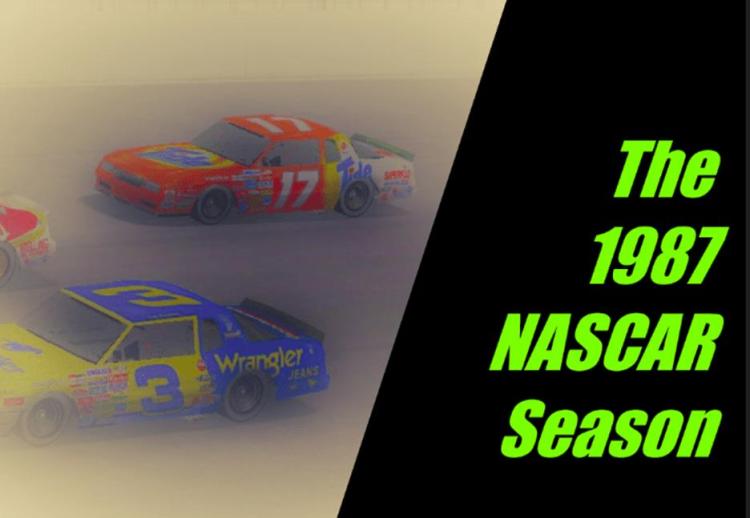
For more articles on NASCAR, visit https://johnmilner.ca/track-talk/ and talk about them – and anything NASCAR-at https://www.facebook.com/profile.php?id=61569092154997.
Preamble: As much as I like NASCAR’s modern product, I also enjoy watching races from the past to see the likes of Dale Earnhardt, Sr., Davey Allison, Richard Petty, Neil Bonnett, Tim Richmond, Darrell Waltrip, and others. Over the last couple of years during NASCAR’s off-season, I have wanted to watch every race of the 1987 NASCAR Cup Season and blog about it. Perhaps 2020 is just a crazy enough year to be the year I complete that project.
This will be part-recap, part random thoughts about whatever race I’m reporting on, with a bit of history lesson tossed in. These races can all be found on YouTube should you want to follow along.
We’ll start with the Busch Clash, which has remained a part of Daytona Speedweeks under a number of different names. In fact, this past year, the Busch Clash returned in name, won by Erik Jones. While in 2020, I think there are any number of ways you can become eligible for the Clash, in 1987, you had to win a pole in the previous season.
The 1987 Busch Clash was ten drivers competing in a 50-mile/20 lap battle. Chris Economaki introduces the drivers, adding in some chit-chat with each as he walks along the line of cars on pit road.
The competitors include:
- Geoff Bodine
- Alan Kulwicki
- Harry Gant
- Darrell Waltrip
- Ricky Rudd
- Terry Labonte
- Dale Earnhardt
- Cale Yarborough
- Benny Parsons
- Bill Elliott
Economaki makes reference to Tim Richmond, who was sitting out the early part of the 1987 season with “pneumonia.” From there, Ken Squier who, in 2020, isn’t suffering from pneumonia but COVID-19, and Ned Jarrett (what a great duo on the mic) discuss the weather and how that, as well as drafting. will affect the race. From the video, it looks like a beautiful Florida day but it had rained the day before.
Country music singer and Grand Marshall Hoyt Axton (who I was literally thinking about the other day because of his tune Della and the Dealer and his appearance on WKRP in Cincinnati) gives the command. I knew I had seen him give the command at a NASCAR race somewhere along the way but Google was no help, so here that question got answered in the first race of this series.
He’s no Larry McReynold but Axton gives a good command. Speaking of McReynolds (who would be crew chief for Morgan Shepherd in 1987), his future broadcast partner Mike Joy is the pit road reporter discussing what the crew chiefs and spotters will be doing during this short race. (Gotta be honest, this is a great broadcasting technique, talking to the novices without making it boring “Yeah, we know all that” to the veteran NASCAR fans.)
The ten cars take the track and take two pace laps before the race gets underway. As I stated before, the modern day Busch Clash has several ways for drivers to be eligible (previous year’s pole winners, former Daytona 500 winners, former Daytona 500 pole winners, previous year’s playoff drivers, etc.) which means, for 2020 as an example, there were 20 drivers in the field, where in 1987 it was much more exclusive.
But the advantage of having more drivers in the field is displayed as they come to take the green. Terry Labonte, in mid-pack, gets tapped from behind and turns into the wall, collecting someone (later determined to be Ricky Rudd), just as the green flag drops. It was an incident that could have taken out half the field.
So Harold Kinder went from waving the green flag to the yellow, and the first lap is a race back to the start-finish line to take the caution. Whether pole-sitter Bill Elliott decided to hang back or something, Waltrip gets a good run and easily wins the race back to the start-finish line.
(Note: After the race, Elliott says he believed NASCAR would totally restart the race so he got off the gas.)
Labonte is on pit road where owner and future first-ballot Hall of Famer Junior Johnson doesn’t think he can drive it but the crew continues to make repairs. He fares better than Rudd who is back in the garage. Harry Gant came to the pits for tires.
Before they go back green, Ken and Ned discuss the prize money for the race, with the winner getting $50,000, which was probably okay for 1987 but probably pretty measly for 2020. On the other hand, Ned Jarrett says that’s almost as much as he won in 1965 when he won 13 races and the championship, so, you know, perspective. Plus, the drivers got bonus money for leading certain laps (Laps 5, 10, and 15).
They show several replays of the wreck and toss out a number of theories as to who or what caused it. Then Waltrip takes the green flag and leads Earnhardt and the rest of the field as the race really begins. With Waltrip out to a significant lead, the battle is between Geoff Bodine and Earnhardt for second, and then Bodine and Elliott.
Man…I never realized just how cool that Tide paint scheme for Waltrip is. I think it has something to do with it running really well at Daytona. By a half-dozen laps, it’s Waltrip, then a tandem of Bodine and Elliott, then a mass of about a half-dozen cars several seconds back.
Waltrip loses the lead by lap 8 as Bill Elliott takes over with Waltrip and Bodine battling for second. The race is on a record pace at the 10 lap mark, with the same three in the picture for the lead and the rest, led by Earnhardt, battling it out back. Waltrip seems to drift up the racetrack when they go into Turn 4 and I think that’s what causes him to fall back from Elliott.
Squier keeps us up to date on the speed. For lap 13, it was over 199 mph. To give you an idea of how far back the cars from 4th on back are, the Elliott/Waltrip/Bodine trio came across the start-finish line and you could not see Earnhardt and the rest even into Turn 4.
Ironically, the battle for second is between two Rick Hendrick cars. Waltrip’s #17 is now a Roush-Fenway car, driven by Chris Beuscher and Bodine’s #5 will return in 2021 for Hendrick driven by Kyle Larson. Ironically, Bill Elliott’s #9 car is also part of the Hendrick stable, driven by his son, 2020 Cup Series champion Chase Elliott.
It’s Lap 15 when Bodine makes a move to pass Waltrip for second but DW holds him off and instead he makes a move for the lead. Elliott holds him off and the battle for second resumes as they complete Lap 17.
There is also talk that this could be the fastest Clash ever. In 1986, the speed through 15 laps was 195.652 mph. A year later, it is now 197.947 mph. As the laps wind down, Elliott is starting to extend his lead, which could be a bad thing as he may have outraced the draft of Waltrip and Bodine, or rather Bodine and Waltrip as they have switched positions.
As they complete Lap 20, Bill Elliott gives Ford their first victory in the Busch Clash with a .29 second lead over Geoff Bodine. Waltrip, Earnhardt and Kulwicki round out the Top 5. The 1987 Clash was also the fastest race in NASCAR history with an average speed of 197.802 mph.
Ned Jarrett says he believes this will make Elliott, winner of the 1985 Daytona 500, the favourite in the 1987 running of the Great American Race. Chris Economaki gets the best line of the day: “What we say today was a clash and what we’re going to see next Sunday is a war.”
Up next are the Budweiser Duels to set the field for the 1987 Daytona 500.
 johnmilner.ca