For more articles on NASCAR, visit https://johnmilner.ca/track-talk/ and talk about them – and anything NASCAR-at https://www.facebook.com/profile.php?id=61569092154997.
One of the main reasons why NASCAR changed their championship format from the Playoffs and back to the Chase was so that NASCAR and it’s associated media wanted to be able to tell more stories. While the main story of the 2026 has been, to date, the dominance of Tyler Reddick, all of that changed this past weekend at the 2.66 mile superspeedway in Alabama named Talladega.
‘Dega gave us one race with multiple possibilities for that story, another that tried to force a story that really wasn’t there, and a third that had three stories, two negative and one major positive that just might be the story of the year. As Monday dawned over ‘Dega, there were three first-time winners to celebrate.
ARCA Menards Series – Alabama Manufactured Housing 200
It started on Saturday afternoon (although it wasn’t shown here until Saturday night) with the ARCA Series race. The ARCA Series suffers from the fact that Joe Gibbs has been using it in recent years as a quick-and-easy way to earn yet another Owner’s Championship Trophy. As much as I hate to say it, most ARCA races are interesting to see only how few are on the lead lap by 20 laps in, and who’s getting a decent finish to help their points tally. As for the win, it’s whoever JGR decides to put in the #18 Toyota for that particular week.
Even this time out, at a place as supposedly as unpredictable as Talladega, it was that #18 Toyota, piloted by Gio Ruggiero, that was out front for most of the day. I suppose if Ruggiero had ended up taking Talladega, it wouldn’t have been the worst thing in the world. It would have been a step down for him, since he’s moved up to a full-time Truck ride (where he won at Talladega last year) and a part-time O’Reilly Auto Parts Series ride. However, a win would still help propel him up the ranks and, as I will be the first to tell you, NASCAR needs to be doing everything it can to create new names for eventual Cup rides.
With about a half-dozen laps go, however, Ruggiero found himself shuffled out of the front-runners, as can happen at ‘Dega. Isabella Robusto was leading after a caution. Was an important chapter, the first female winner in ARCA history, about to be written? The headlines would have written themselves. This would have been an important win for NASCAR and motorsports. As for Robusto, it certainly would have helped her work towards a series championship, another important victory. (Post-Talladega, she remains 13th in the standings.)
So if not, Ruggiero and not Robusto, then who? Could it be…Cletus McFarland? The YouTuber who seems to be willing and able to race anything came under some scrutiny recently when news broke that Richard Childress Racing had signed him to race in the O’Reilly Auto Parts Series. (Track Talk was not immune to this. Read my opinion here.) He’s obviously having fun and providing some laughs in a sport that is often-times a very serious business, Talladega is where Cletus McFarland stopped being a joke. He was ableot overcome the “corporate car” of Ruggiero and JGR and got the lead. He even made a hell of save on what turned out to be the last lap. (Oh yeah, about that…I totally forgot that ARCA only has one lap of overtime so what I thought was the field coming to the white flag was actually them coming to the checkered flag.) If there had been another lap to be put in the books, I’m thinking that Cletus might have been your winner.
Instead, the win at Talladega went to Andy Jankowiak for “Andy J’s” first win in the ARCA series. The pizza delivery driver from New York State finally broke through and into the win column. Whether he had decided that he wasn’t lifting until he saw God or a checkered flag is unknown, but he definitely got his chance to see that checkered flag.
Jankowiak is one of those drivers that I point to (and Robusto and now Cletus are two more) when I tell people that if they are looking for great personalities and great characters that could help build the sport of NASCAR, look to the ARCA series. As I said, the race lead seems to be dominated by JGR’s Driver of the Week but at the same time, it is the drivers deeper in the field that, with the right breaks and more sponsorship, could really make a go of it. I’m not suggesting that all of them will become multi-time Cup Series champions but if they could compete in ARCA or the O’Reilly Series with the big teams, they could certainly make things interesting.
O’Reilly Auto Parts Series – The Ag-Pro 300
The O’Reilly Series race at Talladega was less about the story that the on-track action delivered and more about the story that NASCAR on FOX was trying to tell, namely that Richard Childress Racing and their ECR Engine program was not as dominant at Talladega as they had been in the past. This despite having Jesse Love on the pole, that wasn’t enough for the narrative that Fox, especially Jamie McMurray, was trying to push on viewers.
One would think that McMurray, having won twice at ‘Dega in the Cup Series (not to mention the 2010 Daytona 500 championship), would have had enough exposure to the style of racing at Talladega to understand that it’s a very unpredictable and indeed fluid form of racing. He’s been a part of enough broadcasts to have heard people like Adam Alexander, Mike Joy, and others talk about the number of lead changes among the number of drivers. Unlike a mile-and-a-half or, God help us, a road course, the drafting tracks of Daytona, Talladega, and now Atlanta, produce multiple lead changes. The tandem-drafting style in the Cup race at Talladega in 2011 produced an unprecedented 88 lead changes. While the pack racing hasn’t been able to replicate that feat, Saturday’s O’Reilly Series Race had 38 lead changes, the most in 13 years.
In other words, Jamie Mac, Dega’s gonna Dega and one driver, or even one team, is not going to dominate the race. In fact, pulling away to even a minimal lead is actually detrimental to a driver’s efforts.
While not leading the whole race and out to a five or six second lead as I guess he was expected to, Love did lead the most laps with 37. It seemed as if every time he lost the lead and got shuffled back, the RCR #2 Chevrolet was able to get back to the head of the field. That is, until about a half-dozen laps from the finish. Those racing up front finally decided that if they were going to prevent Love from winning, they had to “hang him out to dry,” so to speak.
Mission Accomplished and Corey Day got his first win for Hendrick Motorsports. Not JR Motorsports, which has long served as an HMS AAA-team, but an actual Hendrick Motorsports team car. I guess Rick Hendrick saw the fun that Joe Gibbs was having in chasing an Owner’s Championship and decided to give it a try. But while Hendrick’s O’Reilly Series efforts have included William Byron and Kyle Larson, the team has also fielded rides for Rajah Caruth and Corey Day. Day seems to be learning on the fly, and not always to the enjoyment of his fellow competitors, he’s learning from his mistakes, enough to get his first win.
While I was hoping for an RCR win just to shut the doubters up, Corey Day is a driver who, if he can clean up his mistakes, might be enroute to a Cup ride some day. A win at Talladega could be the first step towards that goal. The youth movement at HMS seems to have been paying off. You’re probably seeing Chase Elliott and William Byron at HMS for some time to come. Still, nothing in life and nothing in NASCAR is guaranteed. Alex Bowman’s future is still up in the air and I get the sense if Larson could make Cup money racing Sprint Cars, he’d leave NASCAR behind. Day’s win should certainly cement him as a candidate for a Cup seat if and when one becomes available. Good for Day; good for Hendrick, and really, good for NASCAR
NASCAR Cup Series – Jack Links 500
The story of Sunday’s Cup race at Talladega was actually three stories in one.
The first stage, increased in length to prevent it turning into a fuel mileage race, ended up being a debacle. If people don’t like the pack racing, that’s fine and I also understand that not every lap will be three and four-wide racing. There is a time in every race where everyone relaxes, let’s the racing cool down and we see single file racing. On Saturday, with everyone pitting on different strategies, what we saw was three groups of cars, each playing “follow the leader” but nowhere close to producing actual racing.
“My Gawd!” I thought “Is this what they’ve turned Talladega into?” But the death of racing at Talladega were premature. Even by the end of the first stage, everyone was caught up and collected with a solid race to the green-white checkered flag.
The second stage started off with more of that close racing that makes Talladega loved…and feared. While pack racing makes things more competitive, it also makes things more dangerous. While we usually see “The Big One” strike because of mis-timed pushes mid-pack, we’ve also seen it happen at the tail-end of the field, right where some drivers hang out to avoid the wrecks.
On Sunday, in Stage 2, The Big One started with Bubba Wallace – at the front of the field. 25 cars would be involved, but when the Big One started, all I saw was four cars driving away from a cloud of smoke that seemed to envelope everyone else.
My first thought: “Holy crap! We’ve got 70 laps to go and four cars left!” As it turned out, not every car involved was damaged so severely that they were out of the race. Heck, Ty Gibbs was doing the crabwalk down pit road and still managed to compete in the race.
While I’ve had the “You watch NASCAR. You must like watching the wrecks!” stereotype thrown at me on a couple of occasions, nothing could be further from the truth. When there’s a bad wreck (even if it’s just two or three cars, should one hit the wall at a bad angle), I don’t care about anything else except seeing the drivers climb from their cars, be seen moving around inside, or at least put their window net down. As much as I was just complaining about single file racing at ‘Dega, something needs to change. This is now twice in the last handful of ‘Dega races (Heck, it might have been two for two) where over two dozen cars have been caught up in one wreck.
Talladega has been called an “opportunity race.” Heck, Chad Finchum led eight laps and Cody Ware spent quite a bit of time at the front. These are two guys who are lucky to be on the lead lap within a handful of laps from the start of any other race.
Over two dozen cars were involved in the Big One which forced many to the garage area or down a lap for repairs.
This opened up an opportunity for someone to get their first win of the year.
Chris Beuscher. Alex Bowman. Ricky Stenhouse, Jr.
It also gave some drivers an opportunity to get their first Cup win.
Zane Smith. Todd Gilliland. Ryan Preece.
And Carson Hocevar.
As I will with the RCR cars, I will admit to being biased towards Hocevar. He’s my favourite current driver and is a fan and a throwback to my all-time favourite driver, Dale Earnhardt, Sr. On a personal basis, watching Hocevar come across the start-finish line to win the Jack Links 500 at Talladega was awesome. Probably the happiest I have been about a finish to any race in quite some time.
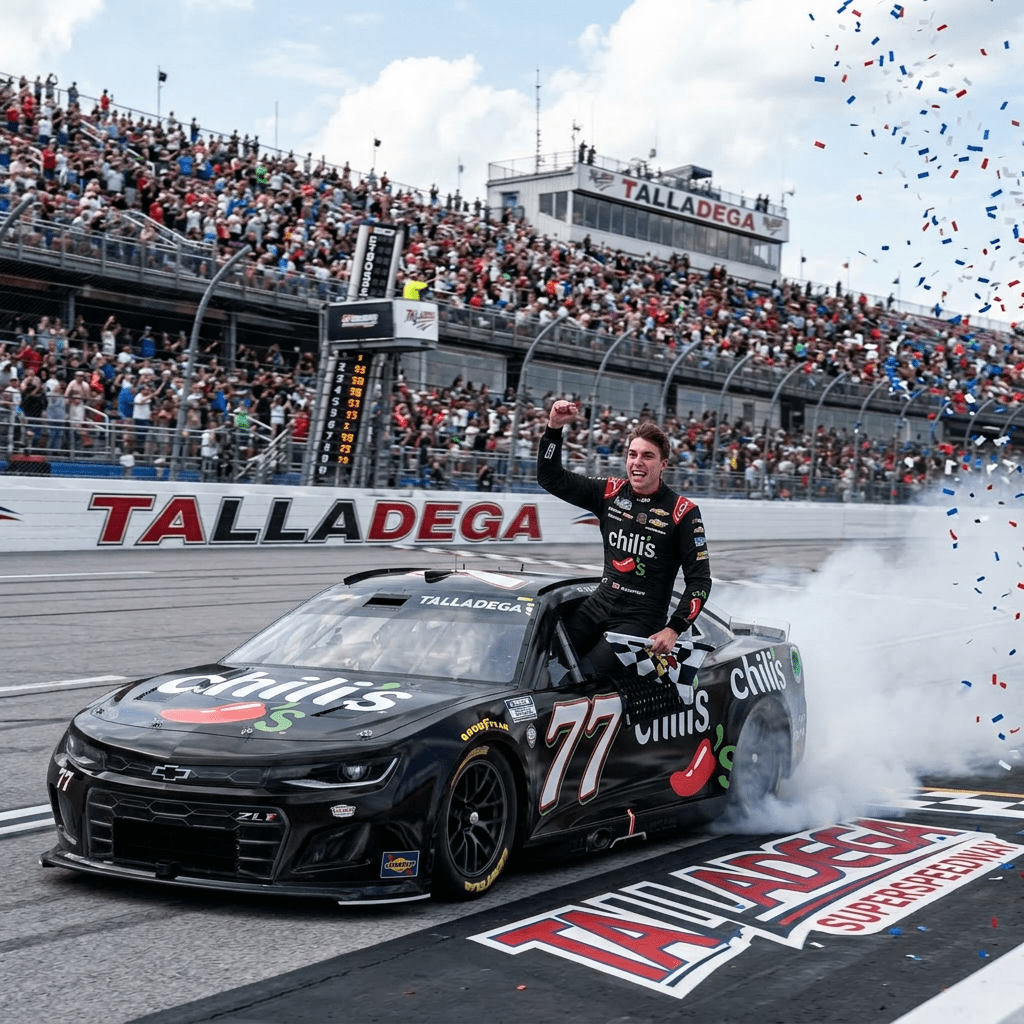
Then came the celebration. Again, as a throwback to Earnhardt managing to control the car while driving around Richmond while hanging out the window to clean the windshield, and combining it with Alan Kulwicki’s iconic “Polish Victory Lap,” Hocevar somehow – and I have no clue how he did it – managed to pilot his #77 Chevrolet along the front stretch, while hanging out the window and cheering to the fans. (He even tried to catch the beers being thrown at him.)
Much like Ross Chastain’s “Hail Melon” run at Martinsville, I watched Hocevar in that celebration and I was like “I am so proud of this guy!” This was Spire Motorsports’ second career win (the first coming with Justin Haley at the 2019 Coke Zero Sugar 400) so it was a win for a small team with a sophomore driver. A colourful character who definitely marches to the beat of his own drum and ruffles many a feather
This was an iconic moment, like the “Hail Melon,” like the “Every Man on Every Crew.”
And usually you go online afterwards and social media is just people complaining, trying to take any joy out of any race (or any other fandom for that matter). It wasn’t like that on Sunday evening. People were talking about how the win and the celebration felt like the start of something. They talked about how this could be the beginning of a new era for NASCAR.
They talked about about NASCAR being fun again.
NASCAR needs Carson Hocevar. They need Ross Chastain. Much as I may have a bad taste in my mouth over how Tyler Reddick left RCR, I can admit that what he’s doing in Cup this year (five wins in nine races coming into Talladega!) is impressive. We need drivers doing that.
Recently, I wrote about the attention that Michael Jordan being a co-owner of 23XI Racing was bringing to NASCAR. To summarize one of my points, I said that while it was great for NBA fans, pop culture fans, etc. to be checking out NASCAR because they heard he had a race team, it was up to NASCAR to provide a product that would keep people tuning back in.
‘Dega provided that product. The first stage may have been a bit of a stumble. The Big One in the second stage may not have been a good look. NASCAR novices may not have understood the importance of Spire Motorsports getting their second Cup win (the first was Justin Haley at the Daytona Summer race in 2019). They may not have seen the assentation of Carson Hocevar from the Truck Series to Cup Series winner or know how much of a colourful character that he is.
But much like fans, snowed in during the 1979 Daytona 500, came away with an iconic image that left them asking “Does this kinda stuff happen every week?” I would suggest that the image of a young race car driver hanging out his side window, celebrating with the fans as he drives down the front stretch, is something that may have led to many a new fan to decide they’re going to tune in to the Texas race next weekend, and see what happens.
At the same time, it may have reminded long-time NASCAR fans that this sport can be fun. And that’s a story worth telling.

