For more articles on NASCAR, visit https://johnmilner.ca/track-talk/ and talk about them – and anything NASCAR-at https://www.facebook.com/profile.php?id=61569092154997.
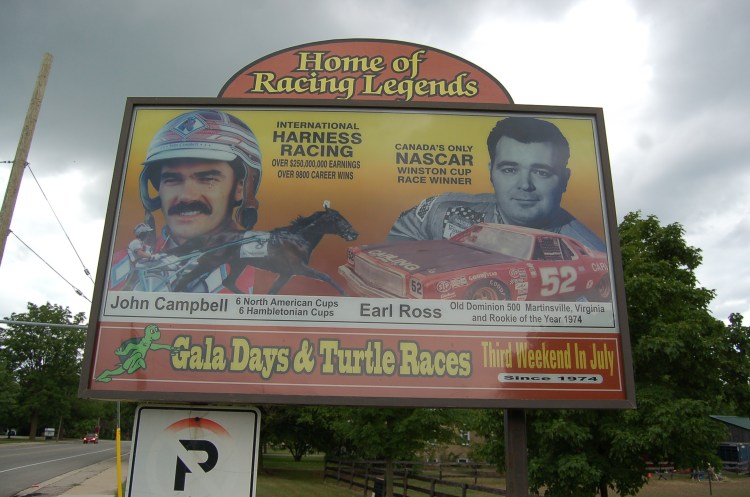
On September 29, 1974, Earl Ross, born on Prince Edward Island and hailing from Ailsa Craig, Ontario, outlasted a field of NASCAR legends including Cale Yarborough, Buddy Baker, David Pearson and Richard Petty to win the 1974 Old Dominion 500 in Martinsville, Virginia. In taking the checkered flag for his first and only win in what is now the Sprint Cup series, Ross became the first Canadian to win at such a level. And one could argue that he remains the only non-American to win in Cup on an oval track.
Fortune is what Wikipedia refers to as “a small, unincorporated area” in Kings County, Prince Edward Island. Born on 1941, Earl’s family would remain in PEI until the young boy was 11 before moving west to Ontario. The Ross family settled in the small town on Ailsa Craig which would become famous for the racers who lived there. (John Campbell, the world’s winningest harness racer, also hails from the town.)
Ross began a love affair with auto racing that began when he built himself a hobby car to race locally in the early 60s. He won the first race he ever competed in and gained no small amount of success running Late Models across Ontario throughout the 1960s. He became the Points Champion at Nilestown, Delaware and Flamboro in 1968. Two years later, he won 9 out of 10 International events which featured the best drivers from the U.S. and Ontario.
He won the 1972 Export A Series Championship run in Eastern Canada and that is when Carling Brewing Company came calling. The Company was looking to enter a car in the 1973 Daytona 500 as a way to promote their Red Cap Ale Brand and Ross was their choice to fill the seat. Over Christmas 1972, Ross travelled to Daytona (where he had gone as a spectator for the 1971 Daytona 500) and began to practice under the watchful eye of NASCAR veteran Donnie Allison.
Rolling off 30th in the 1973 Daytona 500, Ross became the one of the first two Canadians (Vic Parsons of Willowdale, Ontario was the other- he finished 10th) to compete in what is now known as “the Great American Race.” Ross completed just 34 laps and finished 39th behind winner Richard Petty but did better with a third place finish in the ARCA Daytona 200. Ross would compete in only two other races in NASCAR in 1973 (14th at Talladega and 33rd in Michigan.)
1974 was Ross’s biggest season in NASCAR, he ran 21 of the 30 races on the Winston Cup schedule. With Carling’s money behind him, Ross had the equipment that allowed him to compete with the more experienced NASCAR teams. He had top 5 finishes at the World 600 at Charlotte, at Dover and finished second only to Richard Petty (and ahead of David Pearson) in Michigan.
Midway through the 1974 season, the legendary Junior Johnson, a former bootlegger turned Daytona 500 Champion turned car-owner got an offer from Carling. If Johnson’s company would add a second team, driven by Ross, to partner with their current driver, Cale Yarborough, they would sponsor the team and, in fact, would purchase Junior’s entire organization.
Driving Chevrolet Monte Carlos – ironic since he worked for the Ford Motor Company in Talbotville, Ontario) out of Johnson’s garage, the Canadian Ross was also unique in that he fielded an all-Canadian pit crew, including the late Gordie McKichan.
And so, with Johnson as owner and Carling as the sponsor, the thirty-three year old Earl Ross took a two-year-old Chevrolet that was numbered 52 to Martinsville in September 1974. He hadn’t competed in the spring race at Martinsville and had to rely on his short track experienced, garnered in his native Canada.
Ross started 11th and might have been lucky to have finished second if not for teammate Cale Yarborough’s engine blowing up late in the race, with a lead of more than a lap over the rest of the field. Ross would later say he had no brakes for the last 100 laps, but he ran well enough to hold off Buddy Baker and Donnie Allison to take the checkered flag and win the Old Dominion 500. Ross was the first rookie to win a Grand National race since the legendary Richard Petty.
The win at Martinsville did more than make Earl Ross the first non-American to win at NASCAR’s highest level. It also helped propelled him ahead of contemporaries Richie Panch, Jackie Rogers and Tony Bettenhausen for the 1974 Winston Cup Rookie of the Year award. He finished a respectable 8th in the overall standings.
However, the deal between Carling and Johnson fell apart just days after the finale of the 1974 season. The company announced it was pulling out of NASCAR and heading back to Canada.
Ross was able to get sponsorship from Coca Cola for a few more starts and ran for the late June Donlavey to a 13th-place finish at Charlotte in 1975, a race that marked the Cup debut for a young North Carolina driver named Dale Earnhardt. He received some interest from as many as five different teams for Ross to drive for them, but his loyalty to Carling was important to him and he knew he had to return to Canada. His NASCAR career lasted 26 races with the win at Martinsville, five Top 5 and ten Top 10 finishes.
Ross’s days in NASCAR would come to an end with a 39th place finish in the 1976 Daytona 500, which was marked by the thrilling and controversial finish between winner David Pearson and runner-up Richard Petty. (He attempted – but failed – to qualify for the 1978 Daytona 500.)
But while Earl Ross may have headed back north, it didn’t mean he was headed to retirement from racing. He won another Export A Series title in 1975 and competed in ASA, CASCAR Super Series and the OSCRA series as well as on Friday Night Races at Delaware Speedway until well into the 1990s.
Much like he had back in the late 60s and early 70s, Ross had no small amount of success even into the 90s, with finishes in the Top 15 in CASCAR points as late as 1997 (and a second place finish just three years earlier.)
In 1999, on the 25th anniversary off his win, Earl Ross returned to Martinsville to be part of a NASCAR ceremony before the then-modern day race at the track (won by Jeff Gordon – Dale Earnhardt came in second). The owner of Earl Ross Fabricating was proud to say that he had the grandfather clock, given to every winner at Martinsville since the late-1960s, at his home in Ailsa Craig.
Earl Ross was an inductee into the Canadian Motorsport Hall of Fame in 2000, the P.E.I. Sports Hall of Fame in 2008, the Maritime Motorsports Hall of Fame in 2011 and the London Sports Hall of Fame in 2012. Sadly, Earl Ross passed away just shy of the 40th anniversary of his NASCAR Cup win at Martinsville, on September 18, 2014.
 johnmilner.ca